- Animals
- ›Chordates
- ›Vertebrates
- ›Reptiles
- ›Turtles and Tortoises
- ›American Mud and Musk Turtles
- ›Staurotypinae
- ›Staurotypus
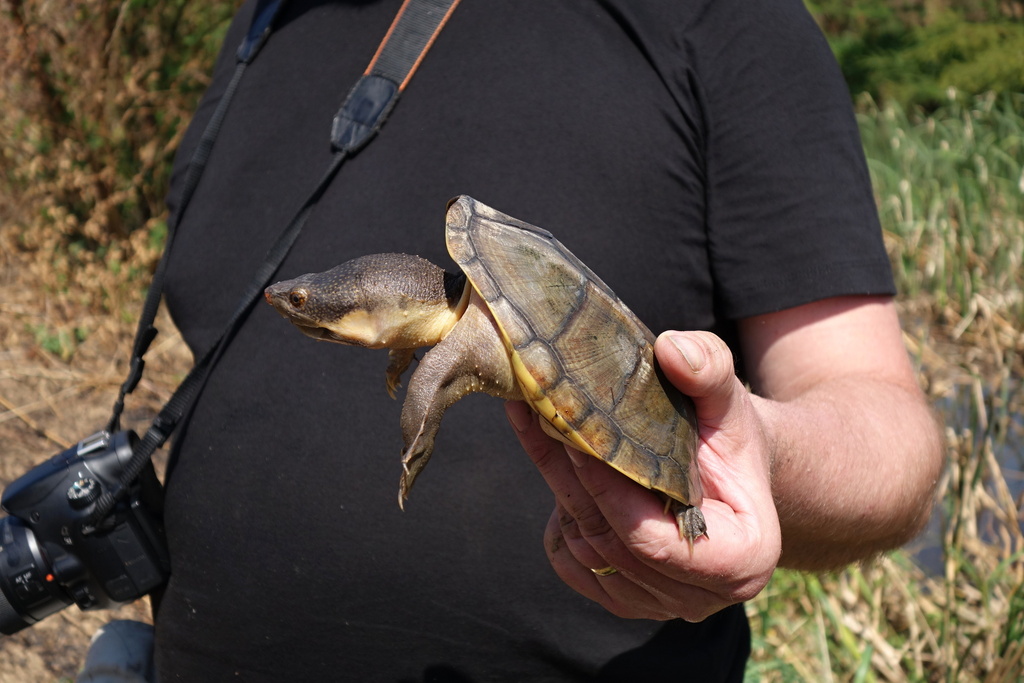
Chiapas Giant Musk Turtle
Staurotypus salvinii
The giant musk turtle (Staurotypus salvinii) , also known commonly as the Chiapas giant musk turtle or the Mexican giant musk turtle , is a species of turtle in the family Kinosternidae. The species is found in Central America.
From the article Giant musk turtle on Wikipedia (CC BY-SA), quoted section by section
Description
S. salvinii is typically much larger than other species of Kinosternidae, attaining a straight carapace length of up to 38 cm (15 inches), with males being significantly smaller than females. It is typically brown, black, or green in color, with a yellow underside. The carapace is distinguished by three distinct ridges, or keels which run its length. The giant musk turtle tends to be quite aggressive, agile and energetic. S. salvinii exhibits XX/XY sex determination, in contrast to the temperature-dependent sex determination of most turtles.
Range & habitat
S. salvinii is found in Belize, El Salvador, Guatemala, western Honduras, and Mexico (Chiapas and Oaxaca).
Wikipedia: “Geographic range”
What it does
Like other musk turtle species, S. salvinii is carnivorous, eating various species of fishes, crustaceans, smaller turtles, insects, mollusks, and carrion. The giant musk turtle's feeding technique is to open its mouth rapidly leading to a powerful inrush of water which sucks the prey into its mouth.
Wikipedia: “Diet”
In human culture
The specific name, salvinii, honors English naturalist and herpetologist Osbert Salvin.
Wikipedia: “Etymology”
Where it lives
Recorded sightings
—
geo-referenced records in GBIF, from museums, herbaria and field observers.
Drag the globe to turn it. Dots are where records exist, not a range map; darker means more records.
In the stacks
Searching the stacks…
Every page naming Staurotypus salvinii in the Biodiversity Heritage Library →
This page is assembled live from iNaturalist, GBIF, Wikipedia, the Source Library and the Internet Archive. It is not yet part of the hand-edited codex. iNaturalist taxon 39711.