 NL·0345
Herbarium of the Nature Library
- Name
- Chelonia mydas
- Family
- Cheloniidae
- Native to
- Tropical and subtropical seas worldwide; nests on beaches in over 80 countries
- Habitat
- Seagrass meadow, Coral reef, Open ocean, Sandy beach
Green sea turtle
Chelonia mydas
Also calledHonu (Hawaiian) · Penyu agar (Malay) · Tortuga verde (Spanish) · Aoumigame (Japanese) · Lǜhǎiguī 绿海龟 (Chinese) · Fonu (Tongan)
A large sea turtle of tropical and subtropical seas, named for the greenish fat under its shell. Adults are the only sea turtles that graze mainly on seagrass and algae, keeping seagrass meadows healthy.
The green sea turtle, also known as the green turtle, black sea turtle, and Pacific green turtle, is a species of large sea turtle of the family Cheloniidae. It is the only species in the genus Chelonia. Its range extends throughout tropical and subtropical seas around the world, with two distinct populations in the Atlantic and Pacific Oceans, but it is also found in the Indian Ocean. The common name refers to the usually green fat found beneath its carapace, due to its diet strictly being seagrass, not to the color of its carapace, which is olive to black. Wikipedia
What it can do
- iNavigates thousands of kilometres using Earth's magnetic field and returns to nest near the beach where it hatched
- iiSwims about 2,000 km from Brazil to nest on tiny Ascension Island
- iiiMows seagrass beds, which keeps the meadows productive
- ivCan rest underwater for hours by slowing its heart
In the field
Field marks
- aLarge sea turtle with a smooth, heart-shaped shell
- bSmall, rounded head with one pair of scales between the eyes
- cShell brown, olive or black
- dSingle claw on each flipper
- Not to be confused with
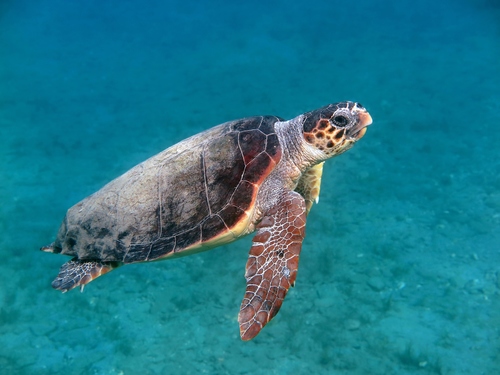
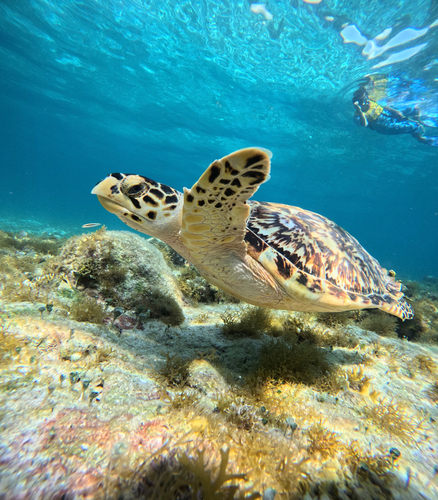
- Hawksbill has a pointed, hawk-like beak and overlapping shell plates. Loggerhead has a large head and reddish-brown shell.
- Where to see it
- Tortuguero (Costa Rica), Ras al Jinz (Oman) and Heron Island (Great Barrier Reef), with guided night viewing
- When
- Tortuguero nesting Jul–Oct; Ras al Jinz all year, peak Jun–Sep; Heron Island Nov–Mar
Life & habits
- Diet
- Juveniles omnivorous; adults herbivorous: seagrass and algae
- Habitat
- Coastal seagrass and reef feeding grounds; open ocean as juveniles; sandy beaches for nesting
- Size
- Shell 0.8–1.2 m (to ~1.5 m); usually 110–190 kg
- Lifespan
- 70+ years; matures at 20–40 years
Females crawl ashore at night every few years to dig nests, laying around 100 eggs several times a season. Nest temperature decides hatchlings' sex: warmer sand produces more females.
Where it lives
Recorded sightings
—
geo-referenced records in GBIF, from museums, herbaria and field observers.
Native range
Tropical and subtropical seas worldwide; nests on beaches in over 80 countries
Drag the globe to turn it. Dots are where records exist, not a range map; darker means more records.
In the old herbals & bestiaries
Woodcuts and engravings matched from the Source Library’s scanned books by name. Plates marked “relative” show a close kin rather than this exact species. Click a plate to read the page it came from, with translation.

Museum of the Royal Society
Nehemiah Grew · 1681 · p.464

Ortus sanitatis
1491 · p.595

Unterhaltungen aus der Naturgeschichte / [Tafelband.]
Borkhausen, Moritz Balthasar (1760-1806) · n.d. · p.47

Unterhaltungen aus der Naturgeschichte / 3 Die Amphibien
Wilhelm, Gottlieb Tobias · 1794 · p.385

History of Animals, Book I: On Viviparous Quadrupeds
Conrad Gessner · 1554 · p.112

History of Animals, Book II: On Oviparous Quadrupeds
Conrad Gessner · 1586 · p.119

Theater of Earthly Creatures
Anonymous · 1672 · p.286
In the stacks
Searching the stacks…
Every page naming Chelonia mydas in the Biodiversity Heritage Library →
Marginalia
In Hawaiian tradition the honu is an ʻaumakua (family guardian), and the turtle Kauila was said to take the form of a girl to watch over children at Punaluʻu. Green turtle soup was a showpiece of London's Lord Mayor's banquets from the 18th century, driving heavy Caribbean harvests.
Curiosity
In October 2025 the IUCN moved the green turtle from Endangered to Least Concern after decades of protecting nesting beaches, though some regional populations remain threatened.
Kinship

Photographs: iNaturalist contributors under the licences shown. Records: GBIF.org. Historical plates: Source Library (CC BY-SA 4.0; originals public domain). Summary text: Nature Library editors and Wikipedia (CC BY-SA). Medicinal and edibility notes are historical and educational, not advice. iNaturalist taxon 39659.