- Animals
- ›Chordates
- ›Vertebrates
- ›Reptiles
- ›Turtles and Tortoises
- ›Side‑necked turtles
- ›Austro-American Side-necked Turtles
- ›Australasian Side-necked Turtles
- ›Elusor
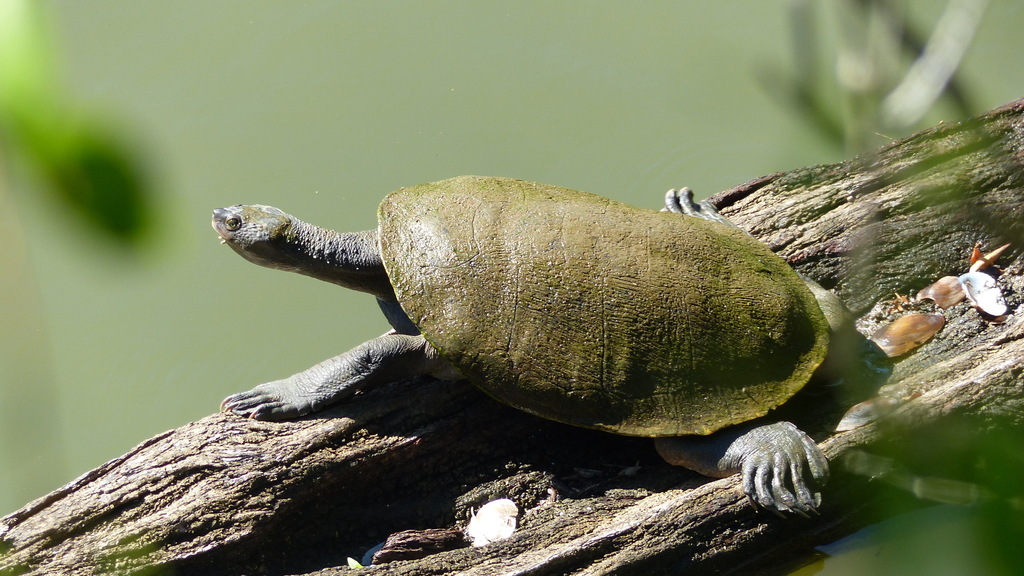
Mary River Turtle
Elusor macrurus
The Mary River turtle (Elusor macrurus) is an endangered species of short-necked turtle in the family Chelidae. The species is endemic to the Mary River in south-east Queensland, Australia. Although this turtle was known to inhabit the Mary River for nearly 30 years, it was not until 1994 that it was recognised as a new species. There has been a dramatic decrease in its population due to low reproduction rates and an increase of depredation on nests.
From the article Mary River turtle on Wikipedia (CC BY-SA), quoted section by section
Description
Unusually for turtles, males are larger than females in this species. Male Mary River turtles are one of Australia's largest turtles. Specimens in excess of 50 cm (20 in) straight carapace length have been recorded. Hatchlings have a straight carapace length of 2.0–3.5 cm (0.79–1.38 in). Adult Mary River turtles have an elongated, streamlined carapace that can be plain in colour or intricately patterned. Overall colour can vary from rusty red to brown and almost black. The plastron varies from cream to pale pink. The skin colouration is similar to that of the shell and often has salmon pink present on the tail and limbs. The iris can be pale blue. The Mary River turtle uses bimodal respiration, and so is capable of absorbing oxygen via the cloaca whilst underwater. Because of this, it can stay under the water for three days at a time. However, it does regularly come to the surface to breathe air in the usual way. A unique feature of the Mary River turtle is the very large tail of males, which can measure almost two-thirds of the carapace length. Also unusual is that the tail is laterally compressed like a paddle. The tail also has haemal arches, a feature lost in all other Australian chelids. …
What it does
Little is known about the ecology and behaviour of the Mary River turtle. It inhabits flowing and well-oxygenated sections of the Mary River basin from Gympie to Maryborough, using terrestrial nest sites. Its habitat consists of riffles and shallow parts that alternate with deeper pools. It prefers to inhabit clear and slow moving water. The Mary River turtle takes an unusually long time to mature; it has been estimated that females take 25 years, and males, 30 years to become adults. Mature males may be aggressive towards other males or turtles of other species. The species is omnivorous, taking plant matter such as algae as well as bivalves and other small animal prey, such as fish, frogs, and sometimes even ducklings.
Wikipedia: “Ecology and behaviour”
Where it lives
Recorded sightings
—
geo-referenced records in GBIF, from museums, herbaria and field observers.
Drag the globe to turn it. Dots are where records exist, not a range map; darker means more records.
In the stacks
Searching the stacks…
Every page naming Elusor macrurus in the Biodiversity Heritage Library →
This page is assembled live from iNaturalist, GBIF, Wikipedia, the Source Library and the Internet Archive. It is not yet part of the hand-edited codex. iNaturalist taxon 39648.