- Animals
- ›Arthropods
- ›Chelicerates
- ›Arachnids
- ›Spiders
- ›Typical Spiders
- ›Haplogyne Spiders
- ›Synspermiatid Spiders
- ›Spitting Spiders and Allies
- ›Wide-claw Spiders
- ›Periegops
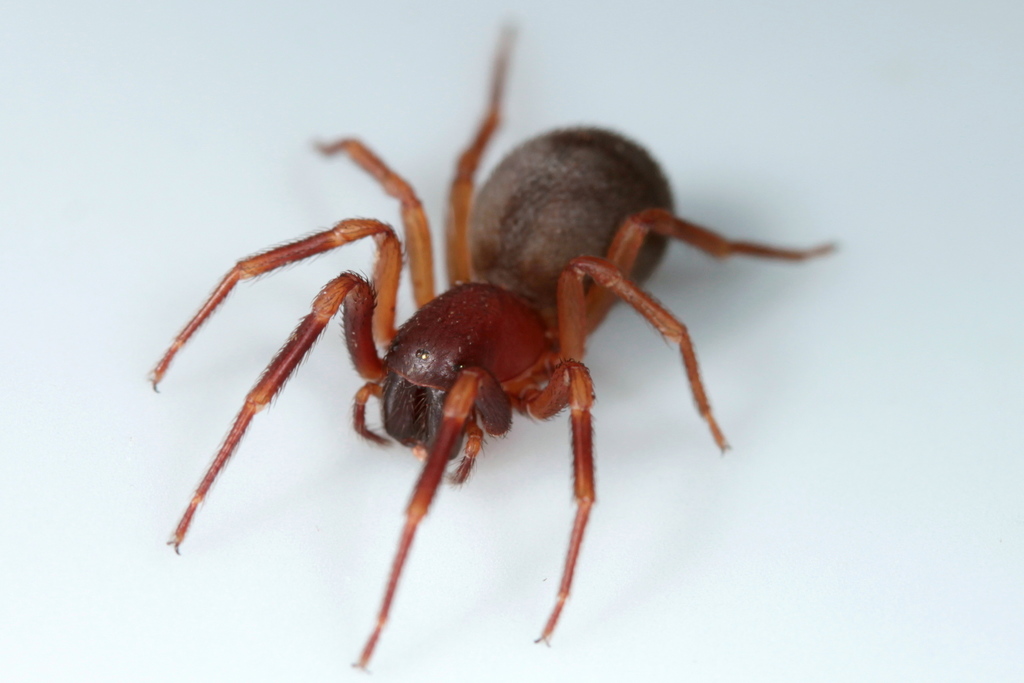
Suter's Periegops
Periegops suterii
Periegops suterii is a species of spider in the genus Periegops that is endemic to the South Island of New Zealand....
From the article Periegops suterii on Wikipedia (CC BY-SA), quoted section by section
Description
Like all members of the Periegops genus, P. suterii has six eyes. The carapace is a red-orange colour on the anterior end but is orange on the posterior end. The abdomen has a black brown chevron pattern. The first pair of legs are orange brown with light orange ends, the other pairs of legs are yellow brown and darker at the proximal end. Chelicerae are red brown. Male body length is 6.6 mm and female body length is 8.1 mm.
Range & habitat
Periegops suterii occurs in forests with well drained soil and deep leaf layers. Within these habitats, they may be found under logs, rocks and leaves. They can occur in podocarp and beech forest. P. suterii is only known to occur in Banks Peninsula and Riccarton Bush in Canterbury. Within these locations, P. suterii has a patchy distribution. The distribution of the species suggests it could be considered a relict species.
Wikipedia: “Habitat and distribution”
What it does
Periegops suterii isn't known to build webs for prey capture, but rather web is used as drag lines and to build silk retreats. P. suterii is likely a fast moving nocturnal hunter. Females have been found with two to three males with them, which may imply that the female has a way of attracting males.
Wikipedia: “Behaviour”
Where it lives
Recorded sightings
—
geo-referenced records in GBIF, from museums, herbaria and field observers.
Drag the globe to turn it. Dots are where records exist, not a range map; darker means more records.
In the stacks
Searching the stacks…
Every page naming Periegops suterii in the Biodiversity Heritage Library →
This page is assembled live from iNaturalist, GBIF, Wikipedia, the Source Library and the Internet Archive. It is not yet part of the hand-edited codex. iNaturalist taxon 394813.