- Animals
- ›Chordates
- ›Vertebrates
- ›Reptiles
- ›Snakes and Lizards
- ›Lizards
- ›Iguanas and Allies
- ›Iguanas, Anoles, and Allies
- ›Curly-tailed Lizards
- ›Leiocephalus
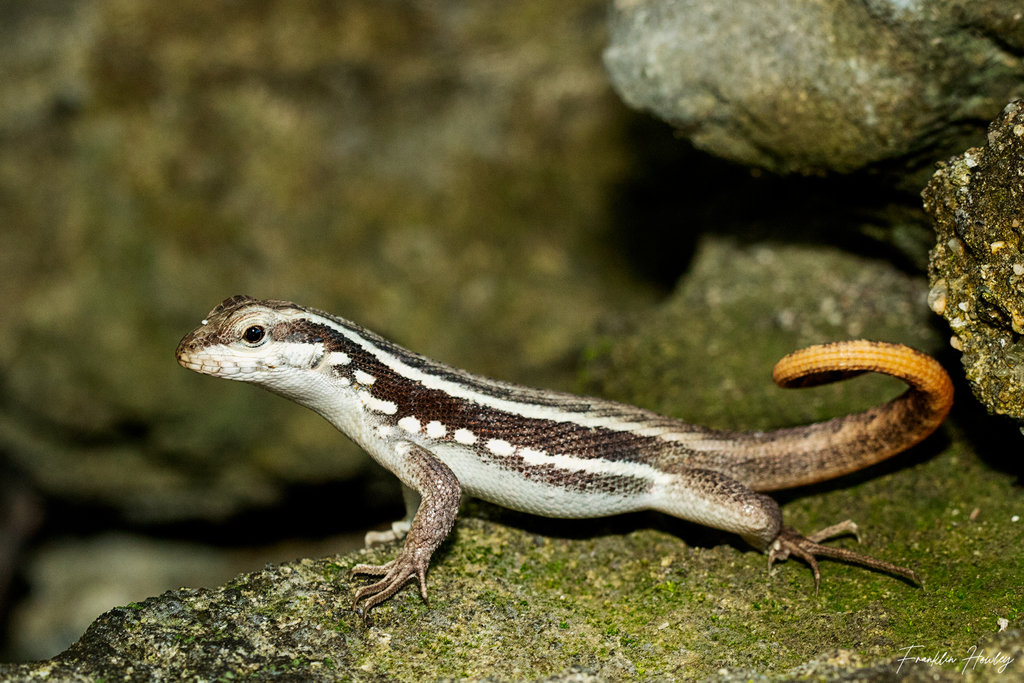
Santo Domingo Curlytail Lizard
Leiocephalus lunatus
Leiocephalus lunatus, commonly known as the Hispaniolan maskless curlytail or Santo Domingo curlytail lizard , is a species of lizard in the family Leiocephalidae (curly-tailed lizard). It is native to the Dominican Republic.
From the article Leiocephalus lunatus on Wikipedia (CC BY-SA), quoted section by section
In human culture
The first description of Leiocephalus lunatus was published by Doris Mable Cochran in 1934, under the name Leiocephalus personatus lunatus. The name lunatus is derived from Latin, meaning 'crescent' or 'half-moon', which according to herpetologists Robert Powell and Matthew Gifford is a reference to the lizard's "crescent-shaped shoulder patches". The holotype of the species is a male specimen collected by George Kruck Cherrie in 1895, with the type locality being Santo Domingo, the capital of the Dominican Republic. In 1967, Albert Schwartz recognized lunatus as its own species rather than as a subspecies of Leiocephalus personatus.
Subspecies. L. lunatus has six recognized subspecies, with L. l. lunatus being the subspecies of Cochran's original description of L. personatus lunatus, recognized by Schwartz as a subspecies of L. lunatus when he recognized the latter as its own species in 1967. The other subspecies are louisae, arenicolor, melaenascelis, thomasi and lewisi. Of these, louisae and arenicolor were also originally considered subspecies of personatus before being moved to lunatus by Schwartz in 1967. The first description of L. l. louisae was published by Cochran in 1934, alongside the one of L. l. lunatus. …
Wikipedia: “Taxonomy and etymology”
Where it lives
Recorded sightings
—
geo-referenced records in GBIF, from museums, herbaria and field observers.
Drag the globe to turn it. Dots are where records exist, not a range map; darker means more records.
In the stacks
Searching the stacks…
Every page naming Leiocephalus lunatus in the Biodiversity Heritage Library →
This page is assembled live from iNaturalist, GBIF, Wikipedia, the Source Library and the Internet Archive. It is not yet part of the hand-edited codex. iNaturalist taxon 39373.