On eBird ↗
American Woodcock
Live sightings near you, the range map, bar charts of when it is seen, and Macaulay Library photos and recordings.
American Woodcock
Scolopax minor
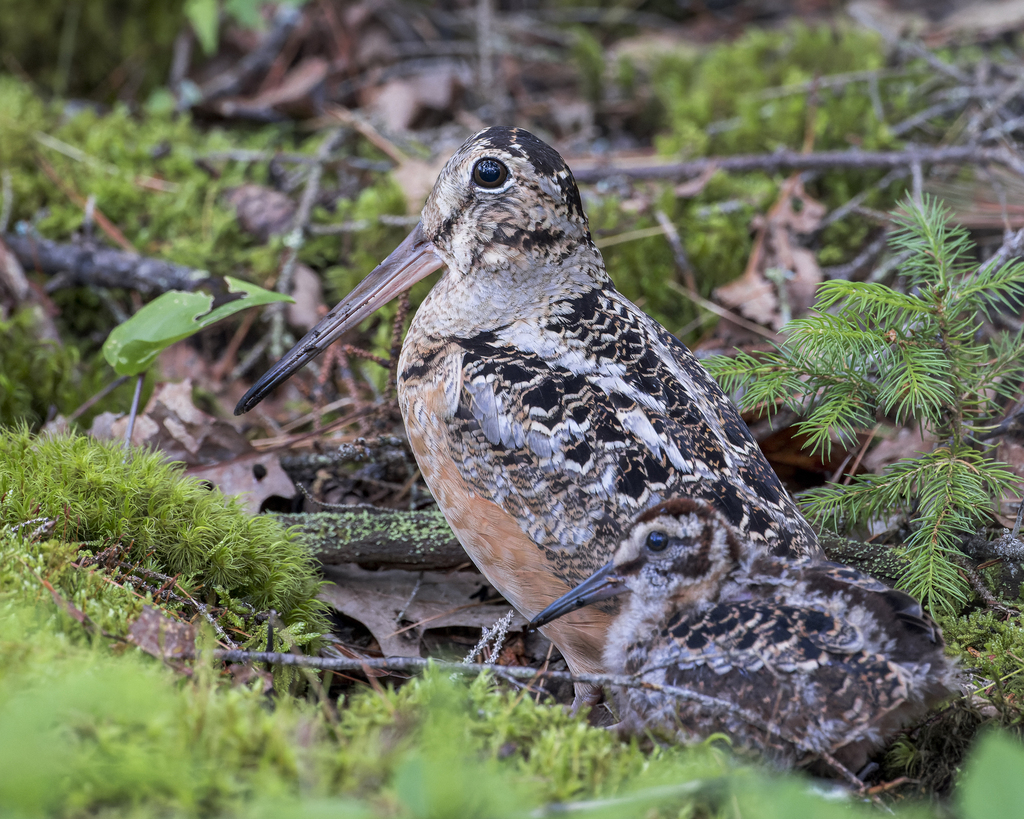
The American woodcock (Scolopax minor), sometimes colloquially referred to as the timberdoodle, mudbat, becasse, bogsucker, brush snipe, night partridge, or Labrador twister is a small shorebird species found primarily in the eastern half of North America. Woodcocks spend most of their time on the ground in brushy, young-forest habitats, where the birds' brown, black, and gray plumage provides excellent camouflage.
The American woodcock is the only species of woodcock inhabiting North America. Although classified with the sandpipers and shorebirds in the family Scolopacidae, the American woodcock lives mainly in upland settings.
From the article American woodcock on Wikipedia (CC BY-SA), quoted section by section
Description
The American woodcock has a plump body, short legs, a large, rounded head, and a long, straight prehensile bill. Adults are 10 to 12 inches (25 to 30 cm) long and weigh 5 to 8 ounces (140 to 230 g). Females are considerably larger than males. The bill is 2.5 to 2.8 inches (6.4 to 7.1 cm) long. Wingspans range from 16.5 to 18.9 inches (42 to 48 cm).
The plumage is a cryptic mix of different shades of browns, grays, and black. The chest and sides vary from yellowish-white to rich tans. This mottled coloring provides camouflage against surrounding leaves and earth. The nape of the head is black, with three or four crossbars of deep buff or rufous. The feet and toes, which are small and weak, are brownish gray to reddish brown. Woodcocks have large eyes located high in their heads, and their visual field is probably the largest of any bird, 360° in the horizontal plane and 180° in the vertical plane. The woodcock uses its long, prehensile bill to probe in the soil for food, mainly invertebrates and especially earthworms. A unique bone-and-muscle arrangement lets the bird open and close the tip of its upper bill, or mandible, while it is sunk in the ground. Both the underside of the upper mandible and the long tongue are rough-surfaced for grasping slippery prey.
Range & habitat
Woodcocks inhabit forested and mixed forest-agricultural-urban areas east of the 98th meridian. Woodcocks have been sighted as far north as York Factory, Manitoba, and east to Labrador and Newfoundland. In winter, they migrate as far south as the Gulf Coast of the United States and Mexico. Although classified with the sandpipers and shorebirds in the family Scolopacidae, the American woodcock lives mainly in upland settings. The primary breeding range extends from Atlantic Canada (Newfoundland, Nova Scotia, Prince Edward Island, and New Brunswick) west to southeastern Manitoba, and south to northern Virginia, western North Carolina, Kentucky, northern Tennessee, northern Illinois, Missouri, and eastern Kansas. A limited number breed as far south as Florida and Texas. The species may be expanding its distribution northward and westward. After migrating south in autumn, most woodcocks spend the winter in the Gulf Coast and southeastern Atlantic Coast states. Some may remain as far north as southern Maryland, eastern Virginia, and southern New Jersey. The core of the wintering range centers on Louisiana, Mississippi, Alabama, and Georgia. Based on the Christmas Bird Count results, winter concentrations are highest in the northern half of Alabama. American woodcocks live in wet thickets, moist woods, and brushy swamps. …
Wikipedia: “Distribution and habitat”
What it does
Woodcocks eat mainly invertebrates, particularly earthworms (Oligochaeta), and it has been known to use worm charming methods in order to bring the worms to the surface. They do most of their feeding in places where the soil is moist. They forage by probing in soft soil in thickets, where they usually remain well-hidden. Other items in their diet include insect larvae, snails, centipedes, millipedes, spiders, snipe flies, beetles, and ants. A small amount of plant food is eaten, mainly seeds. Woodcocks are crepuscular, being most active at dawn and dusk.
Wikipedia: “Food and feeding”
In human culture
Beginning around 2024, the bird became viral on social media due to its comedic demeanor, both for its rocking behavior and distinctive "meep" sound (or "peent" as some birders call it). In a testament to this growing popularity, reports of the woodcock's presence in New York City's Bryant Park in early April 2026 attracted large crowds of fans to the site in the hopes of observing the species and its unique behavior.
Wikipedia: “In popular culture”
Listen
Looking for field recordings…
Where it lives
Recorded sightings
—
geo-referenced records in GBIF, from museums, herbaria and field observers.
Drag the globe to turn it. Dots are where records exist, not a range map; darker means more records.
In the stacks
Searching the stacks…
Every page naming Scolopax minor in the Biodiversity Heritage Library →
This page is assembled live from iNaturalist, GBIF, Wikipedia, the Source Library and the Internet Archive. It is not yet part of the hand-edited codex. iNaturalist taxon 3936.