- Animals
- ›Chordates
- ›Vertebrates
- ›Reptiles
- ›Snakes and Lizards
- ›Lizards
- ›Iguanas and Allies
- ›Iguanas, Anoles, and Allies
- ›South American Lesser Iguanas
- ›Liolaemus
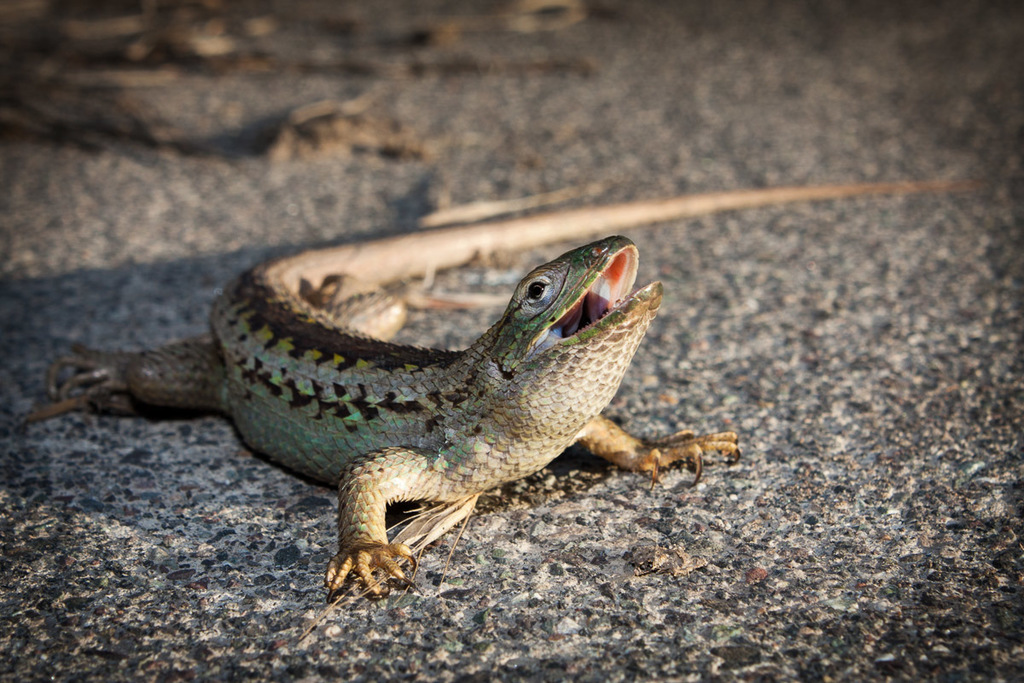
Chilean Tree Iguana
Liolaemus chiliensis
Liolaemus chiliensis, the Chilean tree iguana, is a species of lizard in the family Liolaemidae, also referred to as the weeping or crying lizard in English. Synonyms for this species include Liodeira chilensis and Calotes chiliensis. Less commonly, it is called the Talcahuano smooth-throated lizard.
This species is well known for its distress calls, although the sound of these calls does not resemble weeping or crying.
From the article Liolaemus chiliensis on Wikipedia (CC BY-SA), quoted section by section
Description
The Chilean tree iguana is relatively large-sized compared to other lizards, reaching 25 centimetres (9.8 in) in total length. It is an oviparous species. It is carnivorous and feeds mainly on insects and other invertebrates. The maximum body weight is 24.03g. L. chiliensis individuals in more southern latitudes tend to be smaller in size than their northern latitude counterparts. Given their geographic distribution, lizards further south experience climates with lower temperatures.
These dull-colored lizards tend to be green and gray, helping them camouflage against rocks and vegetation. Axilla groin distance is higher in females than in males. Polyploidy results in morphological differences among lizards of different ploidy (i.e. in head shape and various proportions). The mechanisms behind these physical differences are unclear at this time.
Morphology. Like most reptiles, this species has a tympanic membrane. Their otoliths help detect both acceleration and sound. Their hearing range extends from 500 Hz to 2000 Hz, with a threshold of 40 dB. These lizards excel at recognizing the distress calls of their own species.
Range & habitat
This species is native to the Neotropics. It is also found in the Chilean Matorral, Patagonian Steppe, and Valdivian Temperate Forests, covering a region spanning Chile and Argentina. This lizard lives within the latitudes of 30 and 40°S, and its altitudes are from sea level to 2100 meters. The habitat of this species includes bushes and branches. These lizards bask in bushes that tend to obscure them from possible predators, which makes it more difficult for predators to spot them. L. chiliensis is adept in running and climbing, and can often be found on branches higher than expected. However, they are typically ground dwellers, found within dense shrubs but not on the ground directly. Their geographical distribution extends from Coquimbo (29°S) to Valdivia (39°S). L. chiliensis is active throughout the day. Observations tend to be more frequent from September to February, which may be due to its mating season, the warmer weather in these months, or human beings going out more often in warmer weather and consequentially spotting more of these lizards.
Wikipedia: “Habitat and distribution”
What it does
The diet of L. chiliensis consists mostly of insects and small invertebrates. Juveniles behave and hunt similarly to adults. Studies in species within the chiliensis group have identified that these lizards feed mainly on Coleoptera, Hemiptera, and Hymenoptera. Stomach and fecal contents also included parts of grasshoppers, scorpions, plants, Lepidoptera, and Diptera.
Wikipedia: “Diet”
Where it lives
Recorded sightings
—
geo-referenced records in GBIF, from museums, herbaria and field observers.
Drag the globe to turn it. Dots are where records exist, not a range map; darker means more records.
In the stacks
Searching the stacks…
Every page naming Liolaemus chiliensis in the Biodiversity Heritage Library →
This page is assembled live from iNaturalist, GBIF, Wikipedia, the Source Library and the Internet Archive. It is not yet part of the hand-edited codex. iNaturalist taxon 39234.