- Animals
- ›Arthropods
- ›Chelicerates
- ›Arachnids
- ›Spiders
- ›Typical Spiders
- ›Entelegyne Spiders
- ›RTA Clade Spiders
- ›Meshweavers and Allies
- ›desid spiders
- ›Amphinectine spiders
- ›Mamoea
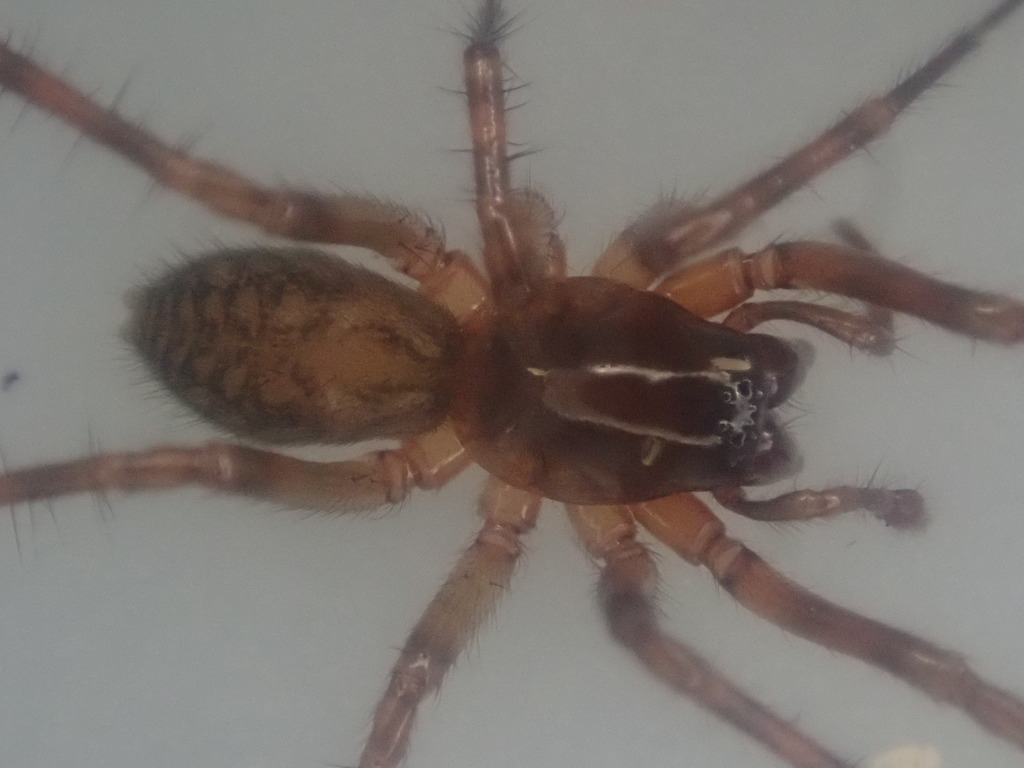
Mamoea grandiosa
Mamoea grandiosa is a species in the spider family Desidae that is endemic to New Zealand and was first described by Ray Forster and Cecil Wilton in 1973. The holotype specimen was collected by Beverley Holloway at Solomon Island, off Stewart Island, during the 1955 Dominion Museum expedition.
From the article Mamoea grandiosa on Wikipedia (CC BY-SA), quoted section by section
Description
The carapace and chelicerae of Mamoea grandiosa are bright red brown, while the legs and sternum are orange brown. The abdomen has a broad grey band down the mid-dorsal (upper) surface with seven pairs of lateral branches on posterior (rear) half. The ventral surface of the abdomen is cream with a few scattered brown patches. The body length of both males and females is given as approximately 12 mm. Forster and Wilton not formally present a diagnosis for M. grandiosa but did note the distinctiveness of the female epigynum. Figures of the male palp are also implicitly diagnostic.
Range & habitat
The type locality for Mamoea grandiosa is Solomon Island / Rerewhakaupoko, south-west of Stewart Island / Rakiura. The holotype specimen was collected by Beverley Holloway during the 1955 Dominion Museum expedition. It is also known from Stewart Island and the southern South Island of New Zealand.
Wikipedia: “Distribution”
Where it lives
Recorded sightings
—
geo-referenced records in GBIF, from museums, herbaria and field observers.
Drag the globe to turn it. Dots are where records exist, not a range map; darker means more records.
In the stacks
Searching the stacks…
Every page naming Mamoea grandiosa in the Biodiversity Heritage Library →
This page is assembled live from iNaturalist, GBIF, Wikipedia, the Source Library and the Internet Archive. It is not yet part of the hand-edited codex. iNaturalist taxon 392075.