On eBird ↗
Greater Yellowlegs
Live sightings near you, the range map, bar charts of when it is seen, and Macaulay Library photos and recordings.
Greater Yellowlegs
Tringa melanoleuca
The greater yellowlegs (Tringa melanoleuca) is a large North American shorebird. The genus name Tringa is the New Latin name given to the green sandpiper by Aldrovandus in 1599 based on Ancient Greek trungas, a thrush-sized, white-rumped, tail-bobbing wading bird mentioned by Aristotle. The specific melanoleuca is from Ancient Greek melas, "black", and leukos, "white".
From the article Greater yellowlegs on Wikipedia (CC BY-SA), quoted section by section
Description
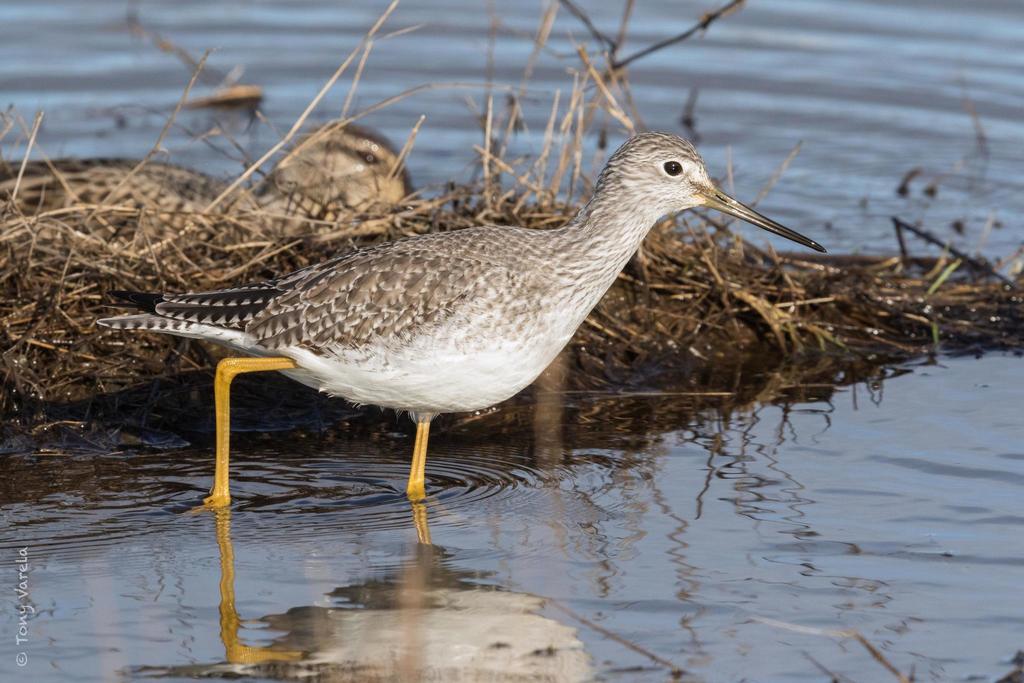
The greater yellowlegs is similar in appearance to the smaller lesser yellowlegs. Its closest relative, however, is the greenshank, which together with the spotted redshank form a close-knit group. Among them, these three species show all the basic leg and foot colours found in the shanks, demonstrating that this character is paraphyletic. They are also the largest shanks apart from the willet, which is altogether more robustly built. The greater yellowlegs and the greenshank share a coarse, dark, and fairly crisp breast pattern as well as much black on the shoulders and back in breeding plumage. Adults have long yellow legs and a bill that is long, thin, and dark. The bill is longer than the head and often has a slight upward curve. The body is grey-brown on top and white underneath; the neck and breast are streaked with dark brown. The rump is white. It ranges in length from 29 to 40 cm (11 to 16 in) and in weight from 111 to 250 g (3.9 to 8.8 oz). Wingspan is 23.6 in (60 cm). The call is harsher, louder, and clearer than that of the lesser yellowlegs. They have a three-syllable whistle when flight-calling, with a lower pitched third syllable.
Range & habitat
Their breeding habitat is bogs and marshes in the boreal forest region of Canada and Alaska. They migrate to the Atlantic and Pacific coasts of the United States, the Caribbean, and south to South America. This species also occurs in tidal pools, sewage ponds, and flooded field during migration. They are very rare vagrants to western Europe.
Wikipedia: “Distribution and habitat”
What it does
These birds forage in shallow water, sometimes using their bills to stir up the water. They mainly eat insects and small fish, as well as crustaceans, marine worms, frogs, seeds and berries.
== References ==
Wikipedia: “Food and feeding”
Listen
Looking for field recordings…
Where it lives
Recorded sightings
—
geo-referenced records in GBIF, from museums, herbaria and field observers.
Drag the globe to turn it. Dots are where records exist, not a range map; darker means more records.
In the stacks
Searching the stacks…
Every page naming Tringa melanoleuca in the Biodiversity Heritage Library →
This page is assembled live from iNaturalist, GBIF, Wikipedia, the Source Library and the Internet Archive. It is not yet part of the hand-edited codex. iNaturalist taxon 3892.