On eBird ↗
Nordmann's Greenshank
Live sightings near you, the range map, bar charts of when it is seen, and Macaulay Library photos and recordings.
Nordmann's Greenshank
Tringa guttifer
Nordmann's greenshank (Tringa guttifer) or the spotted greenshank is a wader in the large family Scolopacidae, the typical waders. They are considered endangered by the International Union for Conservation of Nature (IUCN) Red List and are typically found within the East Asian-Australasian Flyway.
From the article Nordmann's greenshank on Wikipedia (CC BY-SA), quoted section by section
Description
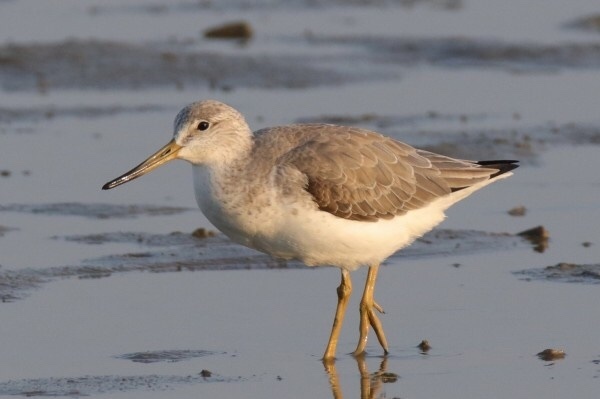
Nordmann's greenshank is a medium-sized sandpiper, at 29–32 cm (11–13 in) long, with a slightly upturned, bicoloured bill, and relatively short yellow legs. Breeding adults have darker plumage than their non-breeding counterparts. These adults often appear boldly marked, with dark brown spangling on their back, chest, and head and a white underbelly.They have a heavily streaked head and upper neck; broad, blackish, crescentic spots on lower neck and breast; and darker lores. Breeding adult bills are darker and less obviously bicolored as well. Non-breeding adults have a lighter brown to gray plumage along their back and minimal spotting along their neck and chest. Their bills are light nearest the head and dark as it extends to the tip. Chicks are light brown with mottled black and dark brown stripes across their back and head. Similar to the North American Blue jay, the Nordmann's greenshank eggs are a pale blue-green with darker gray to brown speckling that condenses near the widest end of the egg.
Range & habitat
Nordmann's greenshank is found primarily within the East Asian-Australasian Flyway and as of 2023, the wild population ranges from 1500 to 2000 individuals. Breeding populations are found in eastern Russia along the south-western and northern coasts of the Sea of Okhotsk and on Sakhalin Island. Their non-breeding range is not fully defined, but significant numbers have been recorded in South Korea, mainland China, Hong Kong, Taiwan during the migratory season. During winter, these birds can be found in Bangladesh, Thailand, Cambodia, Vietnam and Peninsular Malaysia. They have also been recorded on passage or during winter in Japan, North Korea, India, Sri Lanka, Myanmar, Singapore, the Philippines and Indonesia. There are unconfirmed records from Nepal and Guam (to the U.S.).. They have been recorded several times on Eighty Mile Beach in Western Australia. Recently, an individual was discovered on Cairns Esplanade in Queensland, Australia. This individual was known to have over-wintered there from December 2020 to May 2021. In mid-December 2021 what is thought to be the same individual bird, returned to Cairns Esplanade. It has now returned for four straight seasons, being regularly seen in 2022 and 2023.
Wikipedia: “Distribution”
What it does
During the non-breeding season in the Inner Gulf of Thailand, the Nordmann's greenshank has been shown to have roost preferences determined by tide cycles. Birds will choose artificial roosting areas such as saltpans and aquaculture farms during oceanic high tides, but tend to prefer mudflats along the coastline. Roost sites are chosen based on the characteristics: 1) depth of water in selected sites, 2) travel distance for foraging sites, 3) human disturbance risk, and 4) competition with other shorebirds.
Wikipedia: “Roosting Behavior”
Listen
Looking for field recordings…
Where it lives
Recorded sightings
—
geo-referenced records in GBIF, from museums, herbaria and field observers.
Drag the globe to turn it. Dots are where records exist, not a range map; darker means more records.
In the stacks
Searching the stacks…
Every page naming Tringa guttifer in the Biodiversity Heritage Library →
This page is assembled live from iNaturalist, GBIF, Wikipedia, the Source Library and the Internet Archive. It is not yet part of the hand-edited codex. iNaturalist taxon 3891.