- Animals
- ›Chordates
- ›Vertebrates
- ›Reptiles
- ›Snakes and Lizards
- ›Lizards
- ›Skinks and allies
- ›Skinks
- ›Social skinks
- ›Liopholis
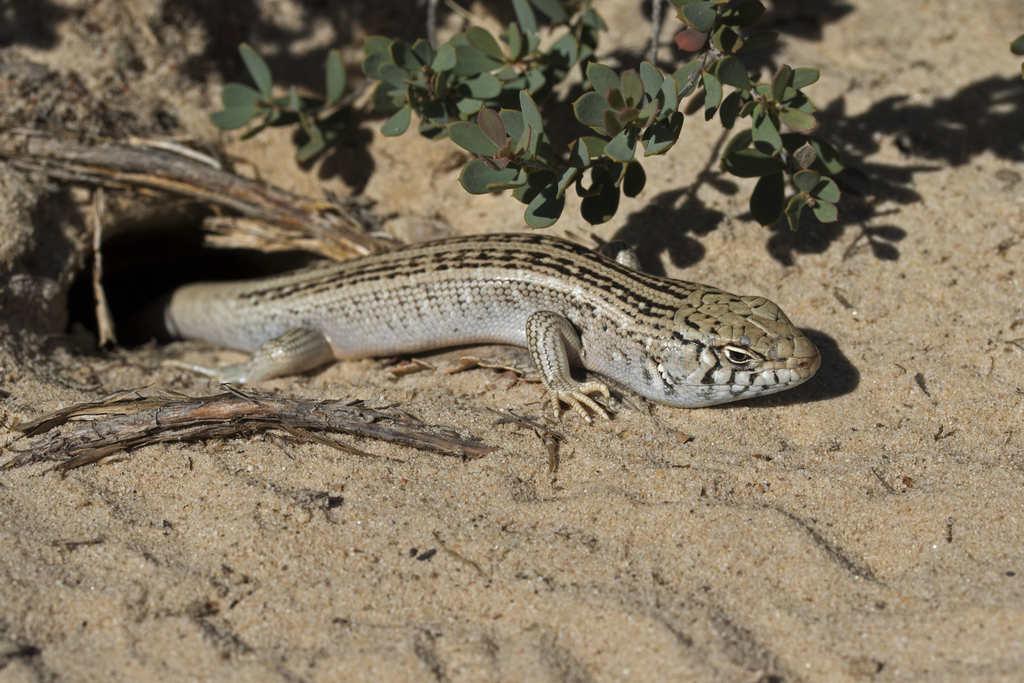
Bull Skink
Liopholis multiscutata
The bull skink, southern sand-skink or southern heath skink (Liopholis multiscutata) is a species of terrestrial skink, a lizard in the family Scincidae. It is one of eleven species within the Liopholis genus.
From the article Bull skink on Wikipedia (CC BY-SA), quoted section by section
Description
The southern heath (bull) skink is characterised by its robust build, dorsal scales, and its coloration which varies from sandy to reddish-brown. It is a medium-sized skink with adults reaching a snout-vent length of 80-95mm. The species displays sexual dimorphism, with males generally larger and more colourful than females. Liopholis multiscutata resembles Liopholis whitii but can be differentiated based on several characteristics. Specifically, the interparietal scale on the top of the head is as wide as, or wider than, the frontal scale, even in mature specimens. The subdigital lamellae, or scales under the toes, have a bicarinate (two-ridged) texture. Additionally, this species has two or three rows of small white or yellow spots within the dark dorso-lateral stripe along its back. Unlike in Liopholis whitii, the flanks exhibit ambiguous pale and dark scales, seldom forming distinct ocelli (eye-like markings). The animal has 37–46 smooth scale rows at mid-body and a snout-vent length of 80 mm.
Range & habitat
The species is endemic to southern Australia, Western Victoria, Kangaroo Island, and the Eyre and Yorke Peninsulas in South Australia extending to the coastal areas of southern Western Australia, encompassing numerous offshore islands. It is restricted to four small and highly disjunct populations in semiarid mallee dunefields in Victoria.
Wikipedia: “Distribution”
What it does
The heath skink's habitat predominantly consists of open forest and low open woodlands, often featuring rock outcrops, as well as coastal dunes and heathlands. Exhibiting cryptic behaviour, it is specialised for burrowing, particularly in sandy or loamy soil types. The animal creates intricate tunnel networks, referred to as warrens, in and around large sand dune crests. These warrens, which often feature multiple entrances, are consistent with those of other species in the same genus and are usually situated at the base of small to medium-sized shrubs. In Victoria, all known heath skink populations occur in the Lowan Mallee bioregion, furthermore they are found within the Mallee Health Ecological Vegetation Class (EVC) which is characterised by low open scrubland with heathy shrubs that are dominated by Banksia ornata (desert banksia), Leptospermum myrsinoides (heath tea tree) and Callitris verrocusa (scrub cypress pine).
Wikipedia: “Ecology and habitat”
In human culture
There is limited research on the life history of the heath skink; however, it is a viviparous skink that produces between 1-3 live young each year in mid to late summer. L. multiscutata is relatively slow to mature. The species has low dispersal ability and its lifespan is currently unknown, however, comparisons can be made with ecologically similar species L. whitii which has a life span of at least 8.5 years.
Wikipedia: “Life history”
Where it lives
Recorded sightings
—
geo-referenced records in GBIF, from museums, herbaria and field observers.
Drag the globe to turn it. Dots are where records exist, not a range map; darker means more records.
In the stacks
Searching the stacks…
Every page naming Liopholis multiscutata in the Biodiversity Heritage Library →
This page is assembled live from iNaturalist, GBIF, Wikipedia, the Source Library and the Internet Archive. It is not yet part of the hand-edited codex. iNaturalist taxon 38613.