- Animals
- ›Chordates
- ›Vertebrates
- ›Reptiles
- ›Snakes and Lizards
- ›Lizards
- ›Skinks and allies
- ›Skinks
- ›Social skinks
- ›Egernia
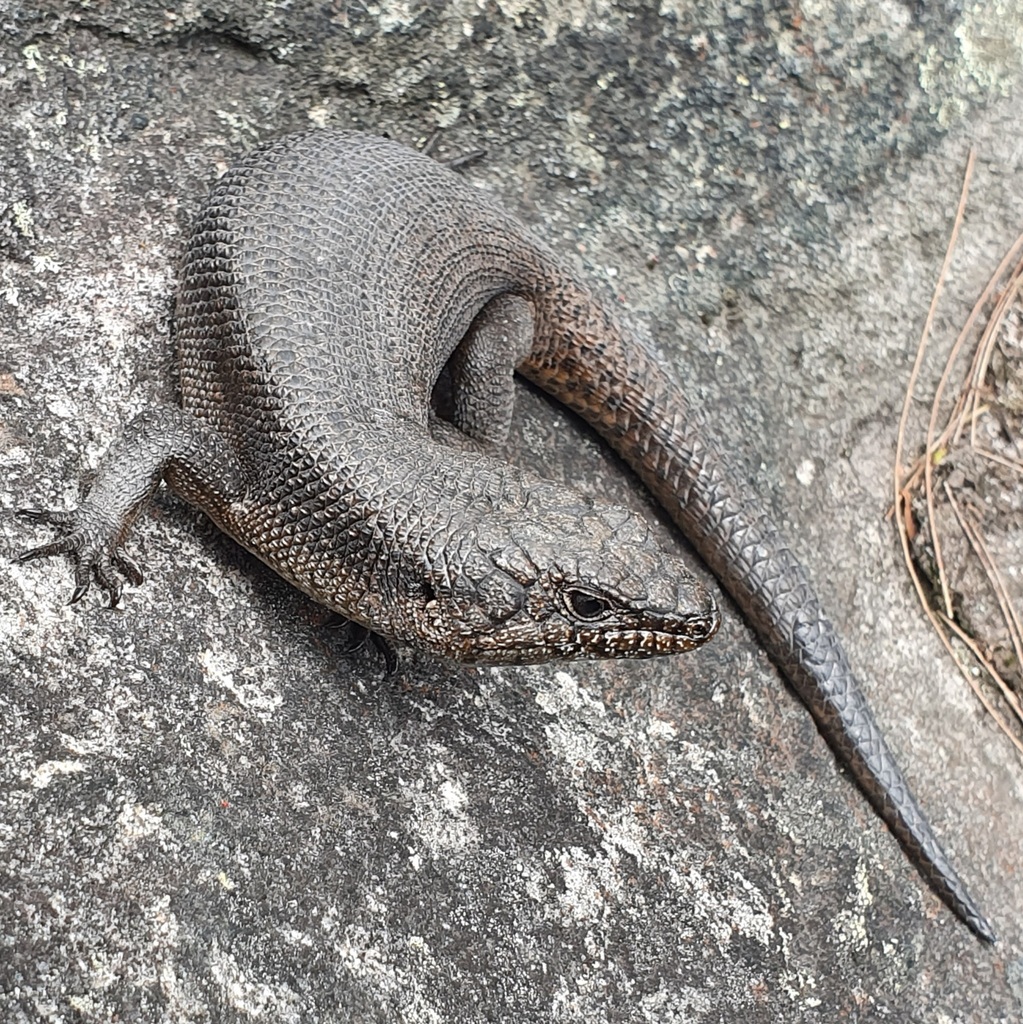
Black Rock Skink
Egernia saxatilis
The black rock skink (Egernia saxatilis) is a species of large skink native to Eastern and Southern Australia from central New South Wales to Grampians National Park in Victoria. A large, dark colored skink, up to 135 mm from snout to base of the tail, the black rock skink is the first reptile discovered to have a "nuclear family" structure where the parents form a pair and care for their offspring for more than one year. The black rock skink is a viviparous skink meaning females give birth to live offspring instead of laying eggs. They defend their home range and families against conspecifics for up to several years.
From the article Black rock skink on Wikipedia (CC BY-SA), quoted section by section
Description
The black rock skink is a relatively large, mostly dark brown or black lizard with an average total length of 215 mm. The black upper side has a pattern of broken-up pale scales that appear as white flecks. The scales on the back are keeled and rough to the touch, while the abdominal scales are smooth and not keeled. These ventral scales are also smaller than the dorsal scales. The underside of the skink is slightly orange and the ventral sides of the tail and throat are white with scattered black markings. The sides of the lizard have black scales with a scattering of lighter brown scales throughout. The feet and digits of the black rock skink are black and shiny. The upper lip of the lizard is a lighter black color than the rest of the body. E. saxatilis reaches a maximum length of 140mm in snout to end of tail length. E. saxatilis is diurnal and is the most active during the morning and later afternoon and spends the majority of its time sheltered in rock crevices. When the weather is warmer, they will emerge from these shelters to bask and forage.
Range & habitat
The species is found in the southeastern woodlands of Australia, mainly on the coast and in nearby mountain ranges. They mainly inhabit the outcropping basalt bluffs of the Warrumbungle Ranges in New South Wales and the rocky outcroppings of the Great Dividing Range. E. s. saxatilis are found almost exclusively in the Warrumbungle Range, while E. s. intermedia are often found further east in the Great Dividing Range. These skinks prefer permanent shelter for habitat including rock crevices beneath boulders and sometimes timber on rocky outcrops. Large crevices allow for a larger family to occupy them; however, they are at higher risk of attack from predators including snakes. Permanent rock crevice habitats have different levels of quality depending on their level of sun exposure and their ability to offer thermoregulatory benefits to the lizards. They spend the majority of their time in and around these shelters. Basking and foraging all occur near to this permanent home. E. saxatilis saxatilis is exclusively rock-dwelling, whereas E. s. intermedia can be found in arboreal habitats. Egernia saxatilis can be excluded from timber habitats if related Egernia species are present, and forced to remain completely saxatile.
Wikipedia: “Habitat and distribution”
What it does
Egernia saxatilis is active during the day, and eats small insects, but in some seasons can also eat vegetation. It lives in the crevices of rock outcrops, and stays near the crevice. It is particularly active during warm weather and often interacts socially. They can be aggressive to other skinks that enter their area. The social organization of these Australian lizards is very complex, as a study has shown monogamous tendencies among this species, contrary to the polygamous tendency of reptiles in general. The adults and young can stay together for over a year, with the female annually producing 2 or 3 young. They are viviparous. Based on examining similar species, it is thought that they can live for 10 years, and are mature by 2 or 3 years.
Wikipedia: “Ecology”
Where it lives
Recorded sightings
—
geo-referenced records in GBIF, from museums, herbaria and field observers.
Drag the globe to turn it. Dots are where records exist, not a range map; darker means more records.
In the stacks
Searching the stacks…
Every page naming Egernia saxatilis in the Biodiversity Heritage Library →
This page is assembled live from iNaturalist, GBIF, Wikipedia, the Source Library and the Internet Archive. It is not yet part of the hand-edited codex. iNaturalist taxon 38603.