- Animals
- ›Chordates
- ›Vertebrates
- ›Reptiles
- ›Snakes and Lizards
- ›Lizards
- ›Skinks and allies
- ›Skinks
- ›Social skinks
- ›Egernia
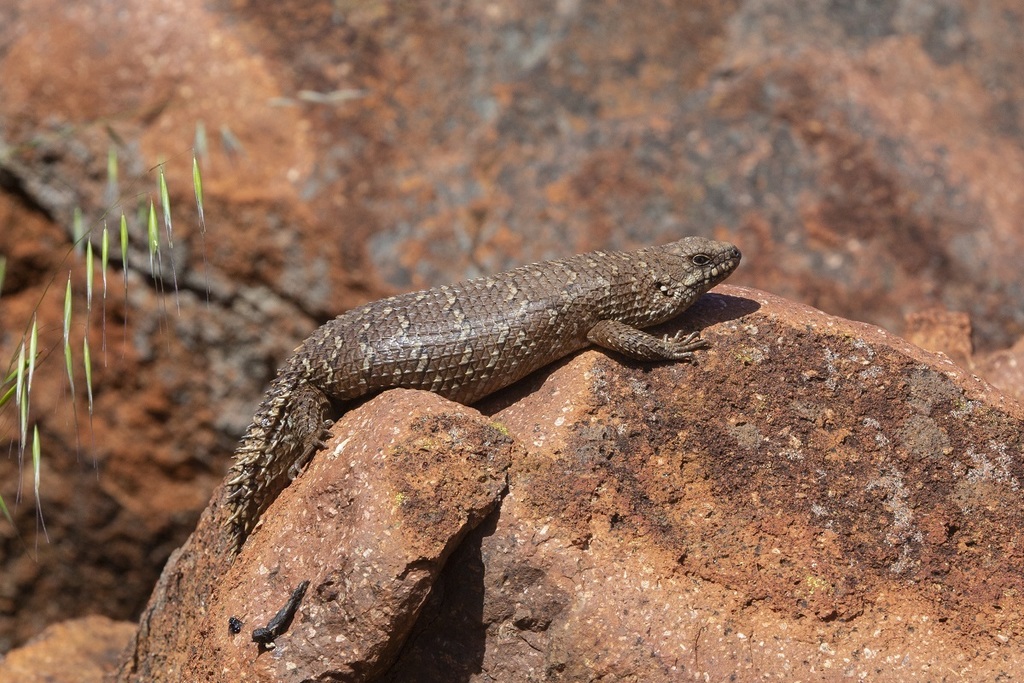
Gidgee Skink
Egernia stokesii
Egernia stokesii is a gregarious species of lizard of the Scincidae family. This diurnal species is endemic to Australia, and is also known as the Gidgee skink, spiny-tailed skink, Stokes's skink and Stokes's egernia. The species forms stable, long-term social aggregations, much like the social groups seen in mammalian and avian species. This characteristic is rarely found in the Squamata order, but is widespread within the Australian subfamily of Egerniinae skinks. Populations of E. stokesii are widely distributed, but fragmented, and occur in semi-arid environments. There are three recognised subspecies. The conservation status for the species is listed as least concern, however, one subspecies is listed as endangered.
From the article Stokes's skink on Wikipedia (CC BY-SA), quoted section by section
Description
Egernia stokesii range in colour from olive to reddish brown, with lighter ventral scales that range from white to yellow. The species often displays scatterings of lighter coloured dorsal scales. The dorsal scales are keeled from the back of the neck to the tail and spiny tail scales are a prominent feature of the species. The tail is flattened rather than cylindrical, and shorter than the head and body of the animal, at approximately 35% of the snout to vent length. E. stokesii is unable to autotomize their tails. The snout to vent length of a mature adult is between 155 and 190mm. The species is slow to reach sexual maturity, generally between five and six years of age, with a lifespan between 10 and 25 years.
The species displays complex social organisation, forming social aggregations of up to 17 closely related individuals. It has been suggested complex social organisation in the species aids in the detection of predators and thermoregulation. These aggregations remain stable over time, with evidence of adult individuals remaining in the same social group for over five years. E. stokesii displays philopatry, with juveniles typically remaining within the natal group until maturity. The social aggregations typically consist of a breeding pair, immature juvenile and sub-adult offspring from successive litters, and other closely related individuals. …
Wikipedia: “Description and ecology”
Range & habitat
E. stokesii may be saxicolous, occupying rocky outcrops, or semi-arboreal, and found in grassland, woodland or shrubland habitats. They are diurnal and non-burrowing, instead sheltering in rock crevices, under logs, or in tree hollows. E. stokesii is found in New South Wales, Northern Territory, Queensland, South Australia, and Western Australia.
Wikipedia: “Habitat and distribution”
What it does
The species is highly monogamous, and there is evidence of mate selection favouring unrelated individuals with dissimilar genotypes and high genetic diversity, from within the established social group. E. stokesii are viviparous, producing between 1 and 8 young each litter. The parturition timeframe varies between one and twelve days, with an average time of 2.8 days. The size of the litter has been demonstrated to positively correlate with both the snout to vent length and gravid mass of the female. The young are presented head first, and encased in membranes with a yolk sac attached. The newborn skinks or mother may consume the birth membranes and yolks sac following parturition, and infanticide has been observed in the species. The reported snout to vent length of newborn juveniles is between 65-95mm, with an average birth weight of 8.15g. Populations of E. stokesii in eastern Australia typically give birth annually between during the summer months of February and March, but may not produce a litter every year. A winter birth has been observed in a wild individual from Western Australia. Juveniles experience a relatively higher infant mortality rate in their first year, whilst adults have a low mortality rate.
Wikipedia: “Reproduction”
In human culture
The specific name, stokesii, is in honour of Royal Navy Admiral John Lort Stokes. The subspecific name, zellingi, is in honour of British biological collector Charles Weldon De Burgh Birch, Count Zelling (1821–1894).
Wikipedia: “Etymology”
Where it lives
Recorded sightings
—
geo-referenced records in GBIF, from museums, herbaria and field observers.
Drag the globe to turn it. Dots are where records exist, not a range map; darker means more records.
In the stacks
Searching the stacks…
Every page naming Egernia stokesii in the Biodiversity Heritage Library →
This page is assembled live from iNaturalist, GBIF, Wikipedia, the Source Library and the Internet Archive. It is not yet part of the hand-edited codex. iNaturalist taxon 38595.