On eBird ↗
Red-necked Stint
Live sightings near you, the range map, bar charts of when it is seen, and Macaulay Library photos and recordings.
Red-necked Stint
Calidris ruficollis
The red-necked stint (Calidris ruficollis) is a small migratory wader. The genus name is from Ancient Greek kalidris or skalidris, a term used by Aristotle for some grey-coloured waterside birds. The specific ruficollis is from Latin rufus, "red" and collum, "neck".
From the article Red-necked stint on Wikipedia (CC BY-SA), quoted section by section
Description
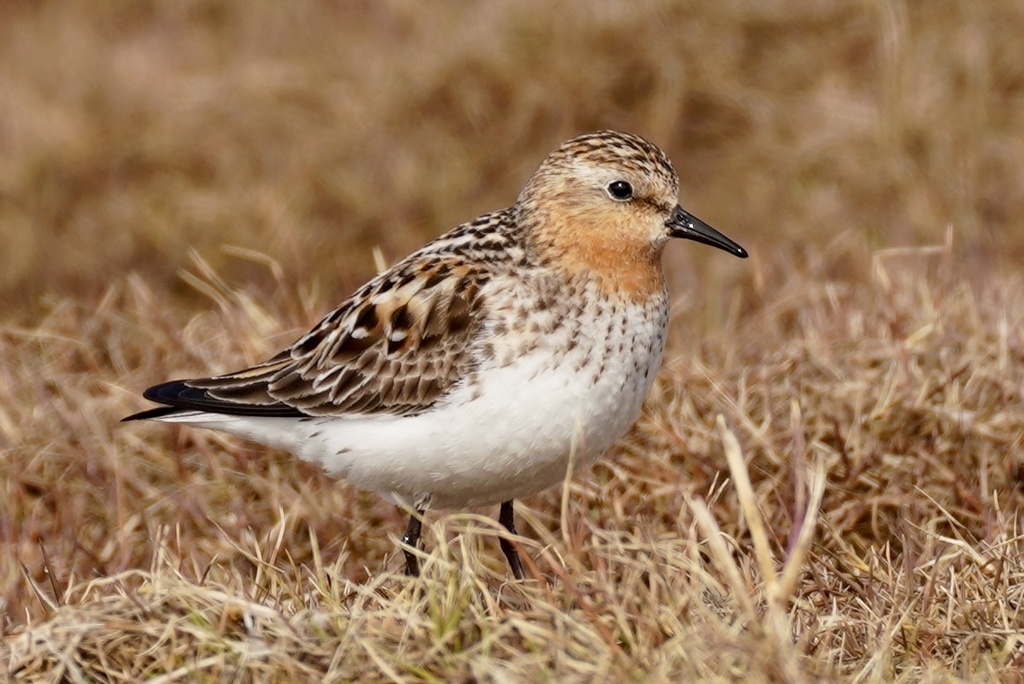
These birds are among the smallest of waders, very similar to the little stint, Calidris minuta, with which they were once considered conspecific. The red-necked stint's small size, fine dark bill, dark legs and quicker movements distinguish this species from all waders except the other dark-legged stints. It measures 13–17 cm (5.1–6.7 in) in length, 28–37 cm (11–15 in) in wingspan, and 21–51 g (0.74–1.80 oz) in weight. It can be distinguished from the western sandpiper and the semipalmated sandpiper in all plumages by its combination of a fine bill tip, unwebbed toes, and longer primary projection. The breeding adult has an unstreaked orange breast, bordered with dark markings below, and a white V on its back. In winter plumage identification is difficult, although it is shorter legged and longer winged than the little stint. Juveniles have more contrasting mantle plumage and weaker white lines down the back than their relative. The call is a hoarse "stit".
Range & habitat
Red-necked stints are strongly migratory, breeding along the Arctic littoral of eastern Eurasia and spending the non-breeding season in Southeast Asia and Australasia as far south as Tasmania and New Zealand. They are rare vagrants to western Europe, with records from Belgium, Denmark, Great Britain, Germany, Ireland, the Netherlands, and Sweden. They are often seen in western Alaska and occasionally elsewhere in the Americas.
Wikipedia: “Distribution and habitat”
What it does
Red-necked stints are highly gregarious and will form flocks with other small Calidris waders, such as sharp-tailed sandpipers and curlew sandpipers in their non-breeding areas.
Breeding. The breeding habitat is low altitude tundra usually in dry raised areas. The birds have only a low degree of site fidelity. The eggs are laid in June. The nest is a shallow depression lined with leaves and grass. The clutch of 3 or 4 eggs is incubated for 20-22 days by both parents. The females leaves soon after the eggs hatch while the male continues to care for the chicks until they fledge at 16-17 days. Only a single brood is raised each year.
Food and feeding. They forage in wet grassland and soft mud, mainly picking up food by sight. In their non-breeding habitat they feed on intertidal mudflats and along the muddy margins of freshwater lakes. They mainly eat insects and other small invertebrates.
Wikipedia: “Behaviour”
Listen
Looking for field recordings…
Where it lives
Recorded sightings
—
geo-referenced records in GBIF, from museums, herbaria and field observers.
Drag the globe to turn it. Dots are where records exist, not a range map; darker means more records.
In the stacks
Searching the stacks…
Every page naming Calidris ruficollis in the Biodiversity Heritage Library →
This page is assembled live from iNaturalist, GBIF, Wikipedia, the Source Library and the Internet Archive. It is not yet part of the hand-edited codex. iNaturalist taxon 3854.