- Animals
- ›Chordates
- ›Vertebrates
- ›Reptiles
- ›Snakes and Lizards
- ›Lizards
- ›Skinks and allies
- ›Skinks
- ›Sphenomorphine Skinks
- ›Eremiascincus
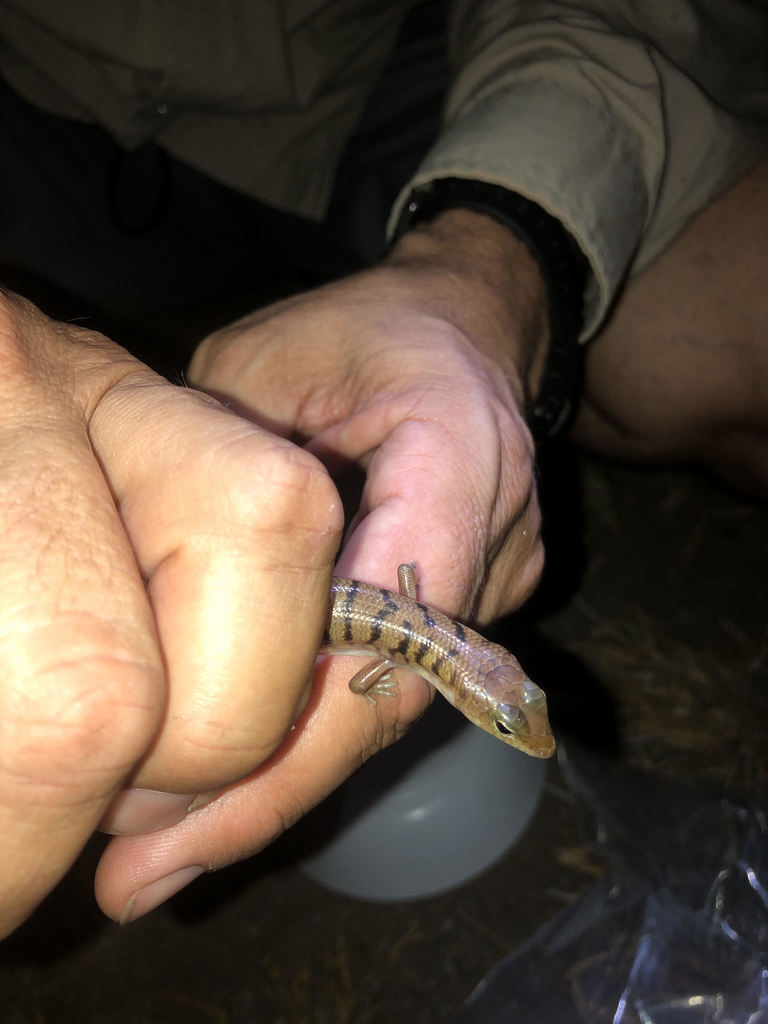
Eastern Narrow-banded Sand-swimmer
Eremiascincus fasciolatus
The Eastern Narrow-banded sand-swimmer or thick-tailed skink (Eremiascincus fasciolatus) is a species of skink found throughout most of the arid and semi-arid interior of Australia.
From the article Eremiascincus fasciolatus on Wikipedia (CC BY-SA), quoted section by section
Description
E. fasciolatus has an SVL of up to 123mm and is a dull, usually pale yellowish brown to reddish brown with 10 – 16 narrow bands, no more than one scale wide on body, and 25 – 35 very narrow bands on original tail. The colour pattern consists of distinct narrow dark brown or black cross bands from base of neck to tail, belly is cream to pinkish. The major pattern variations consist of flecks on the head, neck and limbs. E. fasciolatus has a banded pattern, low dorsal ridges present on posterior of body and tail, one lower labial scale contacts postmental scale, usually 8 upper labial scales, with the last labial scale divided horizontally, and a row of subinfralabial scales present. As these species are so similar in general body pattern, morphology and size, E. fasciolatus cannot be distinguished from other sand-swimmer species by the main diagnostic characteristics or the number and width of caudal bands but with experience can be distinguished by a larger SVL and a more robust build.
Range & habitat
E. fasciolatus occurs throughout most of the arid and semi-arid interior of Australia. It has been recorded from the Central Coast of Queensland, through south-western Queensland, western New South Wales, North-western Victoria and the Northern Territory to northern West Australia. It is largely absent from the northern, southern and eastern fringes of the continent, but may be present on the coastal plain in some parts of south-eastern Queensland.
Wikipedia: “Distribution”
What it does
E. fasciolatus is crepuscular and nocturnal, favouring damp places, such as under logs during the day. They are a fossorial or semi fossorial species and when disturbed, will instantly burrow into the soil with snakelike movement that has earned it the nickname ‘sand-swimmer’. This form of locomotion in loose sand or soil occurs in a wide variety of unrelated desert lizards throughout the world. E. fasciolatus can travel extensively across its home range with James and Losos recording and adult traveling 525m in 22 days and 215m within 24hours. As a result of the extensive range of some individuals, it is not possible to get accurate population density data. E. fasciolatus are ectothermic and regulate their internal temperature by burrowing into the sand by day to avoid the heat and remaining active on the surface at night, with temperatures above 41.6°C proving to be fatal.
Wikipedia: “Behaviour”
In human culture
The Scientific name ‘Eremiascincus’ is derived from the Greek word for desert (eremias) and the Latin word for lizard (scincus). The species name ‘fasciolatus’ is Latin for ‘small bands’. This gives the meaning of the name to be ‘Desert Lizard with small bands’.
Wikipedia: “Etymology”
Where it lives
Recorded sightings
—
geo-referenced records in GBIF, from museums, herbaria and field observers.
Drag the globe to turn it. Dots are where records exist, not a range map; darker means more records.
In the stacks
Searching the stacks…
Every page naming Eremiascincus fasciolatus in the Biodiversity Heritage Library →
This page is assembled live from iNaturalist, GBIF, Wikipedia, the Source Library and the Internet Archive. It is not yet part of the hand-edited codex. iNaturalist taxon 38504.