- Fungi Including Lichens
- ›Basidiomycete Fungi
- ›Pucciniomycotina
- ›Pucciniomycetes
- ›rust fungi
- ›Uredinineae
- ›Pucciniaceae
- ›Puccinia
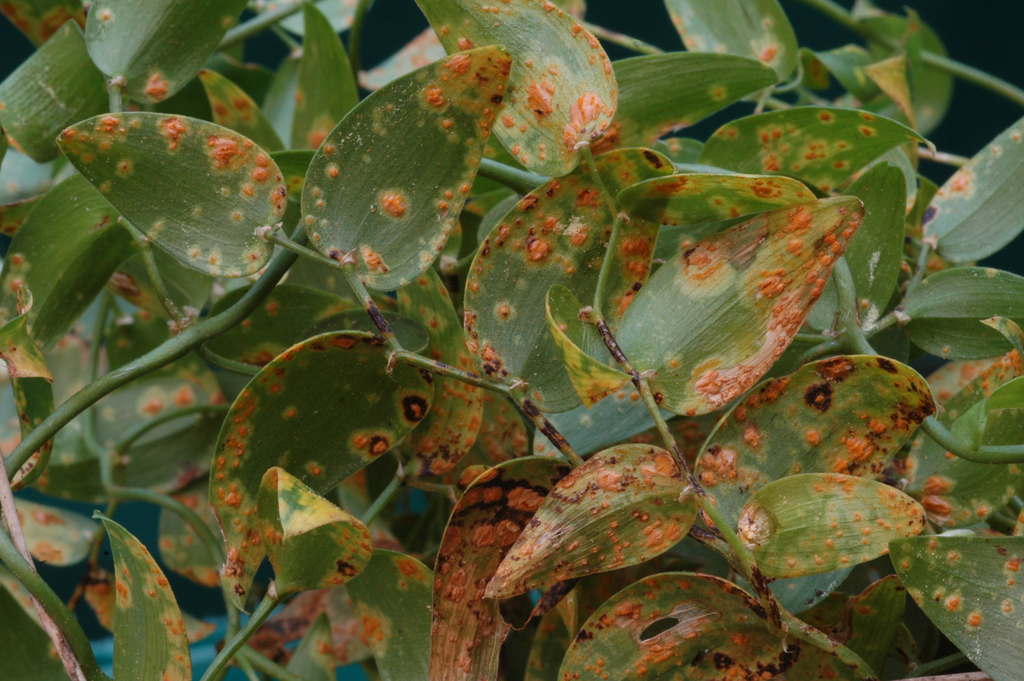
Bridal creeper rust
Puccinia myrsiphylli
Puccinia myrsiphylli is a rust fungus in the genus Puccinia, family Pucciniaceae, and is native to South Africa. It has been tested, introduced, and targeted in Australia and New Zealand as an effective biocontrol agent for Asparagus asparagoides, also known as bridal creeper.
From the article Puccinia myrsiphylli on Wikipedia (CC BY-SA), quoted section by section
Description
Puccinia myrsiphylli is a rust fungus with the following characteristics: "Uredospores ellipsoid or sub-globose, pale yellow 30-40 x 26-30 μ; epispore hyaline, about 1.5 μ thick, closely and finely echinulate and with 4-5 scattered germ pores…Teleutospores oblong, cuneate or clavate, apex rounded, acuminate or truncate, usually attenuate at the base, usually gently constricted at the septum, light brown, darker at the apex, 43-70 x 17-28 μ; epispore smooth, about 1.5 μ thick, thickened at the apex (up to 7 μ); germ pores obscure, pedicel short, fragile, hyaline or tinged with brown." The rust fungus shows up in early to late autumn with little, orange structures on the top of the leaves of the A. Asparagoides, and looking like warts. This is the spermagonia and pycnia stage of the disease cycle. Next, there are aecia, which take the form of cup-shapes and are also orange, but they are on the under side of the leaves. The aecia produce aeciospores, and lead to uredinia. Uredinia and telia are on the under side of the leaves, but also on stems. The uredeina are also orange and in the shape of pustules, while the telia are a brown-black color, but also in the shape of pustules. The uredinia produce urediniospores, which are dispersed by the wind. Telia occur several weeks later. Then the telia produce thick-walled resting spores called teliospores. P. …
Range & habitat
Puccinia myrsiphylli is found in Eastern Cape Province in South Africa. P. myrsiphylli was present in South Africa in winter regions, aseasonal regions, and summer rainfall regions in all regions where there is widespread A. asparagoides. In southern Africa, the occurrence of P. myrsiphylli was dependent on the existence of living foliage of its host plant and season of rainfall. P. myrsiphylli is a very flexible pathogen, as shown by its ability to distribute widely throughout many different South African climate regions. It can also survive harsh, dry conditions without its host. P. myrsiphylli can be found in South Africa, Australia, and New Zealand.
Wikipedia: “Distribution and habitat”
Where it lives
Recorded sightings
—
geo-referenced records in GBIF, from museums, herbaria and field observers.
Drag the globe to turn it. Dots are where records exist, not a range map; darker means more records.
In the stacks
Searching the stacks…
Every page naming Puccinia myrsiphylli in the Biodiversity Heritage Library →
This page is assembled live from iNaturalist, GBIF, Wikipedia, the Source Library and the Internet Archive. It is not yet part of the hand-edited codex. iNaturalist taxon 383971.