On eBird ↗
Australasian Gannet
Live sightings near you, the range map, bar charts of when it is seen, and Macaulay Library photos and recordings.
Australasian Gannet
Morus serrator
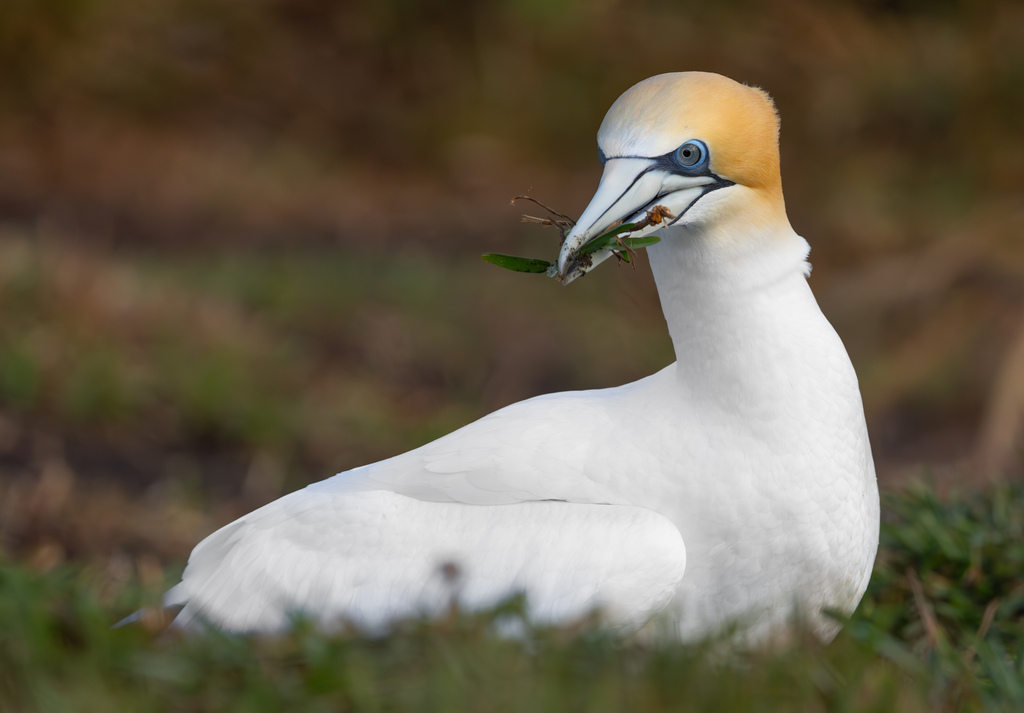
The Australasian gannet (Morus serrator), also known as the Australian gannet or tākapu, is a large seabird of the booby and gannet family, Sulidae. Adults are mostly white, with black flight feathers at the wingtips and lining the trailing edge of the wing. The central tail feathers are also black. The head is tinged buff-yellow, with a pearly grey bill edged in dark grey or black, and blue-rimmed eyes. Young birds have mottled plumage in their first year, dark above and light below. The head is an intermediate mottled grey, with a dark bill. The birds gradually acquire more white in subsequent seasons until they reach maturity after five years.
The species range over water above the continental shelf along the southern and eastern Australian coastline, from Steep Point in Western Australia to Rockhampton, Queensland, as well as the North and South Islands of New Zealand, Lord Howe and Norfolk Islands. Nesting takes place in colonies along the coastlines of New Zealand, Victoria and Tasmania—mostly on offshore islands, although there are several mainland colonies in both countries. Highly territorial when breeding, the Australasian gannet performs agonistic displays to defend its nest. Potential and mated pairs engage in courtship and greeting displays. The nest is a cup-shaped mound composed of seaweed, earth, and other debris, built by the female from material mainly gathered by the male. A single pale blue egg is laid yearly, though lost eggs may be replaced. The chick is born featherless but is soon covered in white down.
From the article Australasian gannet on Wikipedia (CC BY-SA), quoted section by section
Description
An adult Australasian gannet is 84–91 cm (33–36 in) long, weighs 2.3 kg (5.1 lb), and has a 170–200 cm (67–79 in) wingspan. The two sexes are generally of a similar size and appearance, though a 2015 field study at Pope's Eye and Point Danger colonies found females to be 3.1% and 7.3% heavier respectively. Females also had a slightly larger ulna and smaller bill. The plumage is white with black flight feathers on the wings, and central rectrices of the tail. Some individuals have more extensive black plumage of their tail feathers. There is a sharp demarcation between light and dark plumage. Black primary feathers are more resilient to wear, which may explain the dark plumage of the wings. The head and hindneck are tinged buff-yellow. The colour is more pronounced on the head and during breeding season. The eyes have a light grey iris surrounded by a pale blue eye ring, and bare black skin on the face which merges into the bill. In adults, the bill is pearly grey with dark grey or black edges, and a black groove running down the length of the upper mandible. The four-toed feet are dark grey and joined by a membrane of similar colour. There are light green lines running along the ridges of the toes that continue along up the front of the legs.
Fledglings are brownish-grey speckled with white overall. …
Range & habitat
The Australasian gannet is found from Steep Point in Western Australia, along the southern and eastern Australian coastline to the vicinity of Rockhampton in Queensland, as well as the North and South Islands of New Zealand, Lord Howe and Norfolk Islands. At sea, it is generally restricted to waters over the continental shelf, and may enter harbours, bays and estuaries, particularly in stormy weather. Over May and June, young gannets from New Zealand colonies disperse to the north and west, mainly flying north around the North Island and (to a lesser extent) via the Cook Strait. They generally reach as far as southeastern Queensland and Rottnest Island in Western Australia. Far-wandering gannets are occasional visitors to Marion Island and the Crozet Islands in the southern Indian Ocean, and have even reached South Africa where they have interbred with Cape gannets. Some immature gannets spend 3 to 4 years in Australian waters before returning to New Zealand, while others remain in New Zealand waters.
Breeding colonies. Breeding colonies are mostly on offshore islands, though several mainland colonies exist in Australia and New Zealand. Numbers of Australasian gannet have been increasing since 1950, although some colonies have disappeared and others have decreased in size. …
Wikipedia: “Distribution and habitat”
What it does
The Australasian gannet is generally solitary when out at sea, though once a bird has found fish to hunt, other gannets may notice and join it. It is gregarious on land, nesting in colonies. Non-breeding gannets often form groups on the outskirts of the colony. Small numbers of gannets may remain around the colony site outside of the breeding season, using it as a roosting site.
Breeding and courtship. Gannet pairs form monogamous and long term bonds, and pairs may remain together over several seasons until one member dies, although they have been known to separate. The Australasian gannet is highly territorial when nesting, engaging in agonistic displays to mark their ground against neighbours and interlopers. In the bowing display, the male's head and beak point down, and its wings are held up and away from the body, yet folded backwards. He moves his head from side to side before bowing forwards. The male may escalate by lunging at an interloper, either with a closed or open bill, or proceed to locking bills and wrestling for an extended period. Fights can be fatal on occasion. A bird may engage in an appeasement display to calm an attacker by lowering its head and tucking its bill in its chest.
Mated pairs engage in a fencing display when the male arrives back at the nest. The two birds stand breast to breast with wings spread and bills extended vertically. …
Wikipedia: “Behaviour”
Listen
Looking for field recordings…
Where it lives
Recorded sightings
—
geo-referenced records in GBIF, from museums, herbaria and field observers.
Drag the globe to turn it. Dots are where records exist, not a range map; darker means more records.
In the stacks
Searching the stacks…
Every page naming Morus serrator in the Biodiversity Heritage Library →
This page is assembled live from iNaturalist, GBIF, Wikipedia, the Source Library and the Internet Archive. It is not yet part of the hand-edited codex. iNaturalist taxon 3801.