- Animals
- ›Chordates
- ›Vertebrates
- ›Birds
- ›Cranes, Rails, and Allies
- ›Rails, Gallinules, and Coots
- ›Gallinula
On eBird ↗
Samoan Moorhen
Live sightings near you, the range map, bar charts of when it is seen, and Macaulay Library photos and recordings.
Samoan Moorhen
Gallinula pacifica
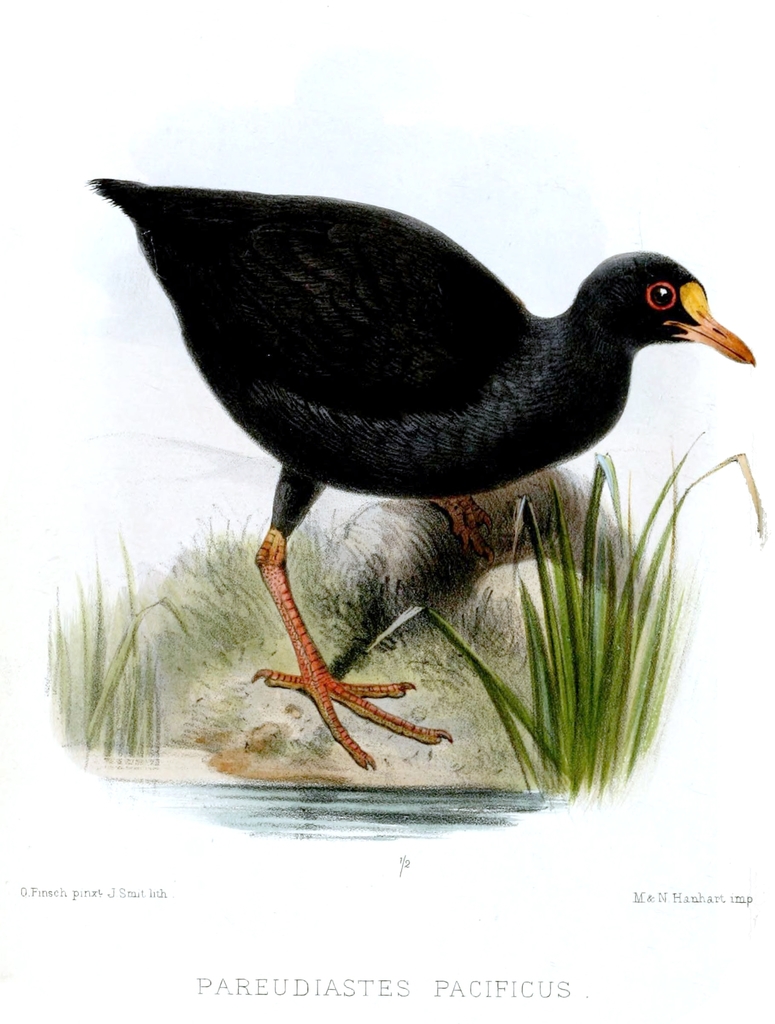
The Samoan moorhen (Gallinula pacifica), also known as the Samoan woodhen and Samoan wood rail, is a nearly flightless rail endemic to the Samoan island of Savai'i that is Critically Endangered. As it has evolved adaptations for a more terrestrial lifestyle and at least partly nocturnal habits, it is probably better placed in a distinct genus, Pareudiastes (which sometimes includes the more distinct Makira woodhen too), but this issue has not yet been thoroughly researched. It was known as puna'e ("one that jumps up") to the native Samoans; this was said to relate to the bird's habit of making a jumping dash into cover when startled from its resting place.
From the article Samoan moorhen on Wikipedia (CC BY-SA), quoted section by section
Description
This small gallinule had a length of about 25 cm. The plumage was darkish blue on head, neck and breast contrasted with an entirely black rump and tail. The upperparts were dark olivaceous with a greenish sheen. The bill and the frontal shield were yellowish to orange red. The eyes and the legs were red.
What it does
Due to its probably nocturnal habits it had large eyes. Its habitat were primary montane forests Its diet consists of insects and other small invertebrates which were preyed by digging the ground and leaf litter; captive birds became sickly when fed a vegetable diet. The eggs said to belong to this species were found in a nest on the ground which was made from twigs and grass. Natives claimed, however, that the puna'e nested in burrows; it is not clear if they confused the rail with petrels or shearwaters (which make similar grunting calls – see below – and nest in burrows) or whether they meant simply scraped-out hollows in the ground.
Wikipedia: “Ecology”
Listen
Looking for field recordings…
Where it lives
Recorded sightings
—
geo-referenced records in GBIF, from museums, herbaria and field observers.
Drag the globe to turn it. Dots are where records exist, not a range map; darker means more records.
In the stacks
Searching the stacks…
Every page naming Gallinula pacifica in the Biodiversity Heritage Library →
This page is assembled live from iNaturalist, GBIF, Wikipedia, the Source Library and the Internet Archive. It is not yet part of the hand-edited codex. iNaturalist taxon 380.