- Animals
- ›Molluscs
- ›Gastropods
- ›Heterobranchs
- ›Euthyneura
- ›Tectipleura
- ›Sea Hares and Akera Snails
- ›Aplysioidea
- ›Seahares
- ›Aplysia
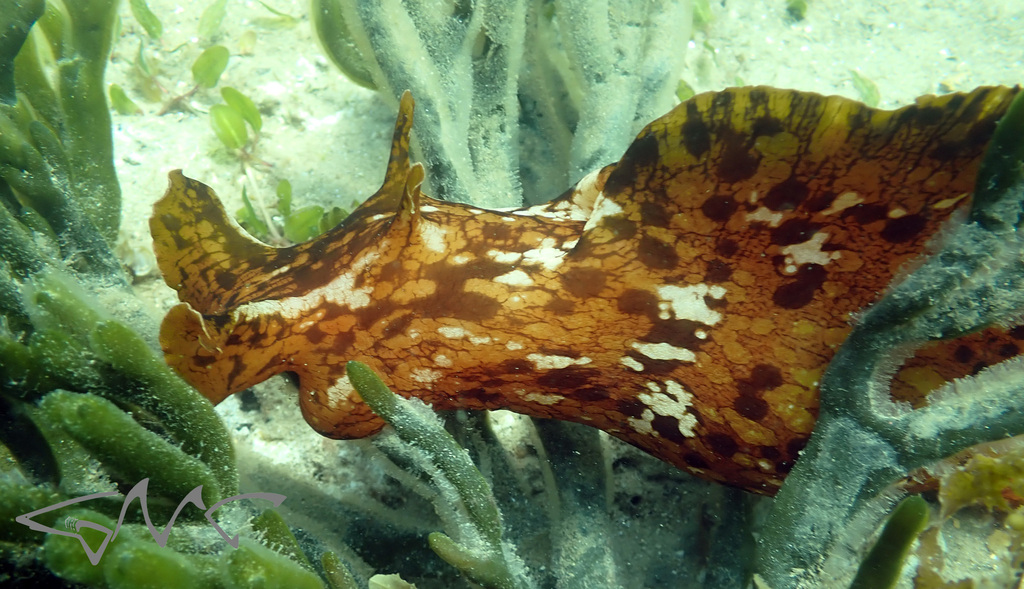
Giant Seahare
Aplysia extraordinaria
Aplysia extraordinaria, common name the "extraordinary sea hare", is a very large species of sea slug, more specifically a sea hare, a marine opisthobranch gastropod mollusk in the family Aplysiidae, the sea hares.
From the article Aplysia extraordinaria on Wikipedia (CC BY-SA), quoted section by section
Description
The length of the shell attains 30 mm and 27 broad. (Described as Aplysia denisoni) The body is high and exhibits a distinct pedal disk, produced posteriorly into a caudal termination. The entire surface is wrinkled and dirty whitish, with black veining (possibly staining) within the wrinkles. The mantle-lobes are moderately large, commencing anteriorly some distance behind the posterior tentacles and terminating slightly in advance of the tail. The anterior tentacles are large, compressed, and notably dilated. The posterior tentacles are large, cylindrical, with the apical slit not extending halfway down the outer side; they are positioned slightly closer to the oral tentacles than to the beginning of the mantle-lobes. The eyes are minute, situated near the outer anterior base of the tentacles. The shell is very thin and straw-colored.
Range & habitat
Its distribution includes the coast off of eastern Australia, northern New Zealand, and possibly a wider range. It is most likely the same species as Aplysia gigantea which is found off of the western coast of Australia, but this has yet to be confirmed.
Wikipedia: “Distribution”
Where it lives
Recorded sightings
—
geo-referenced records in GBIF, from museums, herbaria and field observers.
Drag the globe to turn it. Dots are where records exist, not a range map; darker means more records.
In the stacks
Searching the stacks…
Every page naming Aplysia extraordinaria in the Biodiversity Heritage Library →
This page is assembled live from iNaturalist, GBIF, Wikipedia, the Source Library and the Internet Archive. It is not yet part of the hand-edited codex. iNaturalist taxon 379953.