- Animals
- ›Chordates
- ›Vertebrates
- ›Birds
- ›Pelicans, Herons, Ibises, and Allies
- ›Ibises and Spoonbills
- ›Geronticus
On eBird ↗
Southern Bald Ibis
Live sightings near you, the range map, bar charts of when it is seen, and Macaulay Library photos and recordings.
Southern Bald Ibis
Geronticus calvus
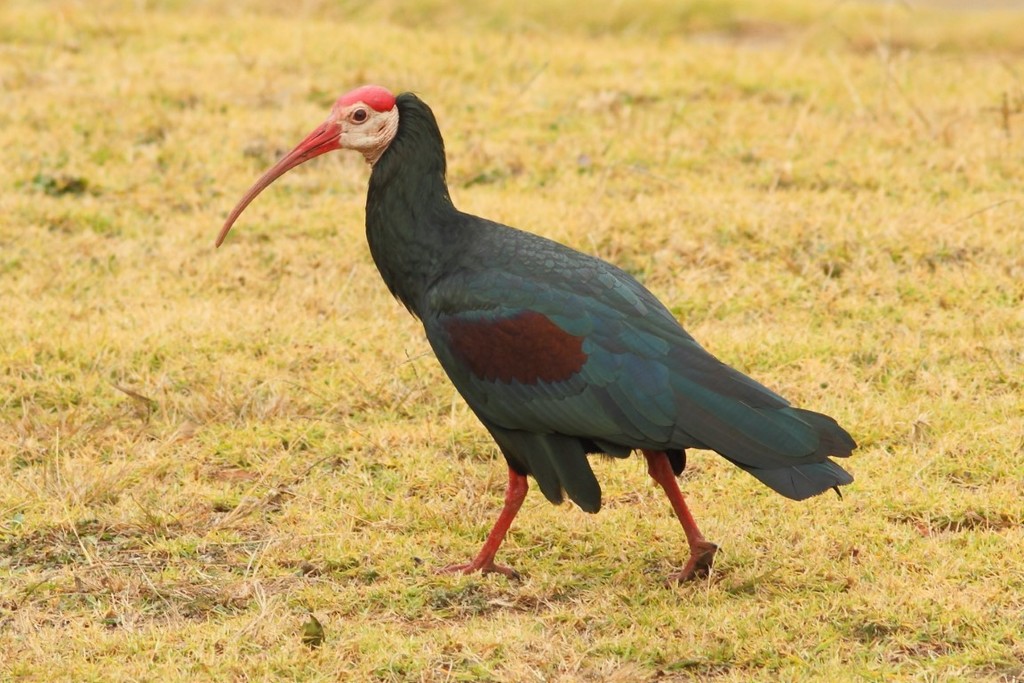
The southern bald ibis (Geronticus calvus) is a large bird found in open grassland or semi-desert in the mountains of southern Africa. Taxonomically, it is most closely related to its counterpart in the northern regions of Africa, the waldrapp (Geronticus eremita). As a species, it has a very restricted homerange, limited to the southern tips of South Africa in highland and mountainous regions.
This large, glossy, blue-black ibis has an unfeathered red face and head, and a long, decurved red bill. It breeds colonially on and amongst rocks and on cliffs, laying two or three eggs which are incubated for 21 days before hatching. It is a large bird that feeds and roosts in substantial groups. It feeds on insects, small reptiles, rodents and small birds. They do little vocalizing other than occasional gobbling sounds.
From the article Southern bald ibis on Wikipedia (CC BY-SA), quoted section by section
Description
The southern bald ibis (Geronticus calvus) is an uncommon bird endemic to the highlands of the southern African region. In South Africa, the species' total breeding population was estimated around 4,600 birds. As of 2024, the total population lower bound is estimated between 7,000 and 8,000. However, little is known about the biology of this species. Its plumage is dark green with iridescent streaks of green, violet and bronze. The neck displays long feathers that are a blue-green shade. As adults, its shoulders display shades of copper. However, as juveniles, the plumage is predominantly a dull grey color. The bird's Latin name, Geronticus calvus, is translated as "bald, old man", referring to the bird's featherless, wrinkled head and face. The head is the key feature in recognizing this species due to the evident bare whitish skin. On the top of the head, there is a red dome-shaped crown. The bills of these birds are down-curved and red, along with their legs. Similarly, their eyes are also colored an orange-red shade.
Range & habitat
The southern bald ibis is a species with a very restricted homerange. It is estimated that there are only 4 600 breeding birds of this species in the South African region. The species is confined to the eastern regions of South Africa and are restricted to the highland and mountainous regions. Its range extends from the highlands of Lesotho extending into Eswatini. The birds may migrate short distances within their designated home ranges. These birds are cliff-nesters and breed in the open areas of mountain faces, as well as river gorges and sometimes around waterfalls. Their breeding habitat is composed mainly of mountainous grasslands that range in altitude from 1 200 to 2 000 meters above sea level. The grassland areas are labeled as 'sour' due to the low nutritional value of the foliage in late summer and early autumn due to the previous grazing of mammals.
Wikipedia: “Distribution and habitat”
What it does
The southern bald ibis is a bird that feeds and roosts in large groups. They travel in groups of up to 100 individuals to find suitable foraging areas. As insectivores, their diet is composed mainly of insects and other small invertebrates found in burnt grasslands. The species live on cliff edges where they build their nests and for the most part, breed in colonies. They do little vocalizing besides occasional gobbling sounds.
Vocalizations. The southern bald ibis is known to be a relatively quiet bird. This species in particular has been noted to make a weak gobbling sound. This is refers back to their old Afrikaans name of "Wilde-Kalkoen", otherwise translated as "wild turkey". This bird is most boisterous in the nesting areas and in flight. It projects a high-pitched keeaaw-klaup-klaup call, resembling that of a turkey's.
Diet. This species is insectivorous and feeds predominantly on insects and other small terrestrial invertebrates. It is a forager, alternating between feeding in harvested maize fields, overgrazed pastures and burnt grasslands. They walk along the land while pecking and probing the ground. The main component of its diet is the caterpillar of the maize stalk borer, Busseola fusca. …
Wikipedia: “Behaviour”
Listen
Looking for field recordings…
Where it lives
Recorded sightings
—
geo-referenced records in GBIF, from museums, herbaria and field observers.
Drag the globe to turn it. Dots are where records exist, not a range map; darker means more records.
In the stacks
Searching the stacks…
Every page naming Geronticus calvus in the Biodiversity Heritage Library →
This page is assembled live from iNaturalist, GBIF, Wikipedia, the Source Library and the Internet Archive. It is not yet part of the hand-edited codex. iNaturalist taxon 3754.