- Animals
- ›Chordates
- ›Vertebrates
- ›Reptiles
- ›Snakes and Lizards
- ›Lizards
- ›Skinks and allies
- ›Skinks
- ›Limbless Skinks
- ›Acontias
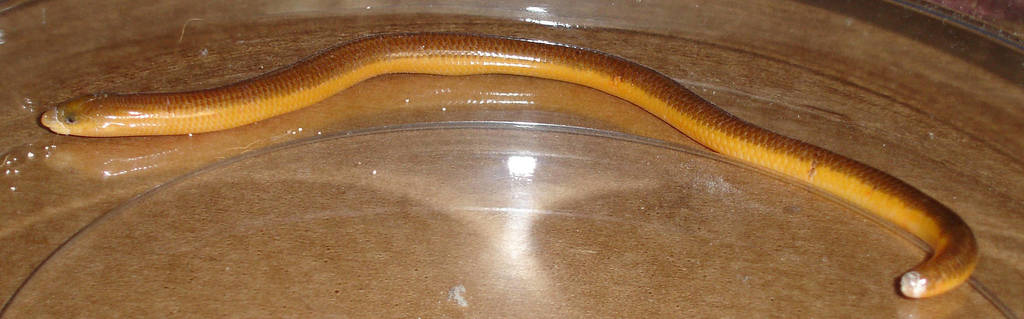
Percival's Legless Skink
Acontias percivali
Acontias percivali, also known commonly as Percival's lance skink, Percival's legless lizard, and the Tanzanian legless lizard, is a species of small, legless lizard in the subfamily Acontinae of the family Scincidae. The species is endemic to Africa.
From the article Acontias percivali on Wikipedia (CC BY-SA), quoted section by section
Description
Percival's lance skink can be identified by its copper-brown back and gold underside. Adults usually have a snout-to-vent length (SVL) of 18–22 cm (7.1–8.7 in). The maximum recorded SVL is 25.7 cm (10.1 in) for the female of the species, and 23.9 cm (9.4 in) for the male.
Range & habitat
The geographic range of Acontias percivali is limited to continental Africa and includes regions of Angola, Botswana, Kenya, Namibia, South Africa, Tanzania, Democratic republic of Congo and Zimbabwe.
Wikipedia: “Geographic distribution”
What it does
Acontias percivali is an insectivores that specializes in feeding on beetle larvae, earthworms, and other slow-moving invertebrates.
Wikipedia: “Diet”
In human culture
The specific name, percivali, is in honor of British naturalist Arthur Blayney Percival (1874–1940), who was a game warden in East Africa.
Wikipedia: “Etymology”
Where it lives
Recorded sightings
—
geo-referenced records in GBIF, from museums, herbaria and field observers.
Drag the globe to turn it. Dots are where records exist, not a range map; darker means more records.
In the stacks
Searching the stacks…
Every page naming Acontias percivali in the Biodiversity Heritage Library →
This page is assembled live from iNaturalist, GBIF, Wikipedia, the Source Library and the Internet Archive. It is not yet part of the hand-edited codex. iNaturalist taxon 37297.