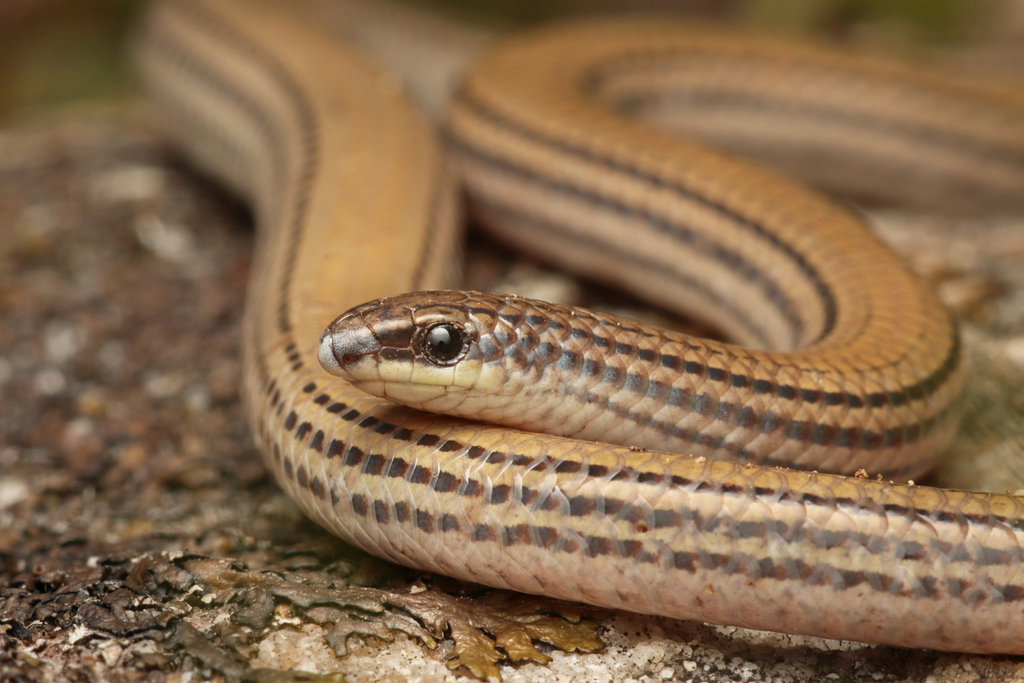
Striated Worm-lizard
Aprasia striolata
The striated worm-lizard (Aprasia striolata) is a species of legless lizard in the family Pygopodidae. It is endemic to southern Australia (southern Western Australia, South Australia, and western Victoria). Commonly known as Striated worm-lizard but has also been referred to as the Striped or Lined worm-lizard due to its pattern of long, thin parallel streaks. Some populations such as those in WA and Kangaroo Island may have absent stripes or the lines present as lines of dots.
In 1994, Webb and Shine dissected 615 preserved pygopodid museum specimens to study their life-history. Most of this information is collected from that study where they noted that there were fewer females than males in the museum collections.
From the article Striated worm-lizard on Wikipedia (CC BY-SA), quoted section by section
Description
The Pygopodidae family of legless lizards is characterised by extreme body elongation and reduced limbs or complete lack of limbs which makes them appear snake-like. The Aprasia genus is morphologically diverse but comprises the small worm-like burrowers. Several of their morphological and trophic features make them similar to sympatric Typholopidae (blind snakes).
Range & habitat
Two isolated populations appear to exist: one is the south-west of Western Australia and the other extending from western Victoria to the Eyre Peninsula in South Australia.
Wikipedia: “Distribution”
What it does
Both males and females feed on ant brood from a variety of ant genera. Almost entirely (>95%) larvae and pupae of ants. In male Aprasia striolata up to 5% of their digestive tracts contained adult ants. Prey is swallowed whole, showing no evidence of being chewed prior to ingestion. Dentition is reduced in the species. Rarely they may consume other insect pupa. In the Webb and Shine study they found one mature male had consumed a small insect pupa along with 19 ant pupae.
Wikipedia: “Diet”
Where it lives
Recorded sightings
—
geo-referenced records in GBIF, from museums, herbaria and field observers.
Drag the globe to turn it. Dots are where records exist, not a range map; darker means more records.
In the stacks
Searching the stacks…
Every page naming Aprasia striolata in the Biodiversity Heritage Library →
This page is assembled live from iNaturalist, GBIF, Wikipedia, the Source Library and the Internet Archive. It is not yet part of the hand-edited codex. iNaturalist taxon 36950.