On eBird ↗
Little Bronze-Cuckoo
Live sightings near you, the range map, bar charts of when it is seen, and Macaulay Library photos and recordings.
Little Bronze Cuckoo
Chalcites minutillus
The little bronze cuckoo (Chalcites minutillus) is a species of cuckoo in the family Cuculidae. It was formerly placed in the genus Chrysococcyx. It is a common brood parasite of birds from the genus Geryone. This cuckoo is found in Southeast Asia, New Guinea and some parts of Australia, where its natural habitat is subtropical or tropical moist lowland forest. It is the world's smallest cuckoo. The pied bronze cuckoo was formerly considered to be a subspecies. Other common names for the little bronze cuckoo include the red-eyed bronze cuckoo and the Malay green cuckoo. It has 11 subspecies which are generally recognized.
From the article Little bronze cuckoo on Wikipedia (CC BY-SA), quoted section by section
Description
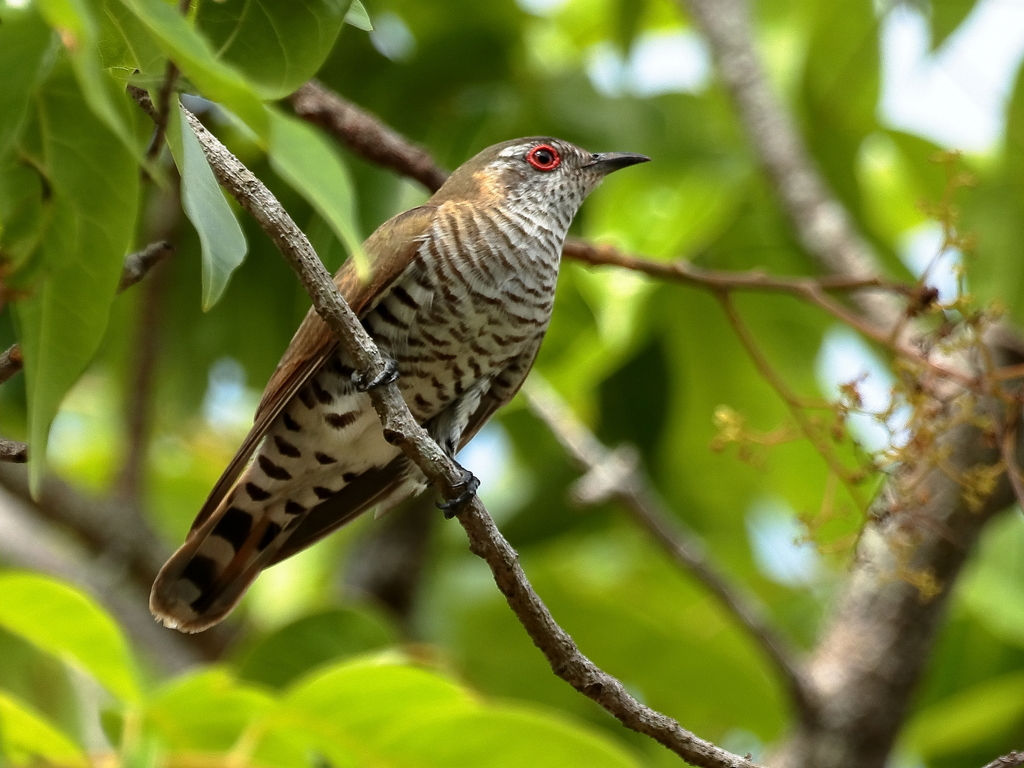
As the world's smallest cuckoo, the little bronze cuckoo measures 15-16 centimeters (5.9-6.3 in) in length and weighs 14.5-17.0 grams (0.51-0.60 oz). The females are slightly larger than the males. The generation length of the Little Bronze Cuckoo is approximately three years. The little bronze cuckoo is characterized by its bronze-green upperparts, white underparts with dark barring, and a distinctive white spot behind the eye. It has a slender body and a long tail, allowing it to maneuver swiftly through dense vegetation. In flight, it is described as being direct with subtle undulation. Males of this species can most easily be distinguished from females by a red orbital ring. Juveniles are much less bright and may lack mottling on their flanks. The little bronze cuckoo's appearance resembles the shining bronze cuckoo, Horsfield's bronze cuckoo, the rufous-throated bronze cuckoo, the pied bronze cuckoo, the violet cuckoo, the banded bay cuckoo and juvenile brush cuckoos.
Range & habitat
The little bronze cuckoo's range covers Southeast Asia, New Guinea and northern and eastern Australia. In terms of habitat, the little bronze cuckoo prefers open woodlands, forest edges, and scrubby areas with dense vegetation. It is also known to live near humans in places such as villages and gardens. The habitats populated by the little bronze cuckoo depends on where they are located geographically:
Thai-Malay Peninsula: forest edges, mangrove lowlands, scrub and gardens. Java: mangroves, monsoon vine forests Australia: Densely vegetated areas, mangroves, monsoon forest edges, near wetlands, forests South-East Queensland and North-East New South Wales: Forest edges and forest New Guinea: Forests and woodlands including eucalyptus, sclerophyll and paperbarks. Members of this species are often located below 500m of elevation but there are some exceptions across its range, and it has been known to occur at up to 2000 meters of elevation.
Wikipedia: “Distribution and habitat”
What it does
The little bronze cuckoo is insectivorous and feeds on ants, bees, sawflies, wasps, ladybugs, true bugs as well as butterflies and their caterpillars. They have been observed catching insects mid-flight both from within vegetation and from the forest floor. This species often hunts alone but has also been seen hunting in groups with as many as 5 birds participating.
Wikipedia: “Diet”
In human culture
A big driver of evolution in parasitic cuckoo species is the hosts available to them. Cuckoo species with many potential hosts are more likely to split off into multiple species that lay their eggs in the nests of specific hosts. The little bronze cuckoo is a good example of this because it is the brood parasitic cuckoo with the most subspecies. In fact, Gerygones, their main hosts, also reflect an unusually high level of speciation which could signal an evolutionary arms race against their brood parasites. The little bronze cuckoo and Geryones have entangled evolutionary histories.
Wikipedia: “Evolutionary history”
Listen
Looking for field recordings…
Where it lives
Recorded sightings
—
geo-referenced records in GBIF, from museums, herbaria and field observers.
Drag the globe to turn it. Dots are where records exist, not a range map; darker means more records.
In the stacks
Searching the stacks…
Every page naming Chalcites minutillus in the Biodiversity Heritage Library →
This page is assembled live from iNaturalist, GBIF, Wikipedia, the Source Library and the Internet Archive. It is not yet part of the hand-edited codex. iNaturalist taxon 369157.