- Animals
- ›Molluscs
- ›Gastropods
- ›Heterobranchs
- ›Euthyneura
- ›Tectipleura
- ›Eupulmonata
- ›Common Land Snails and Slugs
- ›Helicina
- ›Succineoidei
- ›Athoracophoroidea
- ›Leaf-veined Slugs
- ›Aneiteinae
- ›Triboniophorus
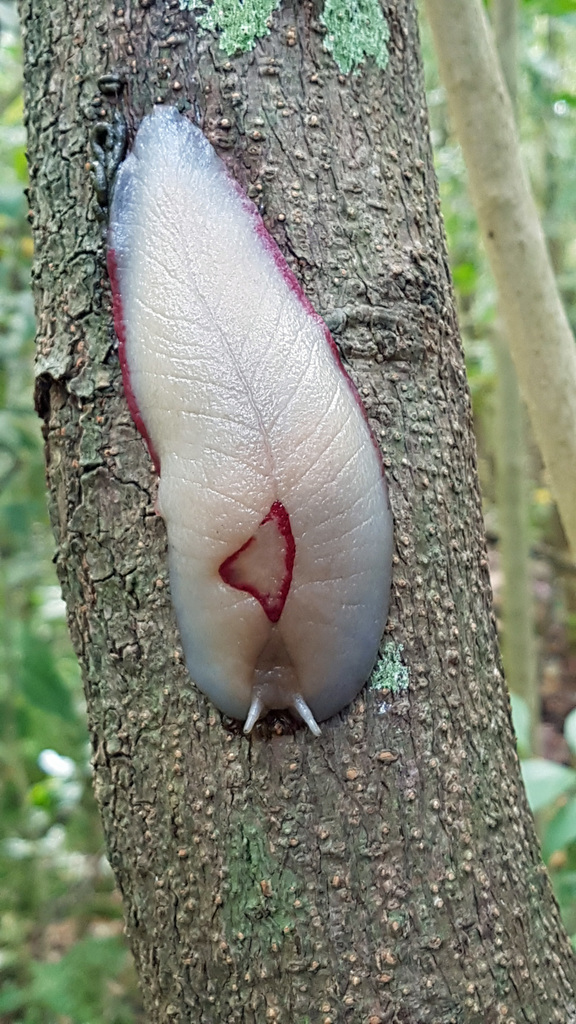
Red Triangle Slug
Triboniophorus graeffei
The red triangle slug, Triboniophorus graeffei, is a species of air-breathing land slug, a terrestrial pulmonate gastropod molluscs in the family Athoracophoridae, the leaf-veined slugs. Native to eastern Australia, this species is named after the distinctive red triangle marking on its back. Reaching lengths of up to 15 centimeters (about 6 inches), it is not only striking in appearance but also holds the title of Australia's largest native land slug. It is a familiar and widespread presence in its natural habitat.
Triboniophorus graeffei is the type species of its genus, Triboniophorus, the key representative of the group. A closely related and visually unique species of Triboniophorus has been identified from Mount Kaputar, though it has yet to be formally described.
From the article Red triangle slug on Wikipedia (CC BY-SA), quoted section by section
Description
Red triangle slugs are easily recognized by their two tentacles; unlike many other slugs, they do not have four. Like other leaf-vein slugs, they also have a distinctive indented pattern on their back that resembles the veins of a leaf. These slugs can grow up to 14 centimeters in length. They are highly variable in color. Individuals can appear white, off-white, yellow, light or dark grey, beige, pink, red, or olive green. Regardless of color, all adults display a red (sometimes orange, magenta, or maroon) triangular mark on the mantle around the breathing pore (pneumostome), as well as a red line along the edge of the foot. The texture of their backs can also differ: some are smooth, while others are rough. Juvenile slugs look quite different from the adults. They lack the red markings but instead have three dark grey stripes running down their backs and a grey outline around the triangular mantle shield. Scientists are currently studying whether some of these different color forms might actually belong to separate species or subspecies.
Range & habitat
This slug species is native to the east coast of Australia, where it ranges from New South Wales to Queensland. A closely related and brightly colored pink form, referred to as Triboniophorus aff. graeffei, is found only on Mount Kaputar in New South Wales. In 1959, malacologist Alan Solem suggested the species might have been introduced to the New Hebrides (now Vanuatu), although no specimens were available to confirm this at the time.
Wikipedia: “Distribution”
Where it lives
Recorded sightings
—
geo-referenced records in GBIF, from museums, herbaria and field observers.
Drag the globe to turn it. Dots are where records exist, not a range map; darker means more records.
In the stacks
Searching the stacks…
Every page naming Triboniophorus graeffei in the Biodiversity Heritage Library →
This page is assembled live from iNaturalist, GBIF, Wikipedia, the Source Library and the Internet Archive. It is not yet part of the hand-edited codex. iNaturalist taxon 369073.