On eBird ↗
Crested Pigeon
Live sightings near you, the range map, bar charts of when it is seen, and Macaulay Library photos and recordings.
Crested Pigeon
Ocyphaps lophotes
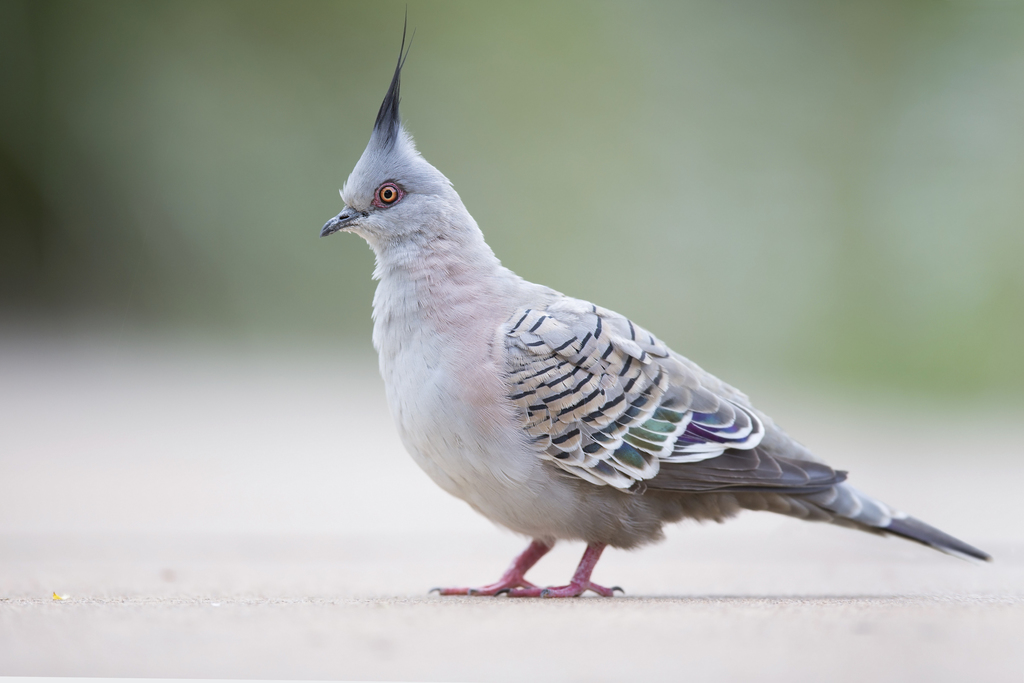
The crested pigeon (Ocyphaps lophotes) is a bird found widely throughout mainland Australia except for the far northern tropical areas. It is the only member of the genus Ocyphaps. Only two Australian pigeon species possess an erect crest, the crested pigeon and the spinifex pigeon. The crested pigeon is the larger of the two species. The crested pigeon is sometimes incorrectly referred to as a topknot pigeon, but the topknot pigeon, Lopholaimus antarcticus has a red-brown...
From the article Crested pigeon on Wikipedia (CC BY-SA), quoted section by section
Description
The length of the crested pigeon varies from 30 to 34 cm (12 to 13 in). Colouration is grey with tinges of brown, pink and green. It has a feathered, but slender, black spike on top of the head. It runs with the crest erect. The periorbital skin is bright orange. Wings have black stripes and are bronzed, while the primary feathers have iridescent areas of brown, purple, blue, and green. Immature birds have duller colours with no bronzing on the wings. The birds can be normally seen in two sizes, they can be thin or plumped. It is almost impossible to tell if a crested pigeon is male or female, because they have the same plumage. If startled, the crested pigeon takes to the air with a distinctive whistling 'call', the source of the noise can be attributed to the way the air rushes over a modified primary feather found on the wings.
Range & habitat
The crested pigeon is found in lightly wooded grasslands in both rural and urban areas, but they can also be seen at watercourses, homestead gardens, pastoral areas, sports grounds, and golf courses. Their habitat has expanded rapidly since settlement has produced pastoral lands (previously they were only found in inland and Western Australia). Foraging for grains, they have adapted to grain farming areas, often feeding on the noxious weed of Echium plantagineum.
Wikipedia: “Distribution and habitat”
What it does
Their most distinctive behaviour is the beating and whistling sound their wings make when they take off. This is most likely to draw the attention of predators to birds on the wing, and away from any birds remaining on the ground, and as an alarm call to other pigeons. When the birds land, their tails tilt upwards and the flight patterns are similar to those of the spotted turtle dove. They can be highly social and tend to be seen in flocks of varying sizes. They are highly gregarious birds when in contact with humans.
Breeding. While they breed throughout the year, it is more common in the warmer months. Males approach females and begin an elaborate mating dance; they bob their bodies up and down, while opening and closing their wings like a fan with each bob. This is accompanied by a soft hooting which is timed with the bobbing. If the female is interested, she remains generally stationary as the male approaches, until copulation is attempted. Bird nest Nesting usually occurs in shrubs or trees. Nests usually consist of a platform of twigs. They lay two oval, white, glossy eggs. The eggs usually hatch 3 weeks after they were laid. Both parents incubate the eggs.
Wikipedia: “Behaviour”
Listen
Looking for field recordings…
Where it lives
Recorded sightings
—
geo-referenced records in GBIF, from museums, herbaria and field observers.
Drag the globe to turn it. Dots are where records exist, not a range map; darker means more records.
In the stacks
Searching the stacks…
Every page naming Ocyphaps lophotes in the Biodiversity Heritage Library →
This page is assembled live from iNaturalist, GBIF, Wikipedia, the Source Library and the Internet Archive. It is not yet part of the hand-edited codex. iNaturalist taxon 3681.