On eBird ↗
Great Barbet
Live sightings near you, the range map, bar charts of when it is seen, and Macaulay Library photos and recordings.
Great Barbet
Psilopogon virens
The great barbet (Psilopogon virens) is an Asian barbet native to the Indian sub-continent and Southeast Asia, where it inhabits forests up to 3,000 m (9,800 ft) altitude. It has been listed as Least Concern on the IUCN Red List since 2004 because of its wide distribution.
From the article Great barbet on Wikipedia (CC BY-SA), quoted section by section
Description
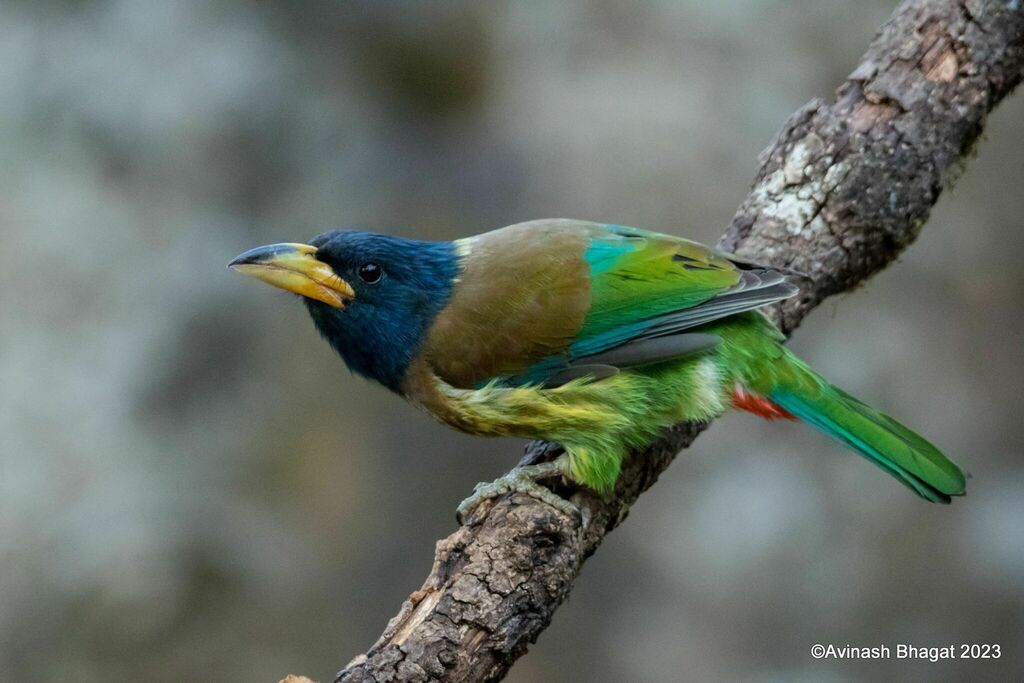
The great barbet has a blue head, large yellow bill, brown and green-streaked body, belly and a red vent. The plumage is green. It is the largest barbet species with a body length of 32–35 cm (13–14 in) and a weight of 192–295 g (6.8–10.4 oz).
Range & habitat
The great barbet is a resident breeder in the lower-to-middle altitudes of the Himalayas, ranging across northern Pakistan, India, Nepal and Bhutan, Bangladesh and some parts of Southeast Asia, as far away as Laos.
Wikipedia: “Distribution and habitat”
What it does
The great barbet's nesting season is from April to July. It typically builds nests in tree holes. Both male and females take care of the young. Its diet consists mainly of fruits and insects. The male's territorial call is a very loud kay-oh. The alarm is a harsh keeab, and another call is a repetitive piou-piou-piou-piou.
Wikipedia: “Behaviour and ecology”
Listen
Looking for field recordings…
Where it lives
Recorded sightings
—
geo-referenced records in GBIF, from museums, herbaria and field observers.
Drag the globe to turn it. Dots are where records exist, not a range map; darker means more records.
In the stacks
Searching the stacks…
Every page naming Psilopogon virens in the Biodiversity Heritage Library →
This page is assembled live from iNaturalist, GBIF, Wikipedia, the Source Library and the Internet Archive. It is not yet part of the hand-edited codex. iNaturalist taxon 367525.