On eBird ↗
Chiriqui Quail-Dove
Live sightings near you, the range map, bar charts of when it is seen, and Macaulay Library photos and recordings.
Chiriqui Quail-Dove
Zentrygon chiriquensis
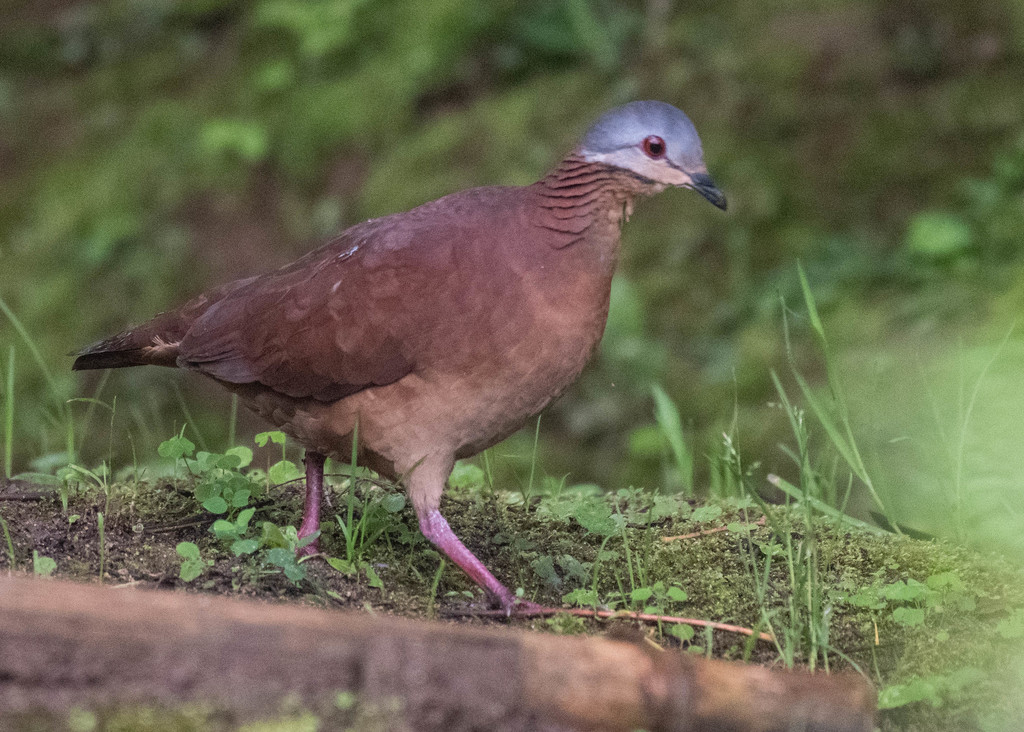
The Chiriquí quail-dove or rufous-breasted quail-dove (Zentrygon chiriquensis) is a species of bird in the family Columbidae found in Costa Rica and Panama. Its natural habitat is subtropical or tropical moist montane forests.
From the article Chiriqui quail-dove on Wikipedia (CC BY-SA), quoted section by section
Description
The male Chiriqui quail-dove is 27 to 31 cm (11 to 12 in) long and the female 26 to 32 cm (10 to 13 in). Adults weigh between 295 and 308 g (10.4 and 10.9 oz). The adult male has a slate gray crown that is paler on the forehead and darker on the nape. The rest of the face is buffy with a black malar stripe and a thin black line through the eye. The eye is brownish orange surrounded by bare red skin. The upperparts transition from chestnut on the shoulders through purplish on the upper back to olivaceous with a greenish gloss on the lower back. The chin is buffy white that darkens to reddish on the chest and sides and then lightens to cinnamon buff on the belly; the flanks are a darker cinnamon. Females are very similar, but their breast is usually darker. Juveniles have a brown crown and upperparts and the underparts have dull black bars.
Range & habitat
The Chiriqui quail-dove is resident from the Cordillera de Guanacaste in northern Costa Rica to Chiriquí and Veraguas Provinces in western Panama. It inhabits the understory of drier parts of the Talamancan montane forests. On the Caribbean side it generally ranges from 600 to 1,700 m (2,000 to 5,600 ft) but can be found locally as high as 2,000 m (6,600 ft). On the Pacific side it usually ranges between 1,000 and 2,500 m (3,300 and 8,200 ft) and occasionally up to 3,100 m (10,200 ft).
Wikipedia: “Distribution and habitat”
What it does
The Chiriqui quail-dove forages on the ground, singly or in pairs. Its diet is seeds, fallen fruit, and small invertebrates. It usually feeds in cover but can be seen along roads and trails in early morning.
Wikipedia: “Feeding”
Listen
Looking for field recordings…
Where it lives
Recorded sightings
—
geo-referenced records in GBIF, from museums, herbaria and field observers.
Drag the globe to turn it. Dots are where records exist, not a range map; darker means more records.
In the stacks
Searching the stacks…
Every page naming Zentrygon chiriquensis in the Biodiversity Heritage Library →
This page is assembled live from iNaturalist, GBIF, Wikipedia, the Source Library and the Internet Archive. It is not yet part of the hand-edited codex. iNaturalist taxon 367490.