On eBird ↗
Tuamotu Sandpiper
Live sightings near you, the range map, bar charts of when it is seen, and Macaulay Library photos and recordings.
Tuamotu Sandpiper
Prosobonia parvirostris
The Tuamotu sandpiper (Prosobonia parvirostris) is an endangered member of the large wader family Scolopacidae, that is endemic to the Tuamotu Islands in French Polynesia. It is sometimes placed in the monotypic genus Aechmorhynchus. A native name, apparently in the Tuamotuan language, is kivi-kivi.
From the article Tuamotu sandpiper on Wikipedia (CC BY-SA), quoted section by section
Description
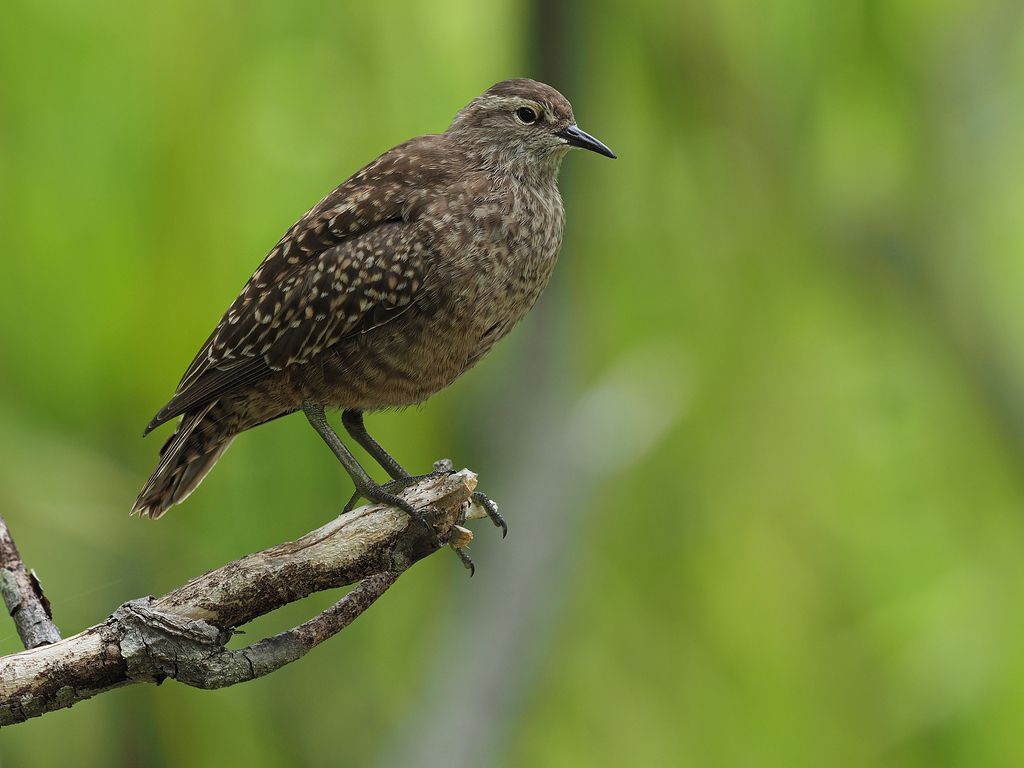
The 15.5–16.5 cm (6.1–6.5 in) long Tuamotu sandpiper is a small, short-winged, mottled brown bird with more or less barred underparts. Its short sharp beak is more like that of an insectivorous passerine than a wader. There are two colour morphs which intergrade. Pale birds are medium brown above and white below, with light barring or spotting on the breast and whitish streaking on the head. The bold supercilium and the chin are also white. The rectrices are brown with white tips and white triangular markings on the outer webs. Dark phase birds replace medium with darker brown and white with light buff or tawny white. The flanks are brown, and the entire underparts are heavily barred that colour. The iris is brown, the beak is blackish and the legs and feet are dirty yellow to dark olive grey; the toes are not webbed. Females and males are alike, the former having a tendency to be slightly larger and paler on average.
Range & habitat
The species has been recorded in modern times from the following atolls, listed from northwest to southeast:
Rangiroa, Niau, Kauehi and Fakarava in the Palliser Islands. Raraka, Katiu, Tahanea, Tuanake, Hiti and Tepoto (Ofiti) in the Raeffsky Islands, Puka-Puka in the Disappointment Islands, Anuanuraro in the Duke of Gloucester Islands, Nukutavake and Pinaki between Raeffsky and Acteon Islands, Tenararo, Vahanga, Tenarunga, Matureivavao, Marutea Sud and Maria Est in (or near) the Acteon Islands, Morane, south of the Acteon group, and Makaroa, Kamaka and Manui in the Gambier Islands.
Wikipedia: “Distribution”
What it does
This bird lives on undisturbed atolls where it feeds in open areas, including the shores and beaches, and scrubland; it is more rarely found in Pandanus thickets. It takes insects such as ants, leafhoppers and wasps in the coral rubble and leaf litter, also taking some vegetation. The call is a soft, high whistle or piping, transcribed as meh by the Whitney South Seas Expedition. It breeds at different times on different islands, generally between April and June. Nests are placed on the lagoon shore and consist of nothing more than a slight hollow in the shoreline coral and shell debris which is lined with grass stems or similar vegetable matter. The clutch is believed to be two eggs, which are white with purple and violet blotches, similar to a smaller version of the upland sandpiper's eggs. One two-egg clutch is in the American Museum of Natural History collection (specimen AMNH 5299).
Wikipedia: “Ecology and behavior”
Listen
Looking for field recordings…
Where it lives
Recorded sightings
—
geo-referenced records in GBIF, from museums, herbaria and field observers.
Drag the globe to turn it. Dots are where records exist, not a range map; darker means more records.
In the stacks
Searching the stacks…
Every page naming Prosobonia parvirostris in the Biodiversity Heritage Library →
This page is assembled live from iNaturalist, GBIF, Wikipedia, the Source Library and the Internet Archive. It is not yet part of the hand-edited codex. iNaturalist taxon 367478.