- Animals
- ›Chordates
- ›Vertebrates
- ›Reptiles
- ›Snakes and Lizards
- ›Lizards
- ›Iguanas and Allies
- ›Iguanas, Anoles, and Allies
- ›Anoles
- ›Anolis
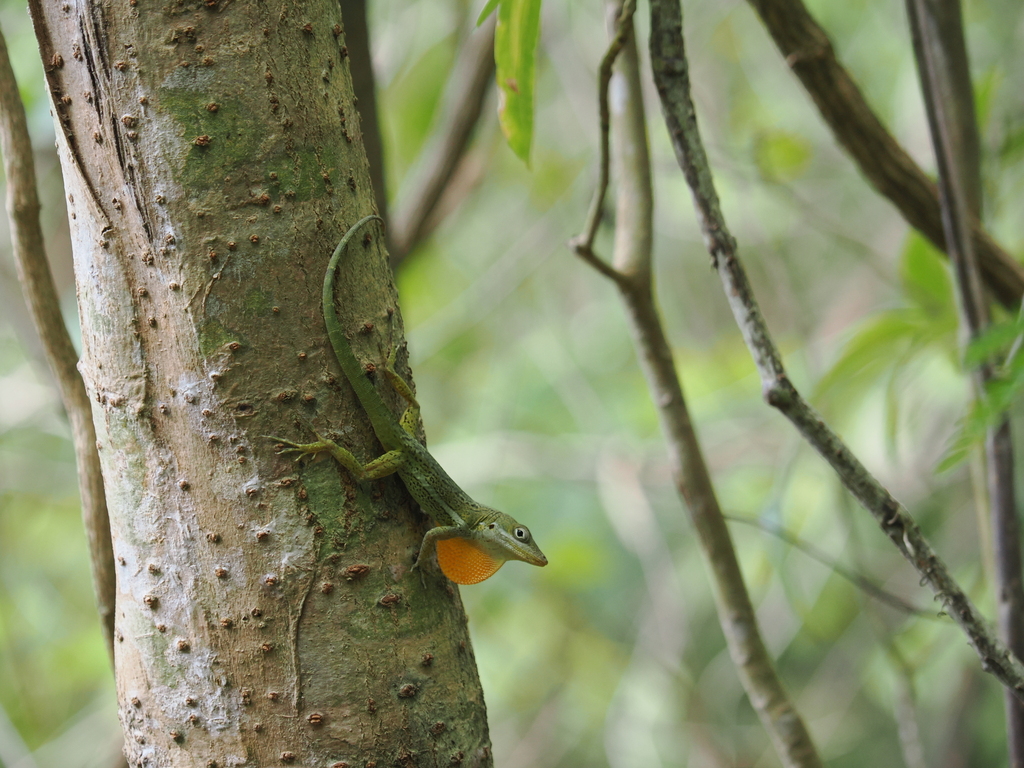
Anguilla Anole
Anolis gingivinus
Anolis gingivinus, also known as the Anguilla Bank tree anole, Anguilla bank anole, and Anguilla anole, is a species of lizard belonging to the family Dactyloidae, the anoles. This species is endemic to the Caribbean Lesser Antilles islands of Anguilla and its satellites, such as Saint Martin, and Saint Barthélemy.
From the article Anolis gingivinus on Wikipedia (CC BY-SA), quoted section by section
Description
Anolis gingivinus males have an average SVL of 72 mm (2.8 in) while in females it is around 53 mm (2.1 in). The overall colour is olive to light grey with a vivid orange chinflap with bold stripes along the back, becoming paler on the sides. They sometimes have green on their lower bodies and males may show dark marbled spotting along the body.
Range & habitat
Anolis gingivinus is found in the northern Lesser Antilles on Anguilla, Saint Barthélemy, Saint Martin and Sint Maarten, as well as their satellite islands. Anguilla Bank tree anole is a highly adaptable lizard and can be found in mesic to xeric habitats such as woods, coastal scrub, and overgrown fields, living in trees and on the ground. It is not found in grassland, and, as a result, its shows a localised distribution on Sint Maarten/St. Maarten and St. Barthélemy.
Wikipedia: “Distribution and habitat”
What it does
Anolis gingivinus is widespread and common on Anguilla and many of its satellites, though it is heavily preyed on there by American kestrels. It was the only anole species on Anguilla and throughout most of its range, until the recent introduction to Anguilla of A. carolinensis. A. gingivinus coexists on Saint Martin with A. pogus. Their distribution there does not completely overlap, and where they are both found they appear to fill different niches, for example by A. gingivinus preferring higher and more exposed perches.
Wikipedia: “Ecology”
In human culture
Anolis gingivinus has its specific name gingivinus which is Latin for "pertaining to the gums", Cope did not explain whu he chose this epithet, nor is it evident.
Wikipedia: “Etymology”
Where it lives
Recorded sightings
—
geo-referenced records in GBIF, from museums, herbaria and field observers.
Drag the globe to turn it. Dots are where records exist, not a range map; darker means more records.
In the stacks
Searching the stacks…
Every page naming Anolis gingivinus in the Biodiversity Heritage Library →
This page is assembled live from iNaturalist, GBIF, Wikipedia, the Source Library and the Internet Archive. It is not yet part of the hand-edited codex. iNaturalist taxon 36432.