- Animals
- ›Chordates
- ›Vertebrates
- ›Reptiles
- ›Snakes and Lizards
- ›Lizards
- ›Iguanas and Allies
- ›Iguanas, Anoles, and Allies
- ›Anoles
- ›Anolis
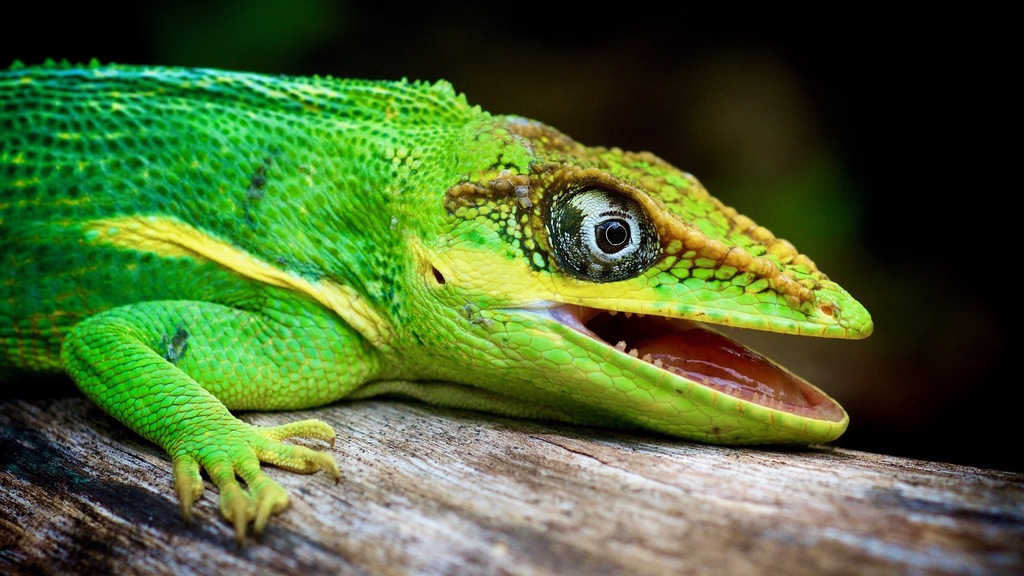
Knight Anole
Anolis equestris
The knight anole (Anolis equestris) is the largest species of anole (US: ) in the Dactyloidae family. Other common names include Cuban knight anole or Cuban giant anole, highlighting its native country, but it has also been introduced to Florida. In its native Cuba, this large anole is called chipojo or chupacocote.
From the article Knight anole on Wikipedia (CC BY-SA), quoted section by section
Description
Adult knight anoles are about 13–20 in (33–51 cm) in total length, including their tail that is longer than the head-and-body, and weigh 0.56–4.83 oz (16–137 g). Males grow larger than females, with adults of the former having a snout–vent length of 3.9–7.5 in (10–19 cm) and the latter 3.5–6.3 in (9–16 cm). It is mostly bright green with a yellow stripe on the side of the head and another on the shoulder, but it is able to perform some color changes. It has a pinkish-white dewlap. Juveniles have light bands on the body.
Range & habitat
Knight anoles are native to Cuba, but have been widely introduced into South Florida, where they reproduce and spread readily as an invasive species. The original introduction to Florida occurred in 1952 on the campus of the University of Miami in Coral Gables. They cannot withstand cold temperatures; in winter freezes in Florida, they have been known to fall to the ground from tree canopies, similarly to the green iguana. In highland parts of its native Cuba, a few individuals may rest adjacent to each other during the relatively cold winters (otherwise the species is solitary and highly territorial). In Cuba they can be seen from near sea level to an altitude of 3,300 ft (1,000 m) in a wide range of habitats with trees, such as forest, mangrove, savanna, cultivated areas and gardens. In its introduced Florida range it even occurs in trees along roads in Miami. Knight anoles are arboreal, mostly found high in trees on the trunk or branches in the canopy, but will descend to the ground to get from one tree to another, or for thermoregulation, when occasionally seen on warm asphalt, rocks, or sidewalks.
Wikipedia: “Distribution and habitat”
What it does
Knight anoles are diurnal and fiercely territorial. Initially they turn to face almost any perceived threat, if only from a distance. During its challenge display, a lizard will sit high on all fours, gape menacingly, turn green, and perhaps bob its head. The male will extend its dewlap, and both females and males will "puff themselves up" with air.
Wikipedia: “Behavior”
Where it lives
Recorded sightings
—
geo-referenced records in GBIF, from museums, herbaria and field observers.
Drag the globe to turn it. Dots are where records exist, not a range map; darker means more records.
In the stacks
Searching the stacks…
Every page naming Anolis equestris in the Biodiversity Heritage Library →
This page is assembled live from iNaturalist, GBIF, Wikipedia, the Source Library and the Internet Archive. It is not yet part of the hand-edited codex. iNaturalist taxon 36391.