- Fungi Including Lichens
- ›Basidiomycete Fungi
- ›Higher Basidiomycetes
- ›Mushrooms, Bracket Fungi, Puffballs, and Allies
- ›Agaricomycetidae
- ›Common Gilled Mushrooms and Allies
- ›Hygrophorineae
- ›Waxcaps and Allies
- ›Hygrocyboideae
- ›Hygrocybeae
- ›Hygrocybe
- ›Pseudohygrocybe
- ›Coccineae
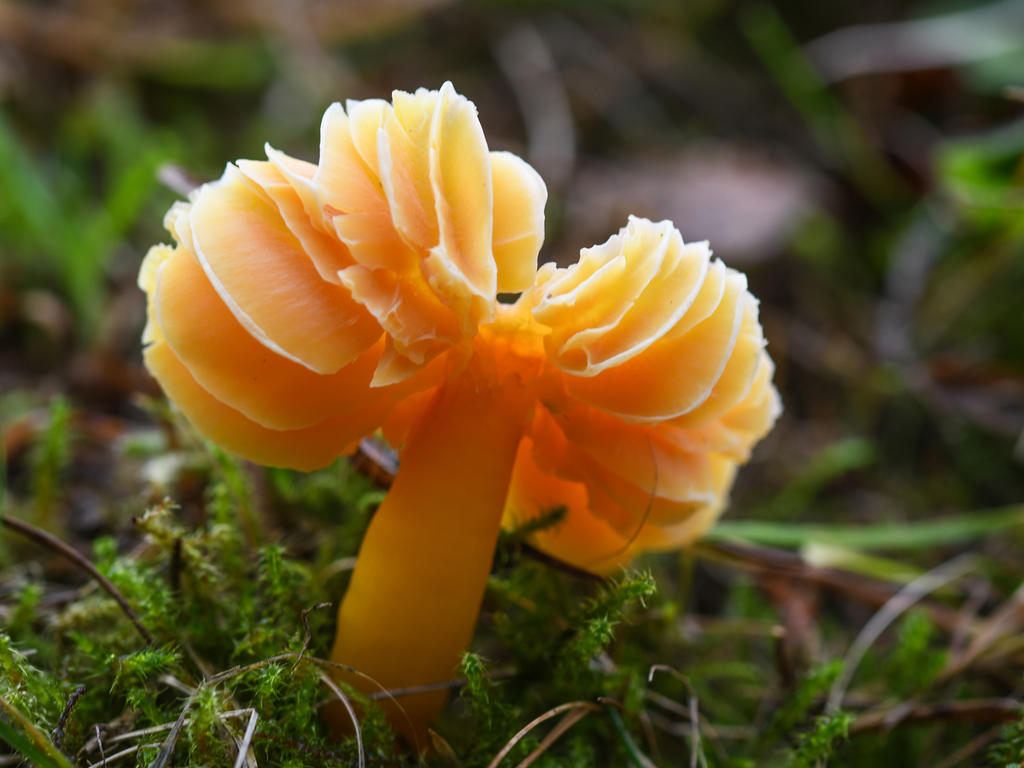
Oily Waxcap
Hygrocybe quieta
Hygrocybe quieta is a species of agaric (gilled mushroom) in the family Hygrophoraceae. It has been given the recommended English name of oily waxcap in the UK. The species has a European distribution and typically occurs in grassland where it produces basidiocarps (fruit bodies) in the autumn. Threats to its habitat have resulted in the species being assessed as globally "vulnerable" on the IUCN Red List of Threatened Species.
From the article Hygrocybe quieta on Wikipedia (CC BY-SA), quoted section by section
Description
The basidiocarps are agaricoid, up to 10 cm (4 in) tall, the cap convex at first (never conical), becoming shallowly convex to flat when expanded, up to 7.5 cm (3 in) across. The cap surface is smooth, dry to slightly greasy when damp, bright yellow to orange-yellow becoming duller with age and sometimes developing a greyish sheen. The lamellae (gills) are waxy, yellow-orange to orange, rather widely spaced and broadly attached to the stipe. The stipe (stem) is smooth, cylindrical, often compressed and grooved, and cap-coloured. The spore print is white, the spores (under a microscope) smooth, inamyloid, ellipsoid to oblong, often constricted in the middle, about 7.5 to 9.0 by 4.0 to 5 μm. When fruitbodies are cut or rubbed, they release a distinctive, oily smell, said to resemble that of pentatomid insects.
Similar species. Several other waxcaps are similarly coloured, but the widely spaced, orange gills of H. quieta are distinctive and the oily smell is diagnostic.
Range & habitat
The oily waxcap is widespread throughout Europe, where it typically grows in old, unimproved, short-sward grassland (pastures and lawns). Recent research suggests waxcaps are neither mycorrhizal nor saprotrophic but may be associated with mosses.
Wikipedia: “Distribution and habitat”
Where it lives
Recorded sightings
—
geo-referenced records in GBIF, from museums, herbaria and field observers.
Drag the globe to turn it. Dots are where records exist, not a range map; darker means more records.
In the stacks
Searching the stacks…
Every page naming Hygrocybe quieta in the Biodiversity Heritage Library →
This page is assembled live from iNaturalist, GBIF, Wikipedia, the Source Library and the Internet Archive. It is not yet part of the hand-edited codex. iNaturalist taxon 363620.