- Fungi Including Lichens
- ›Basidiomycete Fungi
- ›Higher Basidiomycetes
- ›Mushrooms, Bracket Fungi, Puffballs, and Allies
- ›Agaricomycetidae
- ›boletes and allies
- ›Suillineae
- ›Suillaceae
- ›Suillus
- ›Suillus
- ›Suillus
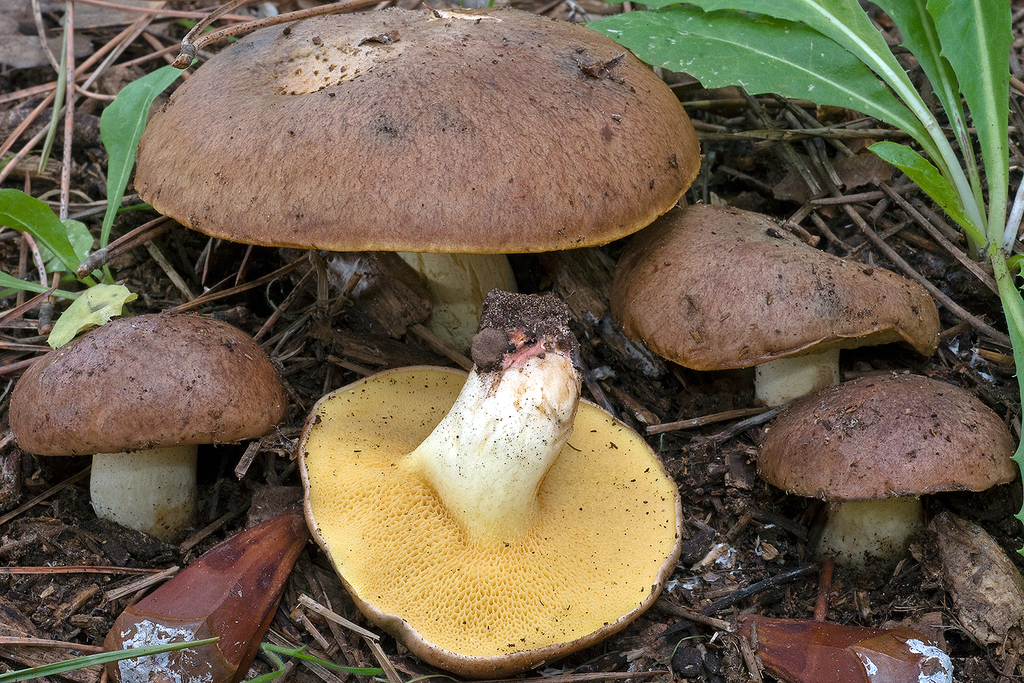
Suillus collinitus
Suillus collinitus is a pored mushroom of the genus Suillus in the family Suillaceae. It is an edible mushroom found in European pine forests. The mushroom has a reddish to chestnut-brown cap that reaches up to 11 cm (4.3 in) in diameter, and a yellow stem measuring up to 7 cm (2.8 in) tall by 1 to 2 cm (0.4 to 0.8 in) thick. On the underside of the cap are small angular pores, initially bright yellow before turning greenish-brown with age. A characteristic feature that helps to distinguish it from similar Suillus species, such as S. granulatus, is the pinkish mycelia at the base of the stem.
Molecular analysis has shown the species to be related to other typical Mediterranean Suillus species such as S. bellinii, S. luteus, and S. mediterraneensis. S. collinitus is a mycorrhizal species, and forms associations with several species of pine, most notably the Aleppo pine. This tree species is commonly used in reforestation schemes and soil conservation against erosion in the Mediterranean region, and S. collinitus is often used as a beneficial inoculant to help the young trees better survive in typically harsh soil conditions.
From the article Suillus collinitus on Wikipedia (CC BY-SA), quoted section by section
Description
The fruit body of Suillus collinitus is a medium to large, fleshy bolete. The cap is initially rounded, becoming convex and finally flat, reaching up to 11 cm (4.3 in) in diameter. The cap is covered with a brown cuticle of variable shade that is decorated with minuscule radial striations, which become more obvious in fully expanded specimens and especially in dry weather. The cap is often shaped irregularly and becomes viscid (sticky) when damp. The tubes are short and their stem attachment is usually slightly decurrent to adnate. The small and angular pores are yellow but darken with age. Young, fresh specimens sometimes bear droplets of a clear fluid that collect on the pore surface. The cylindrical stem is often short and stubby, typically 4–7 cm (1.6–2.8 in) tall by 1–2 cm (0.4–0.8 in) thick, coloured yellowish and ornamented with sparse reddish-brown granules. There is no ring. The base of the stem bears pink overtones and is attached to distinctively pink mycelial threads, which are visible when the fruit body is uprooted. The flesh is yellowish, thick and soft. In a colour reaction test with ammonia solution, the flesh turns reddish. The spores are seen ochre-brown in mass, but pale yellow when viewed with a light microscope. They are fusiform (tapered at each end), sized 8–10.5 by 3–4.5 μm. …
Range & habitat
Suillus collinitus is found throughout Europe. It is an ectomycorrhizal fungus, forming mutually beneficial symbiotic relationships with several species of pine (Pinus). These include several two-needled European species of pine: Aleppo pine (P. halepensis) European black pine (P. nigra), stone pine (P. pinea), and Scots pine (P. sylvestris). The fungus favours limestone soils. S. collinitus is thermophilic, commonly occurring in southern Europe. It is rarely seen in more northern regions, such as the British Isles and Poland. It is red-listed in Denmark as near-threatened, and in Estonia as endangered. It has also been collected in Iran. The mushroom was reported in the municipality of Paipa, in the department of Boyaca, in Colombia. It was reported by mycologyst Juan Camilo Rodríguez Martínez.
Suillus collinitus is the most frequent fungus associating with Aleppo pine – a hardy tree utilised for reforestation schemes and soil conservation against erosion in the Mediterranean region. A study performed in the south of France discovered that S. collinitus and S. mediterraneensis are multi-stage ectomycorrhizal fungi, associating with both young and mature stands of Aleppo pine. These two species may play a key role in the survival and adaptation of this species of pine on disturbed calcareous sites. Roots mycorrhizal with S. …
Wikipedia: “Distribution, habitat, and ecology”
Where it lives
Recorded sightings
—
geo-referenced records in GBIF, from museums, herbaria and field observers.
Drag the globe to turn it. Dots are where records exist, not a range map; darker means more records.
In the stacks
Searching the stacks…
Every page naming Suillus collinitus in the Biodiversity Heritage Library →
This page is assembled live from iNaturalist, GBIF, Wikipedia, the Source Library and the Internet Archive. It is not yet part of the hand-edited codex. iNaturalist taxon 363592.