- Animals
- ›Chordates
- ›Vertebrates
- ›Reptiles
- ›Snakes and Lizards
- ›Lizards
- ›Iguanas and Allies
- ›Iguanas, Anoles, and Allies
- ›Phrynosomatid Lizards
- ›Phrynosomatine Lizards
- ›Uma
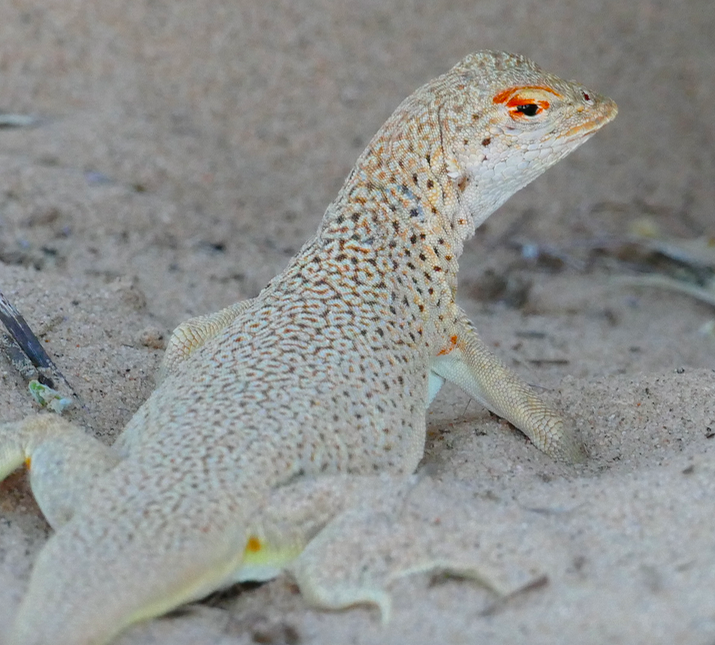
Mojave Fringe-toed Lizard
Uma scoparia
The Mojave fringe-toed lizard (Uma scoparia) is a species of medium-sized, white or grayish, black-spotted diurnal lizard in the subfamily Phrynosomatinae. It is adapted to living in sand dunes in the Mojave Desert. It ranges from Los Angeles County, Riverside County, and San Bernardino County in California to extreme western Arizona in La Paz County. The Mojave fringe-toed lizard is omnivorous.
From the article Mojave fringe-toed lizard on Wikipedia (CC BY-SA), quoted section by section
Description
The Mojave fringe-toed lizard is a flat-bodied lizard with smooth skin. Like other members of the Uma genus, they also have prominent elongated scales which form a fringe on the sides of their hind toes..
The color of its skin resembles the environment it inhabits, ranging from a tannish white to a grayish white, and likely contains small black spots along its back. On its underside, there are up to three crescent-shaped throat markings which are characteristic of the Mojave fringe-toed lizard. Also characteristic of this species are the dark bands on its tail and dark blotches on the sides of its belly. During breeding season, the dark spots on its belly-sides turn pink, and its underside turns pale-yellow. The length of this lizard's tail matches the length of its body, with the whole organism reaching lengths of around 7 inches long. The males are protective of their territory, as they walk the perimeter of their of their home and exhibit assertion displays. These displays are associated with reproduction rather than resource protection. Females are not seen to protect their territory, but rather exhibit territoriality over a specific site.
Range & habitat
The Mojave fringe-toed lizard's range extends from Inyo County, Los Angeles County, Riverside County, and San Bernardino County in California to western Arizona in La Paz County. Most are restricted to areas which have fine sand, dry lake beds, desert washes, and hillsides. The elevational range of their habitat is from sea level up to 3000 ft.
Wikipedia: “Geographic range”
What it does
The adult form typically hibernates from November to February by burying itself around a foot below the sand. Juveniles hibernate much closer to the surface, but some don't hibernate at all and are active throughout the whole year. During March and April, this species of lizard is active for fewer hours in comparison to its close Uma relatives due to the cooler temperature of the Mojave desert. The Mojave fringe-toed lizard reaches sexual maturity during its second year, and its mating season is around late spring. The amount of rainfall influences the breeding capacity of the lizard, and females typically lay 1-5 eggs per mating season with an average of 2-3 eggs, hatching in September. There is no seasonal migration in this species. The lizards likely bury their eggs in the sand similar to other lizard species. More young are produced after wet winters, likely due to the abundance of spring annual plants and insects.
Wikipedia: “Life cycle”
Where it lives
Recorded sightings
—
geo-referenced records in GBIF, from museums, herbaria and field observers.
Drag the globe to turn it. Dots are where records exist, not a range map; darker means more records.
In the stacks
Searching the stacks…
Every page naming Uma scoparia in the Biodiversity Heritage Library →
This page is assembled live from iNaturalist, GBIF, Wikipedia, the Source Library and the Internet Archive. It is not yet part of the hand-edited codex. iNaturalist taxon 36135.