- Animals
- ›Chordates
- ›Vertebrates
- ›Reptiles
- ›Snakes and Lizards
- ›Lizards
- ›Wall lizards, amphisbaenians, and allies
- ›Wall Lizards
- ›Lacertinae
- ›Algyroides
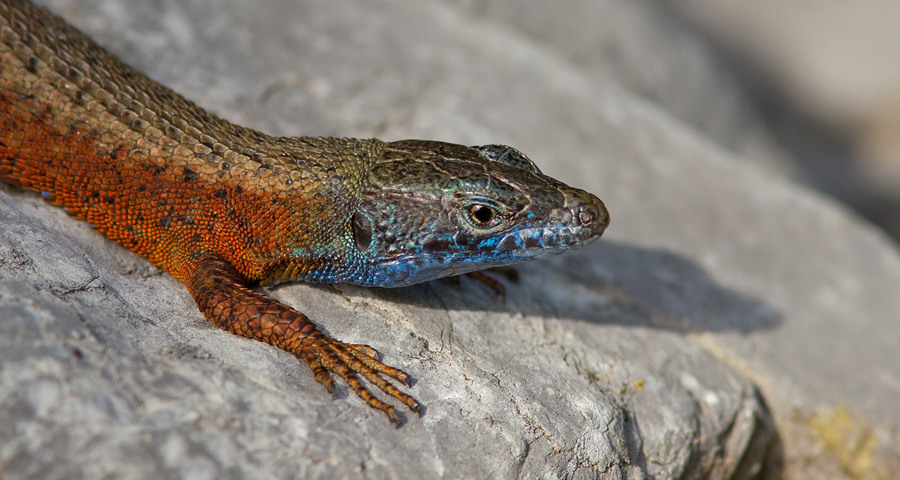
Blue-throated Keeled Lizard
Algyroides nigropunctatus
The blue-throated keeled lizard (Algyroides nigropunctatus), or Dalmatian algyroides, is a species of lizard in the family Lacertidae.
From the article Blue-throated keeled lizard on Wikipedia (CC BY-SA), quoted section by section
Description
The maximum total length (including tail) is 25 cm (9.8 in) which makes it significantly larger than any of the other Algyroides species. A. nigropunctatus can be recognized by the keeled V-shaped scales on the flanks, tail and back. It owes its common name to the bright blue throat of the males in the mating season. Sometimes also females get a blue throat that is less bright. The remainder of the body is light brown to rusty brown, the belly is white to yellowish. It owes its specific name, nigropunctatus, to the rows of black dots on the back. These dots are mostly missing in females outside the mating season.
Range & habitat
A. nigropunctatus is found in Italy and the Balkans. The natural habitats of A. nigropunctatus are Mediterranean-type shrubby vegetation, rocky areas, arable land, pastureland, plantations, rural gardens, and urban areas.
Wikipedia: “Distribution and habitat”
What it does
The food consists of insects, worms, and other small invertebrates. The blue-throated keeled lizard likes to climb. It is easily frightened and is not often kept in captivity due to its protected status. Only two or four eggs are laid, and it has been assumed that females can produce eggs both in early spring and early autumn. The males bite the females in the neck during mating and don't let go for quite some time, which is common for Algyroides lizards.
Wikipedia: “Behaviour and ecology”
Where it lives
Recorded sightings
—
geo-referenced records in GBIF, from museums, herbaria and field observers.
Drag the globe to turn it. Dots are where records exist, not a range map; darker means more records.
In the stacks
Searching the stacks…
Every page naming Algyroides nigropunctatus in the Biodiversity Heritage Library →
This page is assembled live from iNaturalist, GBIF, Wikipedia, the Source Library and the Internet Archive. It is not yet part of the hand-edited codex. iNaturalist taxon 36052.