- Animals
- ›Arthropods
- ›Chelicerates
- ›Arachnids
- ›Spiders
- ›Typical Spiders
- ›Entelegyne Spiders
- ›Orbweavers and Allies
- ›Orbweavers
- ›Typical Orbweavers
- ›Cyclosa
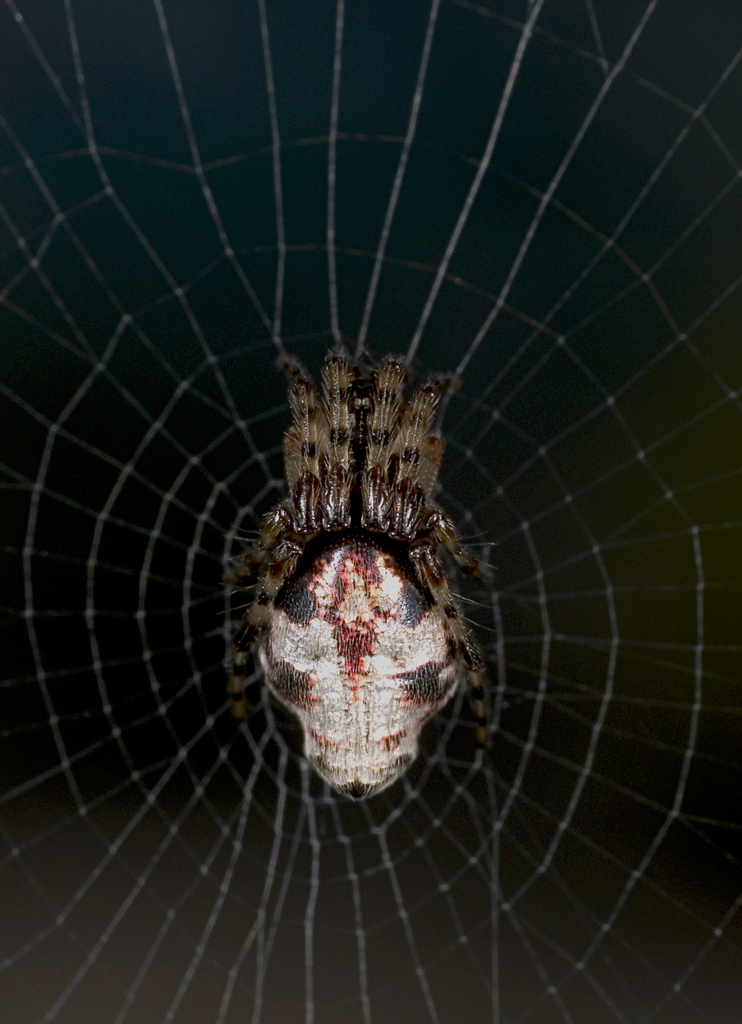
Cyclosa argenteoalba
Cyclosa argenteoalba is a species of trashline orbweaver in the spider family Araneidae. It is found in East Asia. C. argenteoalba is diurnal, which means it is active during the day. Spiders with less silver coloring are better at catching prey, as the silver is bright and warns their prey of their presence. They catch their prey by waiting in the hub of their web until their prey is close enough to catch. Females are on average 2mm longer in size than males. During mating, female genital mutilation is common in order to increase the fitness of the male. C. argenteoalba often attach silk "decorations" on their webs, which are thought to deter predators. C. argenteoalba frequently relocate to different places to build a new webs until a location with a significant amount of prey is found. Parasitic larvae are often found attached to C. argenteoalba, and the larvae are able to manipulate the spider's behavior.
From the article Cyclosa argenteoalba on Wikipedia (CC BY-SA), quoted section by section
Range & habitat
C. argenteoalba is found in China, Korea, Taiwan, Japan, and Russia. They are found in farmland, mountainous regions, and suburban areas, but are usually found on the edge of bamboo and wood forests where there is adequate sunlight.
Wikipedia: “Distribution and habitat”
What it does
C. argenteoalba usually produce two generations per year, but occasionally will produce three. Typically, they will reproduce in May, August, and sometimes October, and during these times their body mass is at its seasonal peak. After females have laid their eggs, their abdomens are noticeably smaller, which makes their reproduction easier to study. Females avoid laying eggs in their webs, instead opting to lay them in the surrounding area. Spiderlings will emerge from their egg sacs after about a month. Overwintering occurs as they mature, and then they begin building their webs in March. In comparison to other cyclosa species (C. octotuberculata and C. seduculata), C. argenteoalba have a rapid growth rate, a lower survival rate and a larger relative clutch size with smaller eggs. These characteristics lead to a larger investment in reproduction in order to counteract the lower survival rate of the species. C. argenteoalba also show a more prominent reduction in clutch size the second time they lay eggs in a year compared to the first.
Wikipedia: “Life cycle and reproduction”
Where it lives
Recorded sightings
—
geo-referenced records in GBIF, from museums, herbaria and field observers.
Drag the globe to turn it. Dots are where records exist, not a range map; darker means more records.
In the stacks
Searching the stacks…
Every page naming Cyclosa argenteoalba in the Biodiversity Heritage Library →
This page is assembled live from iNaturalist, GBIF, Wikipedia, the Source Library and the Internet Archive. It is not yet part of the hand-edited codex. iNaturalist taxon 360501.