- Animals
- ›Arthropods
- ›Chelicerates
- ›Arachnids
- ›Spiders
- ›Typical Spiders
- ›Entelegyne Spiders
- ›Salticoid Spiders
- ›Jumping Spiders
- ›Typical Jumping Spiders
- ›Chrysillini
- ›Phintella
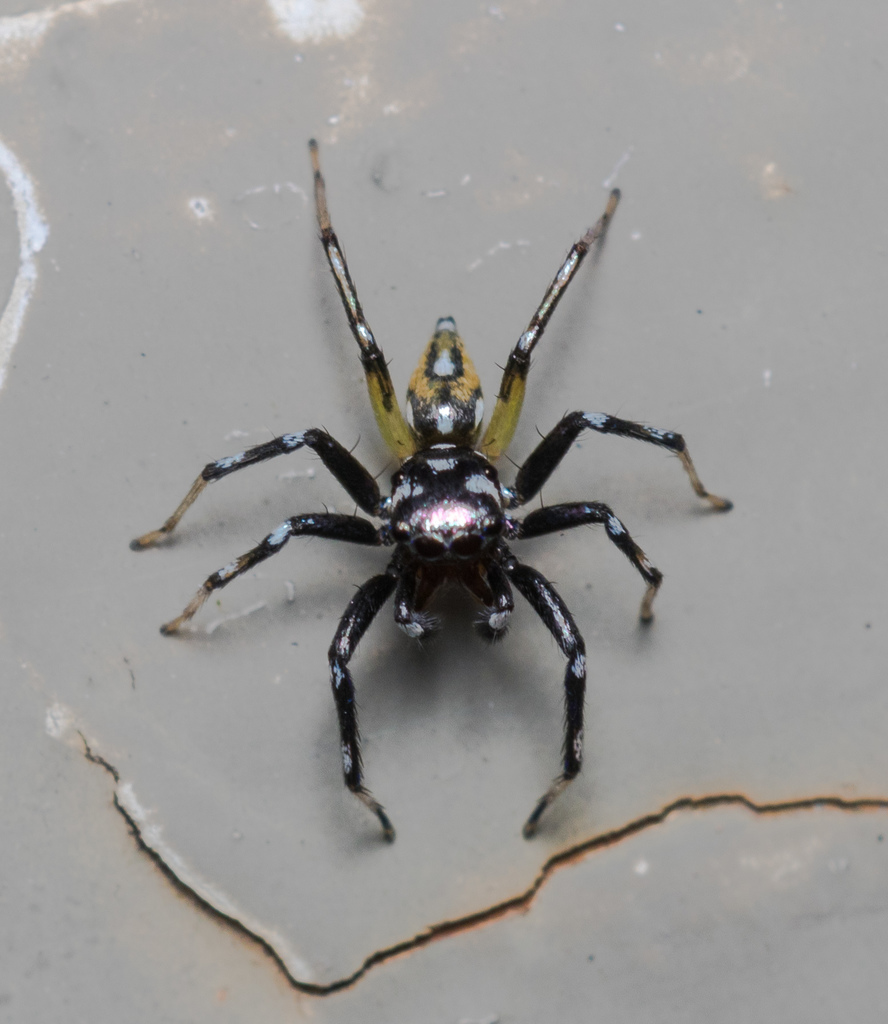
Phintella bifurcilinea
Phintella bifurcilinea is a species of jumping spider in the genus Phintella. Originally described by Bösenberg and Strand in 1906 as Telamonia bifurcilinea, it was transferred to the genus Phintella by Prószyński in 1983.
From the article Phintella bifurcilinea on Wikipedia (CC BY-SA), quoted section by section
Description
The species shows considerable sexual dimorphism, with females measuring approximately 5 mm in total length compared to 4 mm for males.
Female. The female has a relatively small, narrow cephalothorax with the head region dark brown to blackish-brown, marked with a broad white transverse band in front of the last pair of eyes. The thoracic region is dark brown with small white markings and a white-bordered margin. The sternum is blackish-brown or brownish-gray. The chelicerae are yellow with dark brown wedge-shaped markings covering most of the front surface. The maxillae are blackish on the outer side but yellow on the front and inner edges. The palpi are pure white, and the legs are yellowish-white with only the upper surface of the fourth coxae being black. The abdomen displays striking white markings on a dark brown to blackish-brown background. The ventral surface has blackish-brown sides with yellowish point stripes, and two broad grayish-white longitudinal stripes running down the middle that enclose a somewhat broader brown stripe. The epigyne is reddish-brown, and the spinnerets are blackish-gray with the upper ones being longer, thinner, and darker than the lower ones.
Male. In males, the white stripe in front of the last pair of eyes may be absent or barely indicated. …
Range & habitat
Ph. bifurcilinea is widely distributed across East Asia, with records from Korea, Japan, China, and Vietnam. The species was originally collected from Saga and the Yunohama mountains in Japan.
Wikipedia: “Distribution”
Where it lives
Recorded sightings
—
geo-referenced records in GBIF, from museums, herbaria and field observers.
Drag the globe to turn it. Dots are where records exist, not a range map; darker means more records.
In the stacks
Searching the stacks…
Every page naming Phintella bifurcilinea in the Biodiversity Heritage Library →
This page is assembled live from iNaturalist, GBIF, Wikipedia, the Source Library and the Internet Archive. It is not yet part of the hand-edited codex. iNaturalist taxon 360478.