- Fungi Including Lichens
- ›Basidiomycete Fungi
- ›Higher Basidiomycetes
- ›Mushrooms, Bracket Fungi, Puffballs, and Allies
- ›Auriculariales
- ›Auriculariaceae
- ›Auricularia
- ›Auricularia auricula-judae
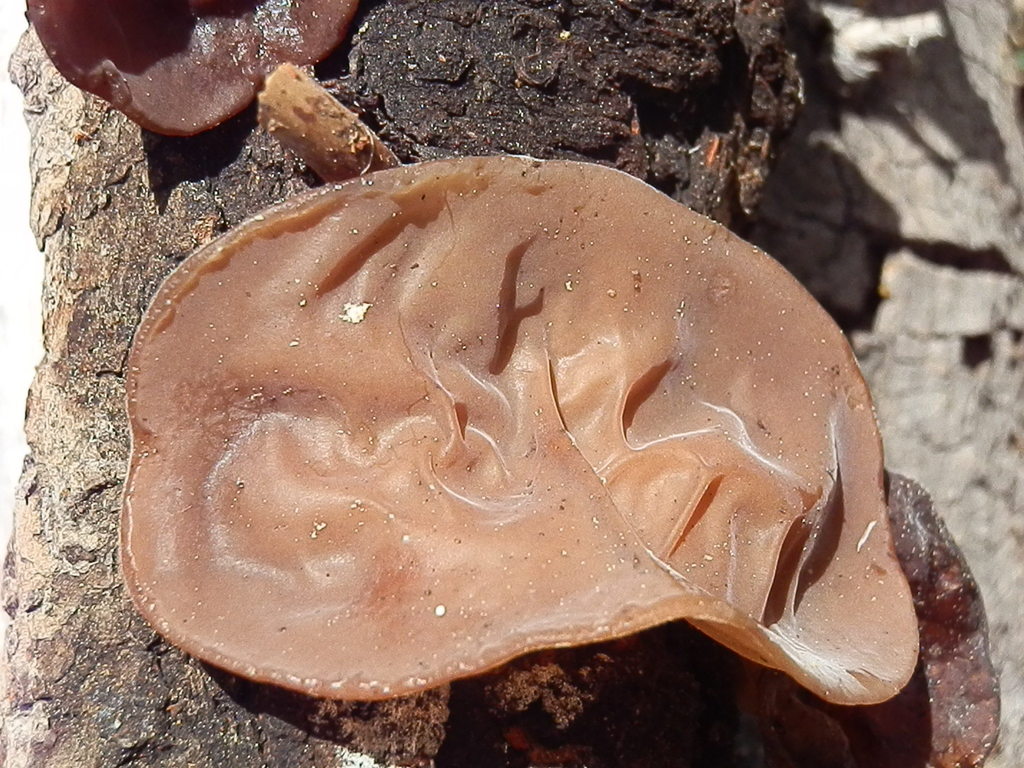
Jelly Tree Ear
Auricularia americana
Auricularia americana is a species of fungus in the family Auriculariaceae. Basidiocarps (fruitbodies} are gelatinous, ear-like, and grow on dead conifer wood. The species was formerly confused with Auricularia auricula-judae, which grows on broadleaf wood and is confined to Europe.
From the article Auricularia americana on Wikipedia (CC BY-SA), quoted section by section
Description
Auricularia americana forms thin, brown, rubbery-gelatinous fruit bodies that are ear-shaped and 2.5–10 centimetres (1–4 inches) across and about 3 millimetres (1⁄8 in) thick. The fruitbodies occur singly or in clusters. The upper surface is finely pilose. The spore-bearing underside is smooth. The spore print is white.
Microscopic characters. The microscopic characters are typical of the genus Auricularia. The basidia are tubular, laterally septate, 55–70 × 4–5 μm. The spores are allantoid (sausage-shaped), 14–16.5 × 4.5–5.5 μm.
Similar species. In North America, Auricularia angiospermarum is almost identical but grows on the wood of broadleaf trees. No other North American Auricularia species grows on conifer wood. In China and Tibet, however, a second species, A. tibetica, also occurs on conifers. It can be distinguished microscopically by its longer basidia and larger basidiospores. Additionally, A. nigricans, Exidia crenata, and Phylloscypha phyllogena are similar.
Range & habitat
Auricularia americana is a wood-rotting species, typically found on dead attached or fallen wood of conifers. It is widely distributed in North America (primarily in the Northeast, between April and September) and is also known from China and the Russian Far East.
== References ==
Wikipedia: “Habitat and distribution”
Where it lives
Recorded sightings
—
geo-referenced records in GBIF, from museums, herbaria and field observers.
Drag the globe to turn it. Dots are where records exist, not a range map; darker means more records.
In the stacks
Searching the stacks…
Every page naming Auricularia americana in the Biodiversity Heritage Library →
This page is assembled live from iNaturalist, GBIF, Wikipedia, the Source Library and the Internet Archive. It is not yet part of the hand-edited codex. iNaturalist taxon 356394.