- Animals
- ›Chordates
- ›Vertebrates
- ›Reptiles
- ›Snakes and Lizards
- ›Lizards
- ›Iguanas and Allies
- ›Iguanas, Anoles, and Allies
- ›Iguanas and Chuckwallas
- ›Dipsosaurus
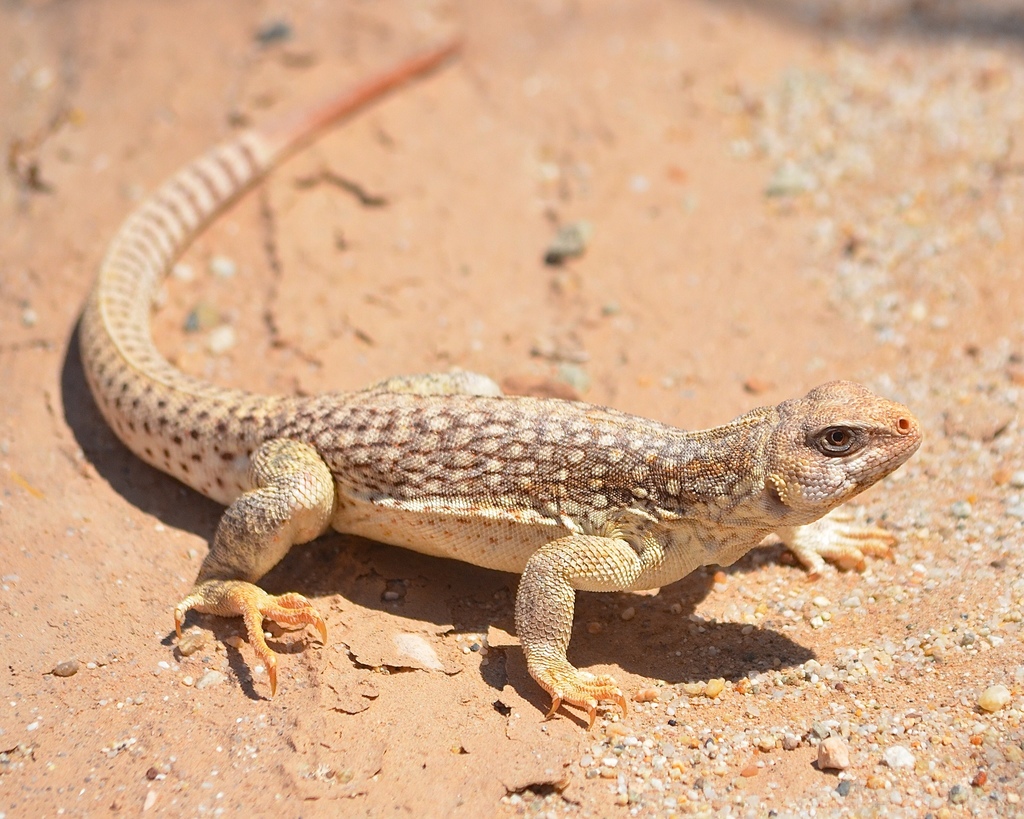
Desert Iguana
Dipsosaurus dorsalis
The desert iguana (Dipsosaurus dorsalis) is one of the most common lizards of the Sonoran and Mojave deserts of the southwestern United States and northwestern Mexico. They also occur on several Gulf of California islands. Their color is mostly grey and tan.
From the article Desert iguana on Wikipedia (CC BY-SA), quoted section by section
Description
The desert iguana is a medium-sized lizard which averages 41 cm (16 in) in total length, but can grow to a maximum of 61 cm (24 in) including the tail. They are pale gray-tan to cream in color with a light brown reticulated pattern on their backs and sides. Down the center of the back is a row of slightly enlarged, keeled dorsal scales that become slightly larger further down the back. The reticulated pattern gives way to brown spots near the back legs, turning into stripes along the tail. The tail is usually around 1+1⁄2 times longer than the body from snout to vent. The belly is pale. During the breeding season, the sides become pinkish in both genders.
Range & habitat
Their preferred habitat is largely contained within the range of the creosote bush, mainly dry, sandy desert scrubland below 1,000 m (3,300 ft). They have a significant presence in the Sonoran and Mojave deserts. They can also be found in rocky streambeds up to 1,000 m. In the southern portion of its range, these lizards live in areas of arid subtropical scrub and tropical deciduous forest. These lizards can withstand high temperatures and are out and about after other lizards have retreated into their burrows. They seek shade when their body temperature is in the low-forties (Celsius), and seek the protection of a burrow when their body temperature reaches the mid-forties (Celsius). They burrow extensively and if threatened will scamper into a shrub and go quickly down a burrow. Their burrows are usually dug in the sand under bushes like the creosote. They also often use burrows of kit foxes and desert tortoises. Reproduction also plays a role in where these lizards are found. It is believed that the high temperature environment helps with successful hatching of eggs. The eggs often hatch between temperatures of 28 and 38 degrees Celsius.
Wikipedia: “Habitat”
What it does
Mating takes place around May–June. Only one clutch of eggs is laid each year, with each clutch having 3-8 eggs. The hatchlings emerge around September. Desert iguanas are primarily herbivorous, eating buds, flowers, fruits and leaves of many annual and perennial plants. They are especially attracted to the flowers and leaves of the creosote bush and alfalfa. They also eat insects, especially ants, crickets and mealworms, as well as the feces of other herbivores. Predators of these iguanas and their eggs are birds of prey, foxes, rats, long-tailed weasels, and snakes.
Wikipedia: “Diet and reproduction”
Where it lives
Recorded sightings
—
geo-referenced records in GBIF, from museums, herbaria and field observers.
Drag the globe to turn it. Dots are where records exist, not a range map; darker means more records.
In the stacks
Searching the stacks…
Every page naming Dipsosaurus dorsalis in the Biodiversity Heritage Library →
This page is assembled live from iNaturalist, GBIF, Wikipedia, the Source Library and the Internet Archive. It is not yet part of the hand-edited codex. iNaturalist taxon 35356.