- Animals
- ›Chordates
- ›Vertebrates
- ›Reptiles
- ›Snakes and Lizards
- ›Lizards
- ›Iguanas and Allies
- ›Iguanas, Anoles, and Allies
- ›Iguanas and Chuckwallas
- ›Brachylophus
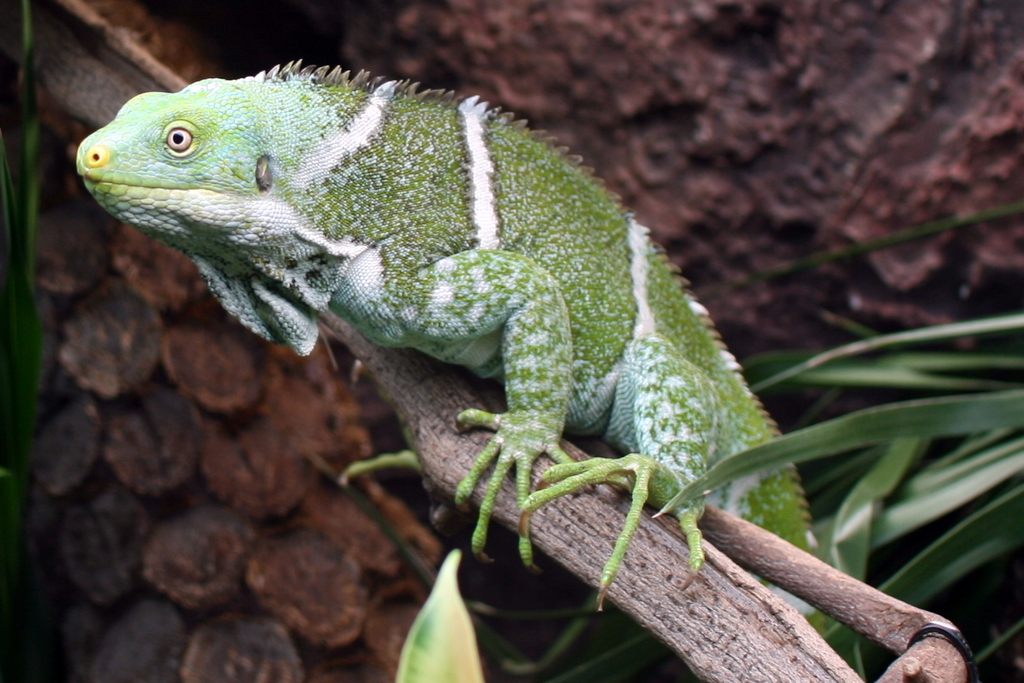
Fijian Crested Iguana
Brachylophus vitiensis
The Fiji crested iguana or Fijian crested iguana (Brachylophus vitiensis) is a critically endangered species of iguana native to some of the northwestern islands of the Fijiian archipelago, where it is found in dry forest on Yadua Taba (west of Vanua Levu), Yadua, Macuata, Yaquaga, Devuilau (Goat island), Malolo, Monu and Monuriki.
From the article Fiji crested iguana on Wikipedia (CC BY-SA), quoted section by section
Description
The Fiji crested iguana is a large stocky lizard distinguished from the Fiji banded iguana by the presence of three narrow, cream to white colored bands on males, rather than the broader bluish bands of the latter species. These whitish bands often have chevrons of black scales close to them. Brachylophus vitiensis is distinguished by its larger size growing to 75 centimetres (30 in) in length and weighing as much as 300 grams (0.66 lb). It is further distinguished by the presence of a taller spiny "crest" on its back with spines as long as 1.5 centimetres (0.59 in) running from the nape of the neck to the base of its tail. When Fiji crested iguanas first hatch from their eggs they are dark green, but after several hours their skin becomes bright emerald green and narrow white bands can be seen along their body. Their eyes are reddish orange or pinkish gold in color.
Range & habitat
B. vitiensis is found on the islands of Fiji, in the South Pacific. The species is restricted to tropical dry forests, specifically to the rain shadow forests located on certain islands in Fiji. These forests are one of the most threatened vegetation types in the Pacific. A small population of the Fiji crested iguana – fewer than 80 individuals – can be found on the small island of Macuata. The majority of this species – fewer than 4,000 individuals – is most commonly found on the island of Yadua Taba. The island is a National Trust of Fiji reserve, and is thus the only legally protected population of the Fiji crested iguana. The island is now also free of forest burning and the presence of goats, which was a major factor in the initial decline of the species. There are some other Fijian islands where evidence of the species has been recorded: Deviulau, Waya, Monuriki, Monu, Qalito (possibly extinct), Yaquaga, Yadua, Yaduataba and Malolo Levu. A small protected forestation area was created recently on Malolo Levu for the last few crested iguanas that were found on that island. Juveniles have been reported on the site, indicating some degree of reproduction is ongoing. However, the outlook for this subpopulation is a matter of great concern. …
Wikipedia: “Habitat”
What it does
The Fiji crested iguana is a diurnal creature that tends to live under the shade of trees and will seek sunlight/heat on days with cool temperature. It has the ability to rapidly change colour from green to black when aroused. It uses this ability when threatened by any potential predator in its surroundings. These colours will vary depending on the severity of the situation, bright green is standard, dark green would be slightly dangerous, and black would be an extreme. If its white bands or its sudden change in colour has not intimidated its predator, it will ultimately resort to an expansion of its neck, a bobbing of its head, and it will pounce itself towards the potential threat. In order to move from tree to tree where it usually resides, it uses the overlapping branches in order to move effectively through their environments. Their long toes and tails help them keep balance while they move through the trees.
Wikipedia: “Behaviour”
In human culture
The generic name, Brachylophus, is derived from two Greek words: brachys (βραχῦς) meaning "short" and lophos (λοφος) meaning "crest" or "plume", denoting the short spiny crests along the back of this species. The specific name, vitiensis, is a Latin toponymic adjective derived from the Fijian word for Fiji. The species B. vitiensis is closely related to the Lau banded iguana (B. fasciatus) and Fiji banded iguana (B. bulabula). The southwest Pacific iguanas of the genus Brachylophus and the related extinct genus Lapitiguana are thought to be descended from ancestral iguanas that rafted 9,000 km (5,600 mi) west across the Pacific Ocean from the Americas, where their closest relatives are found.
Wikipedia: “Taxonomy and etymology”
Where it lives
Recorded sightings
—
geo-referenced records in GBIF, from museums, herbaria and field observers.
Drag the globe to turn it. Dots are where records exist, not a range map; darker means more records.
In the stacks
Searching the stacks…
Every page naming Brachylophus vitiensis in the Biodiversity Heritage Library →
This page is assembled live from iNaturalist, GBIF, Wikipedia, the Source Library and the Internet Archive. It is not yet part of the hand-edited codex. iNaturalist taxon 35327.