- Animals
- ›Chordates
- ›Vertebrates
- ›Reptiles
- ›Snakes and Lizards
- ›Lizards
- ›Iguanas and Allies
- ›Iguanas, Anoles, and Allies
- ›Iguanas and Chuckwallas
- ›Ctenosaura
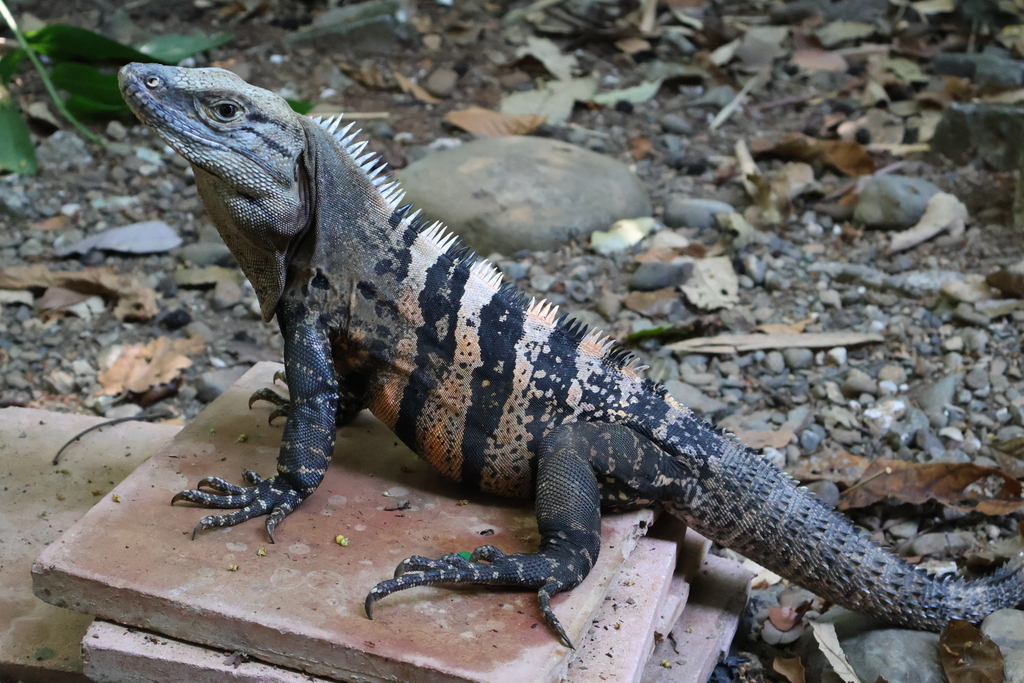
Black Spiny-tailed Iguana
Ctenosaura similis
Ctenosaura similis, commonly known as the black iguana or black spiny-tailed iguana, is an iguanid lizard native to Mexico and Central America. It has been reported in some Colombian islands in the Caribbean Sea and Pacific Ocean, and has been introduced to the United States in the state of Florida. The largest species in the genus Ctenosaura, it is commonly found in areas such as grasslands and forests.
From the article Ctenosaura similis on Wikipedia (CC BY-SA), quoted section by section
Description
C. similis has distinctive black, keeled scales on its tail, which gives it its common name. It is the largest member of the genus Ctenosaura. The males are capable of growing up to 1.3 meters (4 ft 3 in) in length and the females are slightly shorter, at 0.8–1 meter (2 ft 7 in – 3 ft 3 in). They have a crest of long spines which extends down the center of the back. Although coloration varies extremely among individuals of the same population, adults usually have a whitish gray or tan ground color with a series of 4–12 well-defined dark dorsal bands that extend nearly to the ventral scales. Males also develop an orange color around the head and throat during breeding season with highlights of blue and peach on their jowls.
Range & habitat
The black spiny-tailed iguana is native to southern Mexico and Central America, ranging from the Isthmus of Tehuantepec southward to Panama, occurring at sea level to ca. 1,320 meters elevation, but it is absent from interior highlands. Its distribution is irregular and discontinuous on the Atlantic versant where it ranges through portions of Tabasco, northern Chiapas, Campeche, Yucatan, and Quintana Roo in Mexico, much of Belize, Guatemala, and the northern coast of Honduras (often following rivers into interior valleys and canyons), but with only a few isolated and disjunct records southward in eastern Nicaragua, Costa Rica, and Panama. On the Pacific coast its distribution is continuous from extreme southeast Oaxaca and southern Chiapas, Mexico, south through Guatemala, El Salvador, Honduras, Nicaragua, Costa Rica, to the Azuero Peninsula in Panama. It is also found on many Caribbean and Pacific islands including: Isla Aguada, Isla Contoy, Cozumel, and Isla Mujeres in Mexico; Ambergris Caye, Glover's Reef, Half Moon Caye, Belize; Isla de Utila, Guanaja, Roatán, and the islands in the Golfo de Fonseca, Honduras; Isla de Maíz Grande (Corn Islands) Nicaragua; Coiba Island and Isla del Rey, Panamá; Isla San Andrés and Providencia, Colombia. Its status on a few of these islands, as a native or invasive species is questionable. …
Wikipedia: “Distribution”
What it does
Black spiny-tailed iguanas are excellent climbers, and prefer a rocky habitat with plenty of crevices to hide in, rocks to bask on, and nearby trees to climb. They are diurnal and fast moving, employing their speed to escape predators but will lash with their tails and bite if cornered. The Guinness Book of World Records lists this as the world's fastest lizard, with a maximal sprint speed of 34.6 kilometres per hour (21.5 mph).
They are primarily herbivorous, eating flowers, leaves, stems, and fruit, but they will opportunistically eat smaller animals (rodents, bats, frogs, small birds and smaller iguanas), eggs and arthropods. Juveniles tend to be insectivores, becoming more herbivorous as they get older. They are known to eat the fruit and live in the limbs of the manchineel, a tree highly poisonous to most other animals. González-García et al. 2009 find that abundance is highly dependent on 3 dimensional structure of landscape, tall vegetation not merely short grass.
Wikipedia: “Diet and behavior”
Where it lives
Recorded sightings
—
geo-referenced records in GBIF, from museums, herbaria and field observers.
Drag the globe to turn it. Dots are where records exist, not a range map; darker means more records.
In the stacks
Searching the stacks…
Every page naming Ctenosaura similis in the Biodiversity Heritage Library →
This page is assembled live from iNaturalist, GBIF, Wikipedia, the Source Library and the Internet Archive. It is not yet part of the hand-edited codex. iNaturalist taxon 35303.