On eBird ↗
Pied Cuckoo-Dove
Live sightings near you, the range map, bar charts of when it is seen, and Macaulay Library photos and recordings.
Pied Cuckoo-Dove
Reinwardtoena browni
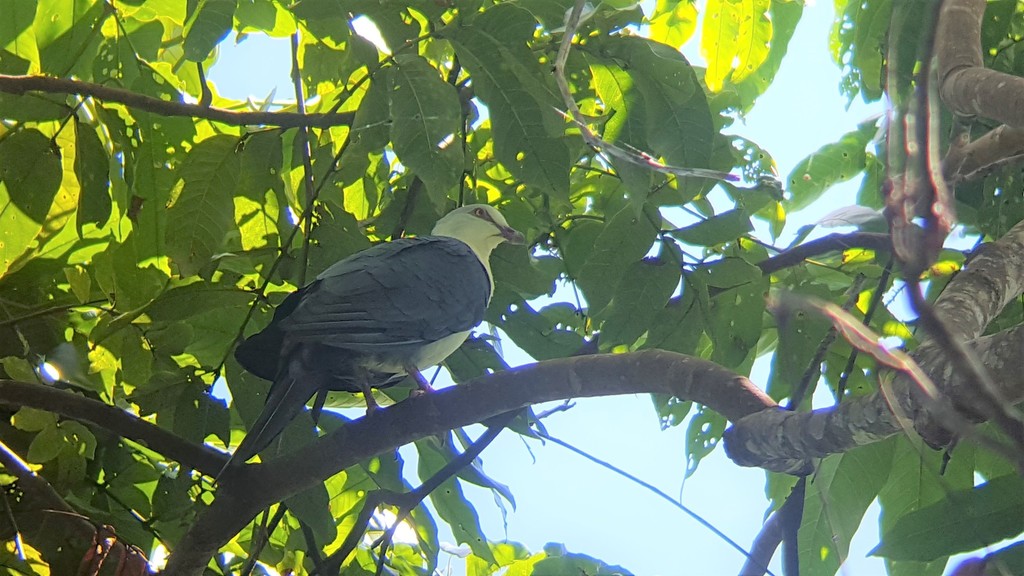
The pied cuckoo-dove (Reinwardtoena browni) is a species of bird in the pigeon family, Columbidae. First described by English zoologist Philip Sclater in 1877, it is endemic to the Bismarck Archipelago, where it mainly inhabits lowland and hill forests at elevations of up to 1,000 m (3,300 ft). It is a large, distinctive pigeon, with a length of 40–46 cm (16–18 in) and a weight of 279–325 g (9.8–11.5 oz). Adults are mainly black and white. The heads and underparts are whitish, while the wings, tails, and upperparts are black. Both sexes look alike. Juveniles are mainly sooty-grey in colour.
The species is usually seen alone or in pairs and usually rather hard-to-find. It feeds on fruit. The only known nest was found in May 1930 and was a simple structure made of twigs on rocky terrain near a stream and contained a single white egg. The dove's population is estimated to number 15,000–30,000 total birds; it is listed as being near threatened on the IUCN Red List due to a decline in its population caused by deforestation in the lowland forests it inhabits. Some studies have found that the species is moderately tolerant of habitat degradation and have suggested that it be categorised as being of least concern.
From the article Pied cuckoo-dove on Wikipedia (CC BY-SA), quoted section by section
Description
The pied cuckoo-dove is a large and long-tailed pigeon, with a length of 40–46 cm (16–18 in) and a weight of 279–325 g (9.8–11.5 oz). The forehead and face are greyish-white, changing to silvery-grey towards the top of the head and hindneck. The neck is paler silvery-grey, darkest where it meets the upper back. The upper back, back, rump, tail, and wings are all blackish, with the wings and central tail feathers being a glossy blue-black. The rectrices are patterned with grey, and the outer three tail feathers have a somewhat indistinct grey band across the middle. The underparts are white from the throat to the belly, turning dark bluish-grey towards the undertail-coverts and flanks. The iris is red or yellow, and the bill is grey or brown with a reddish base. The feet are dark red. Adults of both sexes look alike. Juveniles are mainly sooty-grey in colour, with no hints of warm brown in their plumage. Due to its distinctive black-and-white colouration, this species is unlikely to be confused with any other pigeons that share its range, but is very similar to the closely related great cuckoo-dove. It differs from that species in its shorter tail and the absence of chestnut-brown in its plumage.
Vocalisations. …
Range & habitat
The pied cuckoo-dove is endemic to the Bismarck Archipelago, where it is found on the islands of New Britain, New Ireland, New Hanover, Umboi, Lolobau, Duke of York, Lihir, Tabar and Watom, as well as Manus, Rambutyo and Nauna in the Admiralty Islands. It inhabits rainforest and coastal scrub in lowlands and hills at elevations of up to 1,000 m (3,300 ft). It prefers tall forests and is commonest in hills, often being absent from some lowland areas. It is somewhat tolerant of moderately degraded forest, but does not inhabit heavily degraded forests with little canopy cover.
Wikipedia: “Distribution and habitat”
What it does
The pied cuckoo-dove is rather hard to find and is usually seen either alone or in pairs in the midstorey or canopy of the forest. Roosting occurs low inside the forest, occasionally on exposed branches and vines. It feeds on fruits such as berries. The breeding biology of this pigeon is very poorly known. Courtship displays have been seen from March to May on New Hanover, in July on Dyaul, and in August on New Britain. The only known nest was a simple structure made of twigs, found in May 1930 on a ledge overhanging a stream flowing through rocky terrain on the island of New Britain. Nests contain a single white egg, which only the female has been observed incubating. Eggs are ovoid and are 34.71 mm × 25.03 mm (1.367 in × 0.985 in) in dimension.
Wikipedia: “Behaviour and ecology”
Listen
Looking for field recordings…
Where it lives
Recorded sightings
—
geo-referenced records in GBIF, from museums, herbaria and field observers.
Drag the globe to turn it. Dots are where records exist, not a range map; darker means more records.
In the stacks
Searching the stacks…
Every page naming Reinwardtoena browni in the Biodiversity Heritage Library →
This page is assembled live from iNaturalist, GBIF, Wikipedia, the Source Library and the Internet Archive. It is not yet part of the hand-edited codex. iNaturalist taxon 3530.