- Animals
- ›Chordates
- ›Vertebrates
- ›Reptiles
- ›Snakes and Lizards
- ›Lizards
- ›Iguanas and Allies
- ›Iguanas, Anoles, and Allies
- ›Iguanas and Chuckwallas
- ›Cyclura
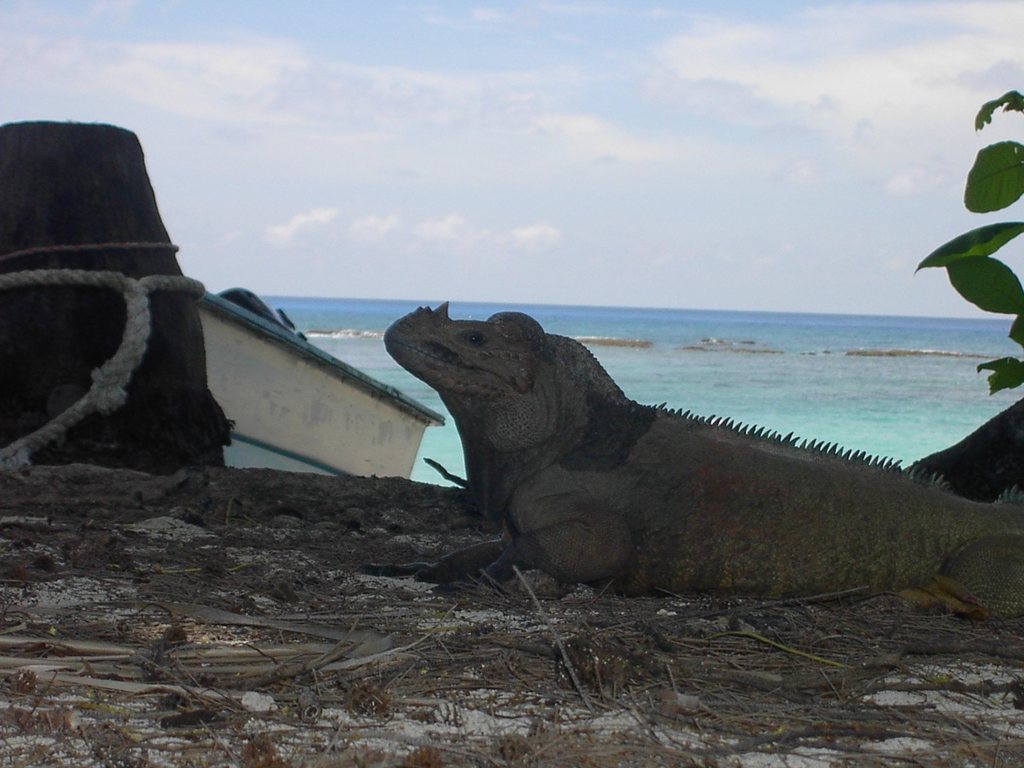
Mona Rhinoceros Iguana
Cyclura stejnegeri
The Mona ground iguana (Cyclura stejnegeri) is a critically endangered species of rock iguana, endemic to Mona Island, Puerto Rico. It is one of the island's few large land animals, and it is the largest endemic terrestrial lizard in the US territory, and one of the biggest rock iguanas within the Antilles. It was previously considered a subspecies of the rhinoceros iguana (Cyclura cornuta).
From the article Mona ground iguana on Wikipedia (CC BY-SA), quoted section by section
Description
The Mona ground iguana is a large-bodied, heavy-headed lizard with strong legs and a vertically flattened tail, which is capable of reaching 1.22 m (4 ft 0 in) in length (from snout to tail). A crest of pointed, horned scales extends from the nape of the neck to the tip of the tail. The color is a uniform gray to olive drab, with slight brown or blue colorations. Juveniles differ from adults in that they have gray transverse bands across their bodies. These bands last until they are sexually mature at about three years of age. Males possess bony, prominent tubercles on their snouts resembling horns, adipose pads in the form of a helmet on the occipital region of their heads, and large dewlaps. This subspecies, like other species of Cyclura, is sexually dimorphic; males are larger than females, and have more prominent dorsal crests, "horns" and femoral pores on their thighs, which are used to release pheromones. Thomas Wiewandt, who spent an extended period on Mona Island studying C. stejnegeri, suggested that the horns, along with lateral spines and prominent parietal bulges, function as protective armor against sharp rocks or as defensive tools to facilitate the escape of males from the grasp of one another.
Range & habitat
Mona ground iguanas are diurnal and spend most of the day basking in the sun conserving energy. Mona ground iguanas are endemic to Mona Island; they are scattered through the entire island, though the southwest part of the island is used only during the nesting season. They live a considerable portion of their lives underground, and are usually found in talus slopes, caves and sinkhole depressions. The average depth underground that they can be found is 1.5 m (4 ft 11 in).
Wikipedia: “Habitat”
What it does
Although Mona ground iguanas use the whole island as their habitat, only 1% of the territory, located on the southwest coast, is suitable for nesting because it contains loose sand, and receives direct sunlight. The females bury their eggs in the sand, and the sunlight incubates the eggs. Males reach sexual maturity at a size of 28–31 cm (11–12 in) in length from snout to vent, usually in their third to fourth year, while females mature one year later at a size of 35–40 cm (14–16 in). Nesting season begins in the second week of June. Usually, one female mates with more than one male in the two weeks the mating season lasts. Copulation may last from 15 sec to 2 mins and 15 sec. One month later, nesting begins. Females will dig a tunnel 0.91 m (3 ft) long located one to two feet underground, where they deposit from five to 19 eggs, with 12 being the average. They will guard their nests for several days, but provide no parental care for the hatchlings, which hatch three months later. Hatchlings measure, on average, 32 cm (13 in) and weigh 73.7 g (2.60 oz) and grow at a rate of 5.23 cm (2.06 in) per year.
Wikipedia: “Reproduction”
Toxicity
Population numbers are estimated at 1,500 with lower densities than similar iguana-inhabited islands in the West Indies. Immature iguanas are scarce and represent only 5–10% of the population, revealing that the population is aging and in decline.
Reasons for decline. The biggest threat to C. stejnegeri are invasive species; feral pigs pose the most serious threat, as they root up iguana nests, and like most Cyclura species, the Mona ground iguana nests communally and at high density. Introduced goats and pigs are a major competitor for food and overbrowsing by goats also leads to loss of protective cover from birds of prey such as the osprey and predation of juveniles by feral cats.
Recovery efforts. A headstarting program was put into place by the Puerto Rico Department of Natural and Environmental Resources, with cooperation from the IUCN Iguana Specialist Group, the US Fish and Wildlife Service, the Toledo Zoo, and the University of Puerto Rico in 1999, to aid in the recovery of the Mona ground iguana. From within the safety of this program, the iguanas are reared until they are large enough to survive in the wild, and predators, such as pigs and feral cats, are no longer a threat. The facility also carries out health screening prior to the release of specimens. …
Wikipedia: “Endangered status”
Where it lives
Recorded sightings
—
geo-referenced records in GBIF, from museums, herbaria and field observers.
Drag the globe to turn it. Dots are where records exist, not a range map; darker means more records.
In the stacks
Searching the stacks…
Every page naming Cyclura stejnegeri in the Biodiversity Heritage Library →
This page is assembled live from iNaturalist, GBIF, Wikipedia, the Source Library and the Internet Archive. It is not yet part of the hand-edited codex. iNaturalist taxon 35295.