- Fungi Including Lichens
- ›Basidiomycete Fungi
- ›Higher Basidiomycetes
- ›Mushrooms, Bracket Fungi, Puffballs, and Allies
- ›Russulales
- ›Milkcaps, Brittlegills and Allies
- ›Russula
- ›Russula
- ›Olivaceinae
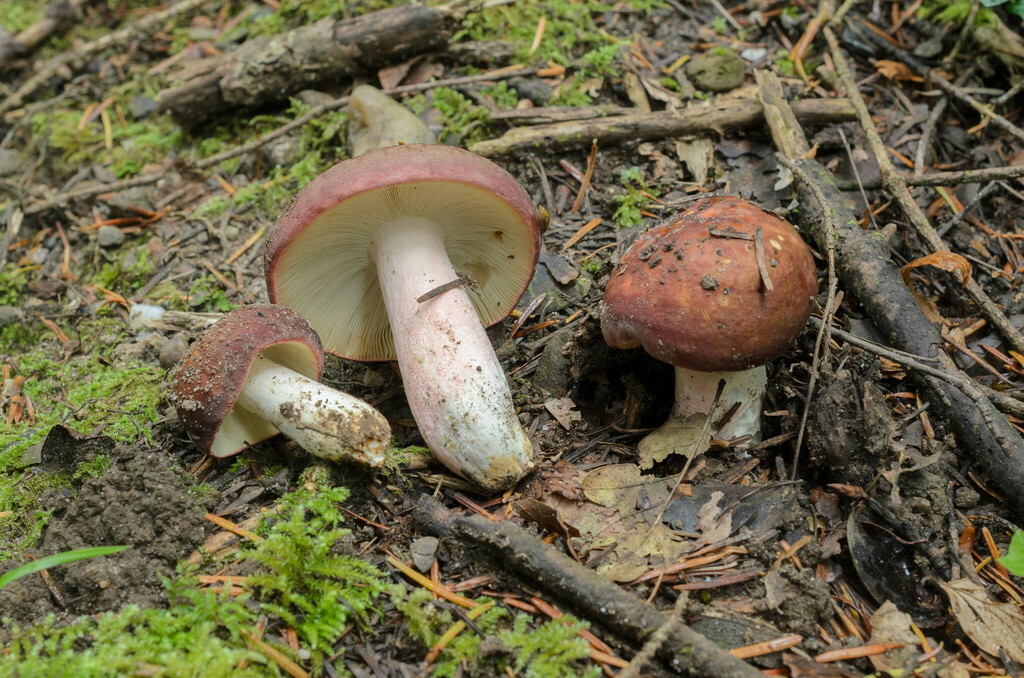
Olive Brittlegill
Russula olivacea
Russula olivacea is an edible and non-poisonous Russula mushroom found mostly in groups from June in deciduous and coniferous forests, mainly under spruce and beech; not rare.
From the article Russula olivacea on Wikipedia (CC BY-SA), quoted section by section
Description
The cap is convex when young, soon flat, yellowish-olive when young which develops into rusty brown; it ranges from 10–30 cm (3.9–11.8 in) in diameter. The gills are cream, deep ochre when old and rather crowded and brittle. The spores are yellow. The stem is strong and evenly thick, often pale pink; it ranges from 7–18 cm (2.8–7.1 in) long and 2–6 cm (0.8–2.4 in) wide. The flesh is firm, white, with a pleasant or innocuous scent, and has a mild or nutty taste. Some say it is edible and other say it is toxic, perhaps causing gastrointestinal upset.
Where it lives
Recorded sightings
—
geo-referenced records in GBIF, from museums, herbaria and field observers.
Drag the globe to turn it. Dots are where records exist, not a range map; darker means more records.
In the stacks
Searching the stacks…
Every page naming Russula olivacea in the Biodiversity Heritage Library →
This page is assembled live from iNaturalist, GBIF, Wikipedia, the Source Library and the Internet Archive. It is not yet part of the hand-edited codex. iNaturalist taxon 352303.