- Animals
- ›Chordates
- ›Vertebrates
- ›Reptiles
- ›Snakes and Lizards
- ›Snakes
- ›Elapid Snakes
- ›Australian Elapids (inc. Sea Snakes)
- ›True sea snakes
- ›Hydrophis
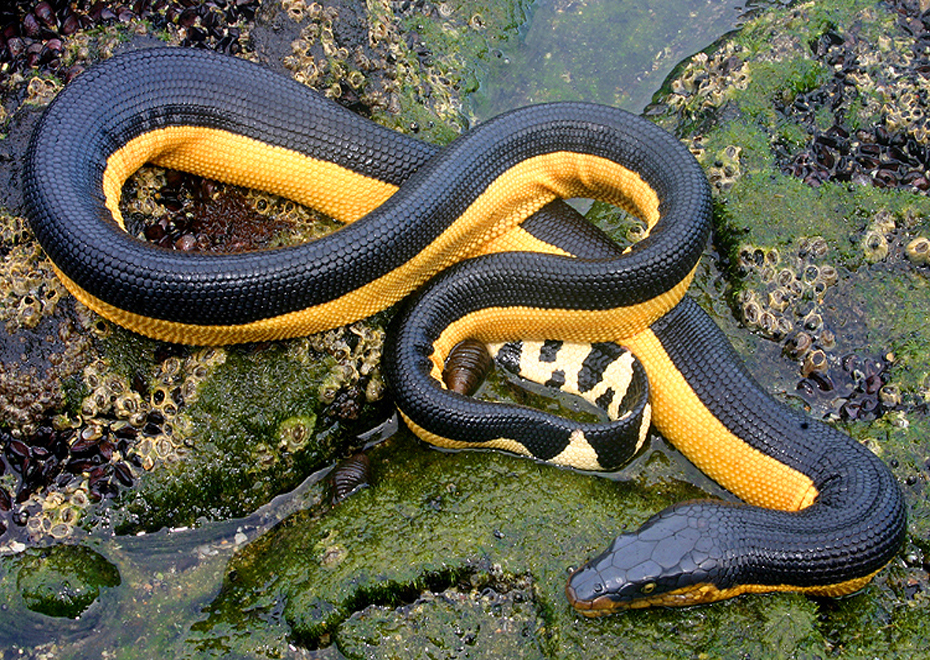
Yellow-bellied Sea Snake
Hydrophis platurus
Hydrophis platurus, commonly known as the yellow-bellied sea snake, yellowbelly sea snake or pelagic sea snake, is a species of snake from the subfamily Hydrophiinae (the sea snakes) found in tropical oceanic waters around the world, excluding the Atlantic Ocean. It was the only member of the genus Pelamis but recent molecular evidence suggests that it is more closely related to the species of the genus Hydrophis.
From the article Yellow-bellied sea snake on Wikipedia (CC BY-SA), quoted section by section
Description
The yellow-bellied sea snake, as the name implies, has a distinctive bicolor pattern with a yellow underbelly and brown back, making it easily distinguishable from other sea snake species. Yellow-bellied sea snakes, like many other species of sea snake, are fully adapted to living their whole lives at sea: mating, eating and giving birth to live young (ovoviviparous). Adaptations to aquatic life include the reduced ventral scale size, laterally compressed body and paddle-tail for swimming, valved nostrils and palatine seal for excluding seawater, and cutaneous gas exchange for prolonging dive times. Yellow-bellied sea snakes have semi-permeable skin which extracts oxygen from the seawater through a process of cutaneous respiration while diving and swimming at the surface of the water. Sea snakes also have a special salt gland located in the lower jaw that was formerly believed to filter out salt from the surrounding seawater but has been found not to be used for that purpose, as sea snakes drink fresh water only. See snake scales for terminology used here
Morphology. …
Range & habitat
The yellow-bellied sea snake is one of the most widely distributed snakes in the world. It is completely pelagic and is often observed on oceanic drift lines, using surface currents and storms to move around the ocean. Their distribution appears to be largely determined by favourable water temperatures, oceanic currents and recent formation of land bridges that have blocked farther dispersal.
The yellow-bellied sea snake has an extensive distribution covering the entire tropical Indo-Pacific, as well as extending to Costa Rica, southern California, and northern Peru. It is the only sea snake to have reached the Hawaiian Islands. The favoured habitat for hunting and reproduction includes free floating mats of sea kelp occurring in the Indian Ocean. The species is the most commonly beached sea snake on the coast of Southwest Australia, including records at beaches near metropolitan areas. It is also reported from Christmas Island and Cocos (Keeling) Islands (Australia). The yellow-bellied sea snake requires a minimum of 16–18 °C (61–64 °F) to survive, long-term. However, the species has been reported in colder waters of the Pacific, such as the coasts of southern California, Mexico, Tasmania, and New Zealand, the latter being a country that would otherwise be free of snakes were it not for the infrequent strandings of yellow-bellied sea snakes and banded sea kraits. …
Wikipedia: “Distribution and habitat”
What it does
Contrary to past beliefs, sea snakes require fresh or brackish water to survive; the yellow-bellied sea snake likely drinks mainly from freshwater lenses that form on the surface of the sea after heavy precipitation. This species has been reported to survive severe dehydration of up to 7 months during seasonal drought. Yellow-bellied sea snakes breed in warm waters; they are ovoviviparous with a gestation period around 6 months. According to Ditmars, females bear live young in tidal pools. They move poorly on land due to their smaller belly scales that form a ventral keel. They are sometimes observed in large aggregations of thousands on the surface of the water in oceanic drift lines, which has been proposed as a strategy to catch prey. They hunt by floating on the surface of the water to attract pelagic fish that are seeking shelter; prey are captured via a backwards swimming motion and rapid lunge of the jaws. The ability to swim backwards is an unusual and distinguishing characteristic of this species. Heatwole proposed that these snakes find their prey by sensing the vibration generated by fish movement. These snakes are not considered aggressive but will defend themselves if threatened.
Wikipedia: “Behaviour”
Toxicity
The venom of this species is highly potent, like that of other sea snakes. Bites are rare and the most common victims are fishermen who try to get them out of fishing nets. The subcutaneous LD50 of the venom is 0.067 mg/kg and the venom yield per bite is 1.0–4.0 mg. Yellow-bellied sea snake venom contains several different neurotoxins and two other isotoxins. Juvenile and adult specimens have the same toxin compounds in their venom; however, juvenile venom is on average less concentrated.
Antivenom. Sea snake venom can cause damage to skeletal muscle with consequent myoglobinuria, neuromuscular paralysis or direct renal damage. The venoms of significant species of sea snake are neutralised with Commonwealth Serum Laboratories Ltd (of Melbourne, Australia) sea snake (Enhydrina schistosa) antivenom. If that preparation is not available, tiger snake or polyvalent antivenom should be used. No deaths have been recorded from bites in Australian waters. The E. schistosa antivenom was tested specifically on Pelamus platurus, and it effectively neutralised the venom.
Wikipedia: “Venom”
Where it lives
Recorded sightings
—
geo-referenced records in GBIF, from museums, herbaria and field observers.
Drag the globe to turn it. Dots are where records exist, not a range map; darker means more records.
In the stacks
Searching the stacks…
Every page naming Hydrophis platurus in the Biodiversity Heritage Library →
This page is assembled live from iNaturalist, GBIF, Wikipedia, the Source Library and the Internet Archive. It is not yet part of the hand-edited codex. iNaturalist taxon 35164.