- Animals
- ›Chordates
- ›Vertebrates
- ›Reptiles
- ›Snakes and Lizards
- ›Snakes
- ›Elapid Snakes
- ›Australian Elapids (inc. Sea Snakes)
- ›Pseudechis
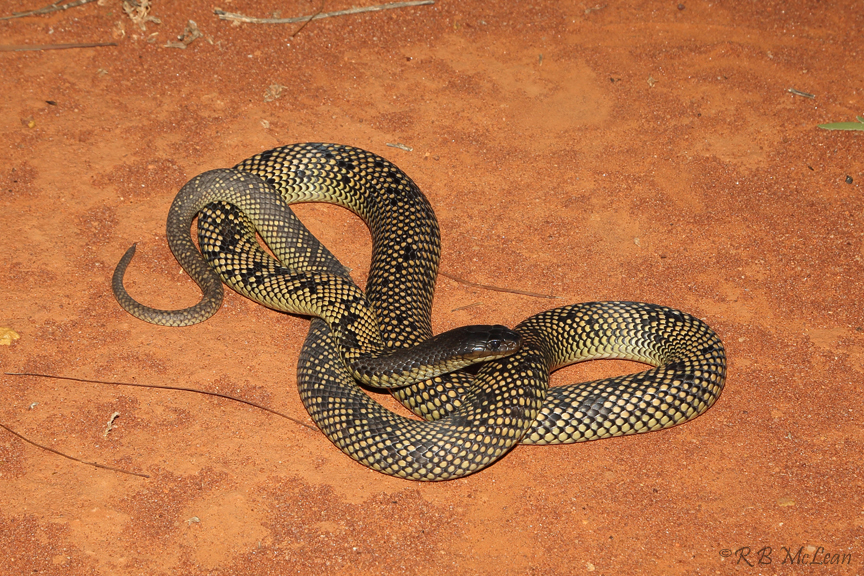
Spotted Mulga Snake
Pseudechis butleri
The spotted mulga snake (Pseudechis butleri), also known commonly as Butler's black snake and Butler's snake, is a species of venomous snake in the family Elapidae. The species is endemic to Western Australia. It is a member of the genus Pseudechis, dangerously venomous snakes that can intimidate an opponent by raising the head and presenting a hood. This cobra-like threat display is supported by the ability to produce a very large amount of venom.
From the article Spotted mulga snake on Wikipedia (CC BY-SA), quoted section by section
Description
P. butleri is a species of Pseudechis, a genus of large front-fanged venomous snakes occurring in Australia and New Guinea. The species is similar to the common mulga P. australis, a larger and widespread snake which occurs in sympatry at parts of central Western Australia. However, P. butleri is spotted with yellow or yellow-green scales and does not usually exceed a total length (including tail) of 1.6 m (5.2 ft). The snout-to-vent length (SVL) is up to 1.56 m (5.1 ft), and the tail length is around 15% of the SVL. The dorsal scales of the body are occasionally all black, but most of the upper body is covered in yellow or brownish scales with black bases. The colour of the head and neck tends to completely black. The neck is slightly defined from the head, broad and slightly larger than the robust body. Pseudechis butleri is readily distinguished from others of the genus, by colouration and by the number of ventral scales. The number of dorsal scale rows at the midbody is 17, at the neck this is usually 19, but ranges from 16 to 23. Just anterior to the tail there are 17 (15–18) rows. P. australis has reddish-brown ventral scales, each with a cream-coloured edge, whereas P. butleri has black-based, bright yellow ventral scales. Also, the number of ventral scales in P. butleri is less than in specimens of P. australis found at the same latitude. P. …
Range & habitat
The distribution range of P. butleri is within the Murchison region of Western Australia, where it occurs in Acacia woodlands on stony and loamy soils, and occasionally amongst rocks. Specimens of this West Australian endemic species have been recorded in Mullewa in the north, as far south as Leonora, and to the east near Laverton.
Wikipedia: “Distribution and habitat”
What it does
P. butleri is oviparous. Mating takes place in October and November. A clutch of 7–12 eggs is laid in December. Hatchlings emerge after 65–80 days.
Wikipedia: “Reproduction”
Toxicity
The venom of P. butleri contains systemic myotoxins. Treatment for positive envenomation is the same as for P. australis, using a black snake antivenom.
Wikipedia: “Venom”
Where it lives
Recorded sightings
—
geo-referenced records in GBIF, from museums, herbaria and field observers.
Drag the globe to turn it. Dots are where records exist, not a range map; darker means more records.
In the stacks
Searching the stacks…
Every page naming Pseudechis butleri in the Biodiversity Heritage Library →
This page is assembled live from iNaturalist, GBIF, Wikipedia, the Source Library and the Internet Archive. It is not yet part of the hand-edited codex. iNaturalist taxon 35157.