- Animals
- ›Chordates
- ›Vertebrates
- ›Reptiles
- ›Snakes and Lizards
- ›Snakes
- ›Elapid Snakes
- ›Australian Elapids (inc. Sea Snakes)
- ›Denisonia
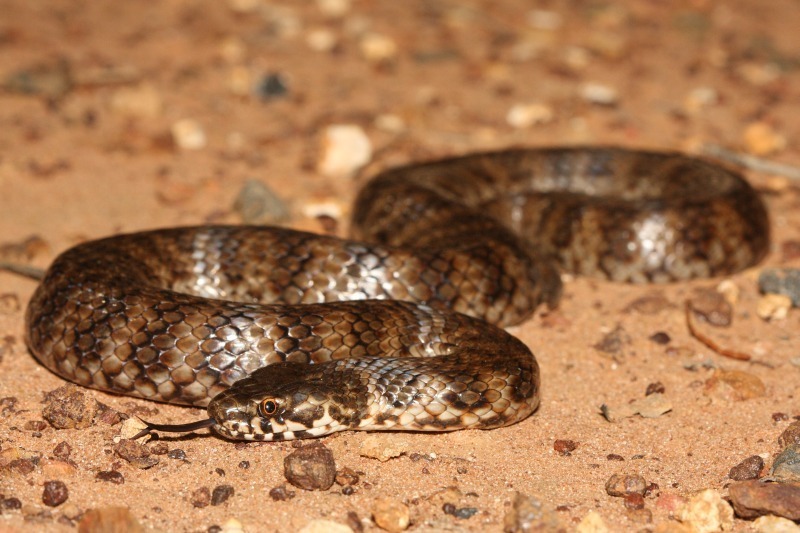
De Vis' Banded Snake
Denisonia devisi
The mud adder (Denisonia devisi), also known as De Vis's banded snake, is an elapid snake found in certain regions of eastern Australia, including South West Queensland, northern New South Wales and north-west Victoria. Its scientific and common names refer to Charles Walter De Vis (1829-1915), first director of the Queensland Museum and writer of around 50 papers on herpetology.
From the article Mud adder on Wikipedia (CC BY-SA), quoted section by section
Description
Denisonia devisi is short, thick, and slightly flat. The eyes are set at the top of the head and have a conspicuous iris. The dorsal surface of the body is yellowish-brown to olive-green in colour, broken by irregular, ragged-edged, narrow, dark bands running across the body. De Vis' banded snake is sometimes confused with death adders, as both have thick, banded bodies. The main difference is that the De Vis' banded snake's tail does not taper abruptly, and its head is not broad and triangular.
Range & habitat
The De Vis' banded snake was thought to be confined to alluvial flats in Queensland and New South Wales. However, when mammal expert Peter Menkhorst reported a death adder in north-west Victoria, an expedition was carried out in November 2005 to survey the Wallpolla Islands. Instead of finding a death adder, the survey identified a De Vis' banded snake for the first time in Victoria. Further confirmation of the species' new habitat came with a report on the results of raising water levels for environmental purposes at several sites along the Murray River at the Victoria - New South Wales border, making special note of the snake. The snake was found in Wallpolla Island Park, a 9,800-hectare (24,000-acre) area consisting of floodplain vegetation in the extreme North West, on the Victoria-New South Wales border. It was a designated "Icon Site", an area of high ecological value within the Murray-Darling basin. The new addition to Victorian snakes was probably carried south during a period of flooding in the Darling River. The usually dry habitat had become more suitable over the years as water and biodiversity increased due to environmental water. In late 2021, sightings of several of the snakes at Chowilla Game Reserve, near Renmark, in the Riverland region of South Australia were confirmed by the South Australian Museum to be the first seen in South Australia.
Wikipedia: “Distribution and habitat”
What it does
The mud adder inhabits low-lying areas, particularly near sites subjected to seasonal flooding. It feeds mainly on frogs, and ambushes their prey. They are nocturnal in warm weather, and inhabit soil cracks. The mud adder gives birth to a fully formed young with an average total length (including tail) of 11 cm (4.3 in). A litter consists of three to 11, five on average, baby snakes.
Wikipedia: “Behaviour”
Where it lives
Recorded sightings
—
geo-referenced records in GBIF, from museums, herbaria and field observers.
Drag the globe to turn it. Dots are where records exist, not a range map; darker means more records.
In the stacks
Searching the stacks…
Every page naming Denisonia devisi in the Biodiversity Heritage Library →
This page is assembled live from iNaturalist, GBIF, Wikipedia, the Source Library and the Internet Archive. It is not yet part of the hand-edited codex. iNaturalist taxon 35029.