- Fungi Including Lichens
- ›Basidiomycete Fungi
- ›Higher Basidiomycetes
- ›Mushrooms, Bracket Fungi, Puffballs, and Allies
- ›Agaricomycetidae
- ›Common Gilled Mushrooms and Allies
- ›Agaricineae
- ›Field Mushrooms and Allies
- ›Agariceae
- ›Agaricus
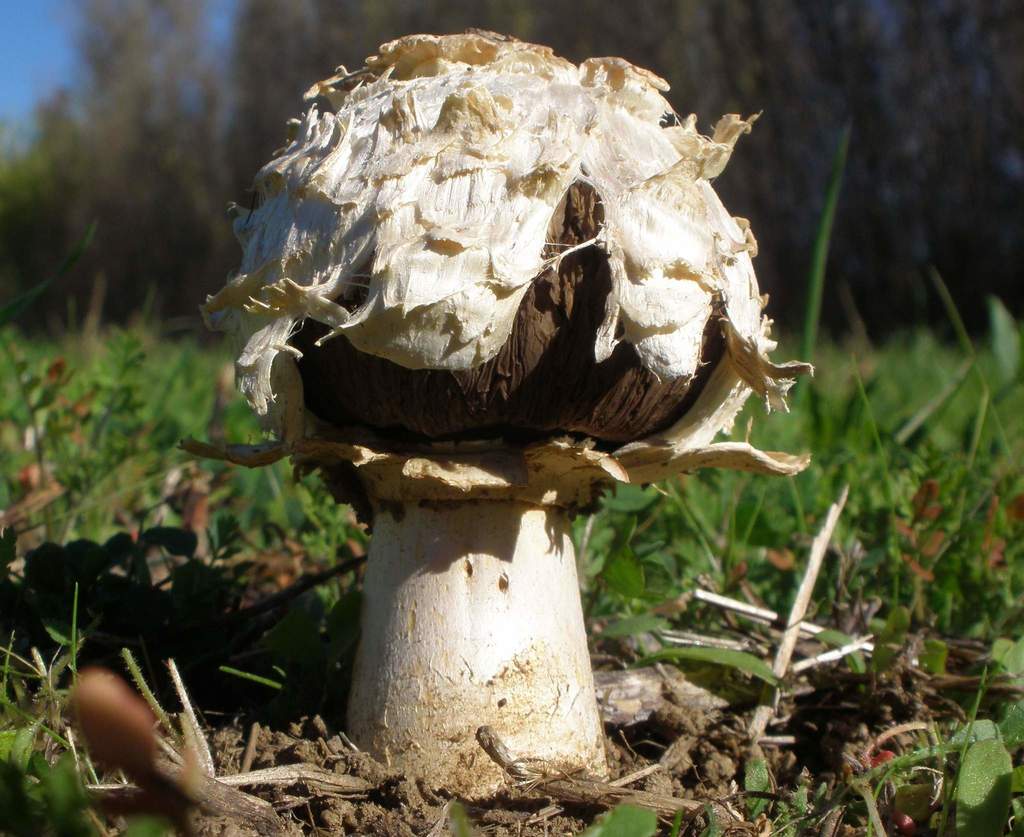
Gasteroid Agaricus
Agaricus deserticola
Agaricus deserticola, commonly known as the gasteroid agaricus, is a species of fungus in the family Agaricaceae. Formerly named Longula texensis (among several other synonyms), the fungus was transferred to the genus Agaricus in 2004 after molecular analysis showed it to be closely related to species in that genus. In 2010, its specific epithet was changed to deserticola after it was discovered that the name Agaricus texensis was illegitimate, having been previously published for a different species.
The fruit bodies can reach heights of 18 cm (7 in) tall with caps that are up to 7.5 cm (3 in) wide. The tough woody stems are 1–2 cm (0.4–0.8 in) wide, thickening towards the base. The fruit bodies are secotioid, meaning the spores are not forcibly discharged, and the cap does not fully expand. Unlike other Agaricus species, A. deserticola does not develop true gills, but rather a convoluted and networked system of spore-producing tissue called a gleba. When the partial veil breaks or pulls away from the stem or the cap splits radially, the blackish-brown gleba is exposed, which allows the spores to be dispersed. Other mushrooms with which A. deserticola might be confused include the desert fungi Podaxis pistillaris and Montagnea arenaria.
From the article Agaricus deserticola on Wikipedia (CC BY-SA), quoted section by section
Description
The fruit body can grow up to 5 to 18 cm (2 to 7 in) in height. Fresh specimens are usually white, but will age to a pale tan; dried fruit bodies are light gray or tan mixed with some yellow. The cap is 4 to 10 cm (1.5 to 4 in) in diameter, initially conic, later becoming convex to broadly convex as it matures. The cap is composed of three distinct tissue layers: an outer volval layer, a middle cuticular layer (cutis), and an inner (tramal) layer which supports the gleba. The surface of the cap is white with yellow-brown to brown-tipped raised small scales; these scales result from the breakup of the volva and the cutis. Initially, the caps are covered by a peridium—an outer covering layer of tissue. After the fruit body matures and begins to dry out, the lower part of the peridium starts to rip, usually starting from small longitudinal slits near where the peridium attaches to the top of the stem. However, the pattern of tearing is variable; in some instances, the slits may appear higher up on the peridium, in others, the peridium rips more irregularly. The peridium may also rip in such a way that it appears as if there is a ring at the top of the stem. The torn peridium exposes the internal gleba. The gleba is divided into wavy plates or lamellae, some of which are fused together to form irregular chambers. …
Range & habitat
Like other Agaricus species, A. deserticola is saprobic—feeding off dead or decaying organic matter. The fruit bodies are found growing singly to sometimes more numerous, at low elevations, and typically in sandy soil. The species' usual habitats include drylands, coastal sage scrub, and desert ecosystems. It also grows in lawns and fields. The range of the fungus is restricted to southwestern and western North America, where it fruits throughout the year, typically during or following cold, wet weather. Zeller gives a range that includes as its eastern border central Texas, and extends westward to San Diego County, California, and north to Josephine County, Oregon. The mushroom used to be common in the San Francisco Bay area before land development reduced its preferred habitats. A. deserticola has been collected in several states in northwestern Mexico, including Sonora, Chihuahua, and Baja California.
Wikipedia: “Habitat and distribution”
At the table
The edibility of A. deserticola fruit bodies is not known definitively, and there are conflicting opinions in the literature, with some sources claiming that the edibility is unknown and consumption should be avoided. However, one popular field guide to North American mushrooms suggests they are edible when they are young and have a pleasant odor and mild taste.
Wikipedia: “Edibility”
Where it lives
Recorded sightings
—
geo-referenced records in GBIF, from museums, herbaria and field observers.
Drag the globe to turn it. Dots are where records exist, not a range map; darker means more records.
In the stacks
Searching the stacks…
Every page naming Agaricus deserticola in the Biodiversity Heritage Library →
This page is assembled live from iNaturalist, GBIF, Wikipedia, the Source Library and the Internet Archive. It is not yet part of the hand-edited codex. iNaturalist taxon 349998.