- Animals
- ›Arthropods
- ›Chelicerates
- ›Arachnids
- ›Spiders
- ›Typical Spiders
- ›Entelegyne Spiders
- ›Orbweavers and Allies
- ›Orbweavers
- ›Argiopinae
- ›Argiope
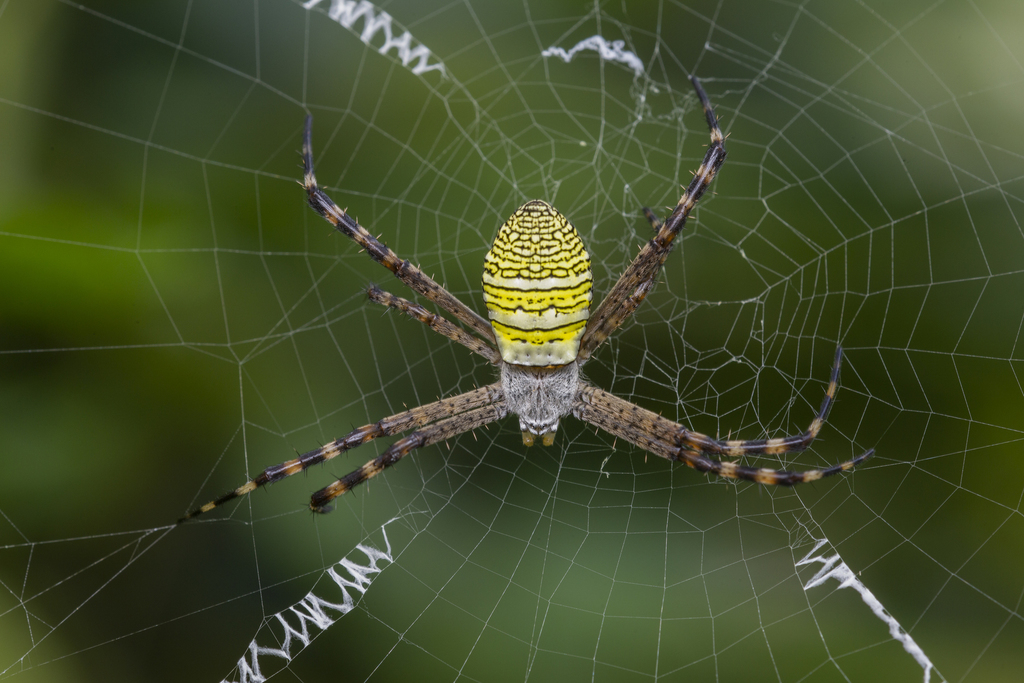
Oval Saint Andrew's Cross Spider
Argiope aemula
Argiope aemula is a species of spider in the family Araneidae, found from India to the Philippines, in Sulawesi and in the New Hebrides. It is one of the species of giant conspicuous "signature spiders" of the genus Argiope, seen in tropical and subtropical grasslands. Signature spiders get their name from the zigzag design embossed on the web, the stabilimentum, that is believed to serve a camouflage function. They show extreme sexual dimorphism and males are...
From the article Argiope aemula on Wikipedia (CC BY-SA), quoted section by section
Description
The female is larger than male - often reaching 25–30 mm while the male tends to stop growing at 5–8 mm. Its Cephalothorax is brownish with a white pubescence. Its posterior median eyes are encircled in black and its sternum is heart shaped. Further, there is a narrow elongation found at the distal end of sternum. Its oval shaped and anteriorly truncated abdomen is yellowish with black stripes. Its ventrum is brownish with yellow parallel lines. Argiope aemula has silver hairs on its carapace - hence its namesake. The female spider has a carapace that is flat with yellow and black horizontal lines that are present from the end of the carapace to the entirety of the backside. The spider has eight legs that are doubled up and spread like an X in the web. The legs are long with claw like structures at the end. Their legs have grey color and black rings around them. The cephalothorax is a dirty white color and the sternum is shaped like a heart. There are four yellow dots that are placed in its abdomen and are organized vertically. The females’ exotic color has been speculated to be associated with prey attraction. Males are much less brilliant in their color. Their sternum and backside are brownish while their carapace is black. Both sexes have abdomens that are oval shaped. They are easy to identify thanks to their stabilimentum in their web. …
Range & habitat
These spiders are found largely in South East Asian countries such as the Philippines, Malaysia, Singapore, and Thailand. They can also be seen in India, Sri Lanka, China, northern Australia, and southern Japan.
Wikipedia: “Distribution”
What it does
When the spiders are less than 23 mm, they build discoid decorations. When they get larger than 23 mm, they tend to build cruciate decorations. Furthermore, mature Argiope aemula that are less than 10 mm long build webs deep inside the vegetation rather than out in the open. This is likely due to the fact that they require extra protection due to their size.
Wikipedia: “Size-affected behavior”
Toxicity
Argiope aemula have venom. However, the venom of these spiders are not a serious threat to humans. Their venom contains polyamine toxins that are sometimes used against prey if they are still alive. When humans get bit, there is some swelling although no medical attention is needed.
== References ==
Wikipedia: “Venom”
In human culture
The term Argiope comes from the Greek Αργιόπη, "silver face" (sharing a common root with the Latin word for silver, argentum), referring to the fact that the spiders in this group have silky silver hairs covering their carapaces.
Wikipedia: “Etymology”
Where it lives
Recorded sightings
—
geo-referenced records in GBIF, from museums, herbaria and field observers.
Drag the globe to turn it. Dots are where records exist, not a range map; darker means more records.
In the stacks
Searching the stacks…
Every page naming Argiope aemula in the Biodiversity Heritage Library →
This page is assembled live from iNaturalist, GBIF, Wikipedia, the Source Library and the Internet Archive. It is not yet part of the hand-edited codex. iNaturalist taxon 349000.