- Animals
- ›Chordates
- ›Vertebrates
- ›Birds
- ›Cranes, Rails, and Allies
- ›Flufftails and Forest Rails
- ›Sarothrura
On eBird ↗
White-winged Flufftail
Live sightings near you, the range map, bar charts of when it is seen, and Macaulay Library photos and recordings.
White-winged Flufftail
Sarothrura ayresi
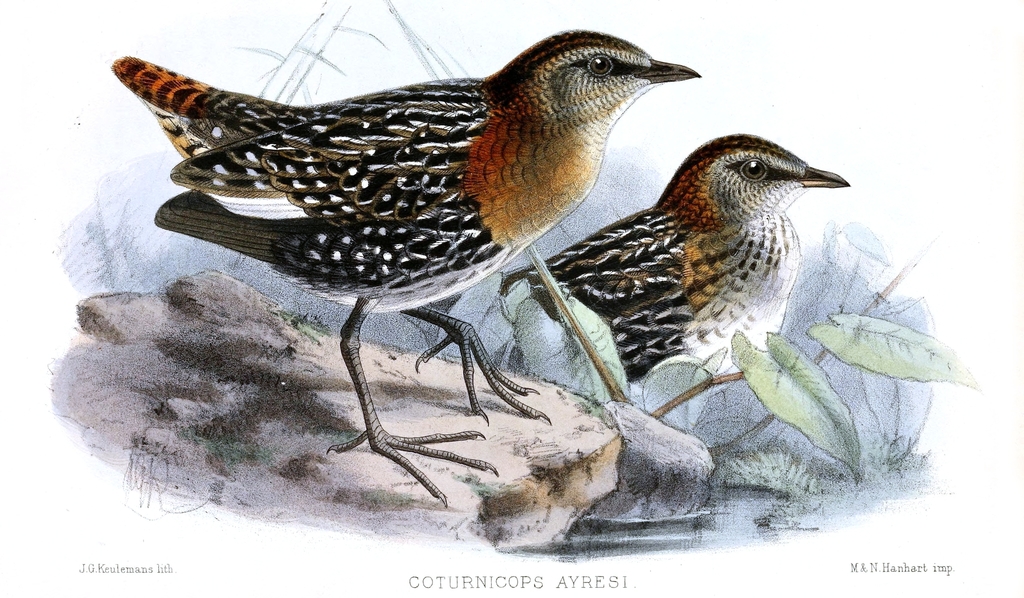
The white-winged flufftail (Sarothrura ayresi) is a very rare African bird in the family Sarothruridae. The estimated global population size of white-winged flufftails is less than 250 adults. These birds reside in Ethiopia and South Africa but it is unknown whether these populations are one large or two different populations.
Both sexes have dull plumage, dark crowns, and when flying show white secondary feathers.
From the article White-winged flufftail on Wikipedia (CC BY-SA), quoted section by section
Description
Its scientific name honours South African ornithologist Thomas Ayres, who discovered it at Potchefstroom. It resembles its relatives in the Flufftail genus, but both sexes have dull plumage and dark crowns. In flight both sexes also show distinctive white secondary feathers, a feature shared only with the related genus Coturnicops. Non-breeding birds call only at dawn and dusk, sometimes in duet. All those in the flufftail genus are native to Africa; however, none are more endangered than the white-winged flufftail.
Range & habitat
The species has a seemingly disjunct range, being found north of the equator in Ethiopia, and south of it in Zambia, Zimbabwe and South Africa. Historically, it was believed to breed only in Ethiopia, though in 2018, it was recorded breeding in South Africa. However, it is still uncertain whether the northern and southern populations are distinct or if they are one large population. The following suggests that they are one interbreeding population. First, their physical features appear identical. Second, new evidence shows a lack of significant difference in immunity gene alleles. Third, there were only three spots found that differed in their mitochondrial DNA. Although, while possibly being one population, the mitochondrial DNA suggests that the population may currently be genetically separating. On the contrary, the following evidence suggests that the northern and southern populations are distinct. While three spots on the mitochondrial DNA may not seem like much, other differing bird subspecies also only have three or fewer sections of difference on their mitochondrial DNA. These studies were conducted on subspecies known to be different due to a landmass keeping them from breeding and/or the species differing in appearance. The uncertainty of the white-winged flufftail's population status is the result of a low amount of research conducted on a rare bird.
Wikipedia: “Distribution”
What it does
Breeding season is estimated to be from June to September because this is when these birds have been spotted on breeding grounds. This is also thought to be the case due to the onset of the rainy season at this time. These birds will lay about four to five eggs in hidden ground nests vulnerable to human and/or livestock traffic. Nest sights are most likely chosen based on vegetation height and water depth since they prefer tall mixed sedges and shallow water.
Wikipedia: “Reproduction”
Listen
Looking for field recordings…
Where it lives
Recorded sightings
—
geo-referenced records in GBIF, from museums, herbaria and field observers.
Drag the globe to turn it. Dots are where records exist, not a range map; darker means more records.
In the stacks
Searching the stacks…
Every page naming Sarothrura ayresi in the Biodiversity Heritage Library →
This page is assembled live from iNaturalist, GBIF, Wikipedia, the Source Library and the Internet Archive. It is not yet part of the hand-edited codex. iNaturalist taxon 347.