- Animals
- ›Chordates
- ›Vertebrates
- ›Reptiles
- ›Snakes and Lizards
- ›Lizards
- ›Geckos
- ›Sphaeros and Allies
- ›Gonatodes
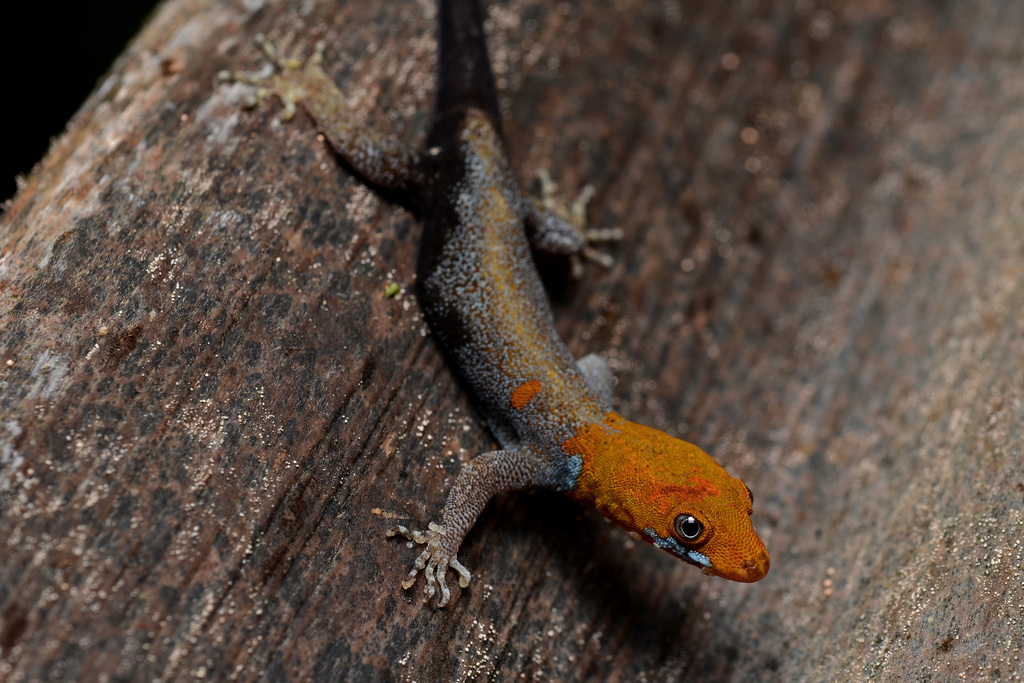
Yellow-headed Gecko
Gonatodes albogularis
Gonatodes albogularis, which has been called a number of vernacular names in English, is a smallish species of gecko found in warm parts of Central and South America, Cuba, Hispaniola and Jamaica. They prefer to live in tropical dry forest habitats. It is sexually dimorphic: the male is colourful, while the female is a more drab grey. The fingers do not have lamellar pads for climbing smooth surfaces like many other geckos but instead have normal claws like most lizards. At one time the species had a breeding population in southern Florida, especially Key West, but this population appears to have died out by the early 1990s. They are believed to be able to tell the difference between brightness and hues of conspecifics. Males are incredibly aggressive with territory defense against both other males and potential predators.
From the article Yellow-headed gecko on Wikipedia (CC BY-SA), quoted section by section
Description
This gecko can grow up to between 69–90 mm (2.7–3.5 in). A maximal length of 100 mm (3.9 in) is also given. Like almost all Gonatodes species it is sexually dimorphic. Male geckos are colourful and have yellowish to orange-coloured heads and dark blue bodies, whereas the female geckos are more drab, having greyish white or light brown heads and bodies. The species are also identified by their round pupils and digits without extending lamellae. It has no eyelids. The young geckos are coloured like the females. Males have a larger snout-vent length, distance from tip of head to the base of the tail. Both males and females reach sexual maturity at the same size with the ability to reproduce any time during the year. They reach this size around the age of 6 months. Similar to other geckos, G. albogularis does not accumulate fat in their abdomens. This suggests that reproductive abilities are not influenced by the amount of fat a lizard has. Reproductive abilities are driven by other factors. G. albogularis is typically found in dry habitats but have also been observed in moist habitats. Their main diet consists of insects and spiders. G. albogularis is also a very territorial lizard. They defend their territories by primarily waving their tails and other behaviors.
Similar species. In the Lesser Antilles it can be distinguished from G. …
Range & habitat
Gonatodes albogularis albogularis The nominate subspecies is known from the Lesser Antilles, northern Colombia (Valle del Cauca, Chocó, La Guajira), Venezuela (Barinas and elsewhere). The first specimens were supposedly collected on Martinique in the early 19th century, but the species has never been recovered from that island again. There are some records from Trinidad and Tobago, but as of 2018 it is believed that these are in error and based on misidentifications with G. vittatus, which is an extremely common species in that country. The syntypes of the nominate form have also been said to have been collected on Cuba, but the nominate form is also thought to be introduced to the island. In the Lesser Antilles it is found on Aruba and Curaçao. Hummelinck proposed that this distribution is not natural and that the species is introduced on these islands. On Curaçao it is particularly common in the central portion of the island around the old plantations of Daniël and Siberië. The populations in Venezuela are found in the ecoregions of: the islands of the coast of the mainland, the coastal strip of the mainland, the lowlands around Lake Maracaibo, the Cordillera de Mérida, the Serranía del Perijá, the hills of Lara and Falcón and the Orinoco Delta. …
Wikipedia: “Distribution”
What it does
Gonatodes albogularis prefers to lay their eggs in communal sites to maximize the hatching success and extra protection from predators. Gonatodes albogularis can have multiple offspring in a year and does not have a preferential breeding season.
Site selection for egg laying. Females primarily nest in tree trunks laying single eggs. However, it has been observed for tree bases to be communal egg-laying spots in Costa Rica and Panama. These locations are also where most of these lizards can be found along with tree branches, under rocks, debris, and in soil litter. Soil litter provides the best conditions for communal egg-laying. These conditions often lead to higher reproductive success of females along with greater success of hatchlings. A high density of eggs in one area can provide moisture control, so the eggs will not dry out as quickly. This is especially valuable during the dry season when eggs are more susceptible to desiccation. Soil litter can also act as protection. The eggs are less visible when they are hidden in the litter, so they are less prone to predators.
Brood size. G. albogularis females only carry one egg at a time with the ability of having more than one offspring in a year. Although reproduction can happen anytime during the year, it happens significantly less from December–May which is during the dry season. …
Wikipedia: “Reproduction and parental care”
In human culture
The etymology of the specific epithet albogularis is from the Latin language adjective albus, meaning '(dull) white', gula, meaning 'throat', and the Latin suffix -arius, which means 'pertaining to'; i.e. together giving 'white-throated', as this described their syntypes. This name was chosen by Duméril and Bibron for this taxon because the specimens they examined had the lower part of the head and the neck being "un blanc extrêmement pur", this colour also being found on the thighs, belly and underside of the tail, which contrasted sharply with "un noir profond" of the flanks and sides of the body -they describe the anterior of the creature as slate-coloured, and the breast whitish-grey. Clearly, dead animals discolour somewhat when preserved, or at least did so with the methods of two centuries ago!
Wikipedia: “Etymology”
Where it lives
Recorded sightings
—
geo-referenced records in GBIF, from museums, herbaria and field observers.
Drag the globe to turn it. Dots are where records exist, not a range map; darker means more records.
In the stacks
Searching the stacks…
Every page naming Gonatodes albogularis in the Biodiversity Heritage Library →
This page is assembled live from iNaturalist, GBIF, Wikipedia, the Source Library and the Internet Archive. It is not yet part of the hand-edited codex. iNaturalist taxon 34580.